


 Back
Back 

If you’ve ever dealt with an invoice that doesn’t match what was ordered or delivered, you know how quickly minor discrepancies can turn into big headaches—opening the door to mispayments and potential invoice fraud.
Issues only compound as your business grows and invoice volume scales.
A 3-way match gives accounts payable teams a layer of control to ensure every invoice you receive is legitimate and correct, so you can avoid errors and protect your finances. But it can be a time-consuming process.
In this guide, you’ll learn how 3-way matching works and how automation helps keep payments timely, VAT records accurate, and AP cost-effective.
Key Takeaways
- 3-way matching ensures purchase orders, invoices, and receiving reports align before you pay suppliers.
- It’s a reliable way to catch billing errors and prevent invoice fraud.
- A strong 3-way match process improves payment and VAT accuracy, builds vendor trust, and gives finance teams greater control over spending.
- Tipalti automates 3-way matching, reducing manual effort, speeding up approvals, and enabling you to scale accounts payable processes without extra headcount.
What a 3-Way Match Is and How It Works
A 3-way match is a verification process that validates the accuracy of an invoice by cross-checking it against the original purchase order (PO) number and goods receipt note (GRN).
By matching invoices before approval, accounts payable (AP) teams help ensure that you pay vendors correctly while preventing duplicate payments, fraud, or payment for undelivered goods.
The three-way matching process follows a clear workflow for sharing and verifying information.
Here’s how it typically unfolds.
| Process Stage | What Happens |
|---|---|
| 1) You place an order | You buy a product or service from your supplier. Procurement creates and sends a purchase order. |
| 2) You receive the goods or services | The supplier delivers the products or services. The receiving department acknowledges a receiving report (or goods receipt). |
| 3) The supplier sends the invoice | The supplier issues an invoice to the buyer using the PO details (they may send this before the delivery date, depending on the terms). |
| 4) AP performs a 3-way match and gets approval | AP verifies that the PO, goods receipt, and invoice all match. If aligned, a budget holder approves the supplier invoice. |
| 5) AP processes payment | AP schedules payment according to the terms agreed with the supplier. Payment reconciles in your accounting system. |
The systematic approach ensures accountability at every stage of the payment process, contributing to efficiency and financial health.
Eliminating purchasing discrepancies with a streamlined 3-way match workflow helps you:
- Maintain payment accuracy. Ensure every invoice, PO, and goods receipt aligns, and you pay the correct subtotal and VAT based on delivery or payment terms.
- Strengthen vendor management. Build trust with reliable, timely, and transparent purchases and payments, while avoiding UK government late payment charges and interest.
- Simplify audits and HM Revenue and Customs (HMRC) compliance. Maintain well-documented, consistent records for Making Tax Digital (MTD) adherence, regulatory audits, and accurate VAT returns.
- Improve cash flow forecasting. Provide finance teams with a clear view of upcoming liabilities and minimise unexpected variances.
3-way matching also provides a safeguard against fraudsters—a persistent and costly threat to UK businesses.
3-Way Matching Protects UK Businesses Against Fraud
Fraudulent transactions cost UK businesses £1.17 billion in 2024, according to UK Finance research.
In cases of authorised push payment fraud (APP), invoice and mandate scams are the most common.
These scams often involve fraudsters posing as suppliers and requesting payments on behalf of legitimate partners.
The UK Government’s Economic Crime Survey reports that 27% of UK businesses with employees experienced fraud in 2024, accounting for more than 6 million incidents.
Fraudulent scams include:
- False invoices for non-existent goods or services.
- Duplicate invoices.
- Alteration of existing invoices.
These threats aren’t always external.
In 2021, a member of staff at a public limited company was jailed for six-and-a-half years for faking 29 invoices worth almost £670,000 in one month.
In a more recent case, a National Trust employee was convicted for authorising 148 invoices worth more than £1 million from his sons, who were posing as vendors. An audit or procurement activities found no evidence of work tied to payments.
By requiring three independent documents to align before approval, 3-way matching makes it almost impossible for invalid or manipulated invoices to go unnoticed.
It ensures your business only pays for what was ordered, received, and invoiced correctly, blocking common pathways to AP fraud.
Note: If you suspect you are a victim of fraud, act promptly to minimise the risk to your business. Contact your payment services provider as soon as possible to block or freeze transactions. You should also report the fraud to an appropriate UK authority, such as Action Fraud.
2-Way Matching vs. 3-Way Matching
3-way matching is a comprehensive process to ensure accurate transactions. It adds an extra layer of protection to the commonly used 2-way matching approach.
A 2-way match compares the purchase order and invoice, but not the receiving report. While it makes the matching process simpler, you run the risk of paying for goods or services you’ve yet to receive.
For example, say you order 50 laptops for £600 each.
With 2-way matching, AP cross-references the invoice number and purchase order. So, even if only 40 laptops arrive, they can still approve the invoice for 50.
With a three-way match, AP also verifies the goods receipt, in this way catching any mismatches between laptops received and billed. This allows you to raise the discrepancy with your supplier before payment or pay for the 40 laptops you actually received.
When to Use 2-Way vs. 3-Way Matching
For services where product and value are more intangible, or where you use direct shipping from suppliers, 2-way matching can save time and speed up manual invoice approvals.
However, where you need to verify goods or maintain strong financial controls to comply with UK corporate governance, 3-way matching offers robust protection.
Here’s when to opt for 3-way matching:
| Situation | How 3-Way Matching Helps |
|---|---|
| High-value purchases | Prevents overpayment or payment for undelivered items. |
| Complex or bulk orders | Catches partial shipments, damaged goods, or quantity/price discrepancies. |
| Multi-entity purchasing | Ensures consistent controls and accurate payments across multiple entities. |
| New or risky suppliers | Adds extra protection against errors, fraud, or unreliable vendors. |
| Regulated industries / audit-heavy environments | Creates a robust audit trail for compliance and reporting. |
In short, where accuracy upon receipt matters, use a 3-way matching process.
Note: It’s also possible to use 4-way matching by adding an inspection report check to PO, GRN, and vendor invoice matching. This can be beneficial for sensitive, high-value industries that require strict compliance or verification, such as manufacturing or healthcare. However, the additional step can increase payment cycles and administrative costs. A 3-way match strikes the right balance between control and efficiency.
Who Is Responsible for 3-Way Matching?
Successful three-way matching is a team effort. Ensuring speed, accuracy, and compliance requires an efficient and coordinated process, from procurement to auditing.
In the UK, 3-way matching supports core internal controls that many mid-market and large companies must demonstrate under the Corporate Governance Code.
This includes clear segregation of duties between procurement, receiving, and accounts payable, as well as documented GRN procedures and verifiable audit trails for HMRC and statutory audits.
For this reason, the roles below are typically separated and monitored to ensure accurate and compliant purchasing and payment cycles.
Here are the departments responsible for 3-way matching and how they contribute:
| Department | Role in 3-Way Matching |
|---|---|
| Procurement team | Issues POs, ensures order details are accurate, and communicates terms to suppliers. |
| Receiving department | Confirms delivery of goods or services, inspects quality and quantity, and creates the goods received note (GRN). |
| Accounts payable department | Carries out 3-way matching, investigates discrepancies, and processes payment on approval. |
| Budget holder (e.g., finance manager) | Reviews and authorises payments, oversees internal controls, and ensures compliance with company policies. |
| Suppliers and vendors | Provide accurate invoices and deliver goods or services according to the PO and agreed terms. |
| Auditing team | Verifies that all documents align, ensures processes follow internal controls, and reviews the audit trail for HMRC and company compliance. |
A streamlined workflow and an accurate 3-way matching approval process are critical for smooth payments.
Efficient invoice management depends on whether you handle matching manually or through an automated system. Let’s look at which method works best.
Managing 3-Way Matching: Manual or Automation?
How you manage three-way matching depends on your business and goals. If invoice volume is low or inconsistent (and is likely to remain that way), manual matching can be effective.
If your business is growing, implement invoice automation software. Why? Manual processes are difficult to scale.
As invoice volume increases, manual spreadsheets and email approvals put more demand on finance teams, who may struggle to cope.
In companies that have yet to adopt AP automation, stress on AP teams is the biggest challenge.
Adding extra headcount can spread the workload. However, this requires significant investment in hiring, training, and labour, which will ramp up invoice processing costs and put a dent in your bottom line.
Plus, as the saying goes, too many cooks spoil the broth. More budget holders mean approval bottlenecks, disparate data, and higher fraud exposure.
The result? Mishandling and financial close delays that affect payments and, ultimately, your vendor relationships.
Automating the matching process solves these problems.
By digitising your workflows, you can manage the invoicing process in one place, reducing AP workload while increasing payment speed and accuracy.
The outcome has a direct impact on employee satisfaction.
Employees whose companies use automation report being more satisfied with their jobs and employers, according to Salesforce research.
Here’s how automated matching compares to manual checks on key aspects of the three-way matching process, making work more efficient for AP teams:
| Factor | Manual 3-Way Matching | Automated 3-Way Matching |
|---|---|---|
| Matching speed | Time-consuming and labour-intensive. Approvals can bottleneck. | Fast, real-time matching with minimal human intervention. |
| Processing errors | Risk of human error, missing documents, and data entry mistakes. | Significantly reduced errors thanks to system validation and automated checks. |
| Payment efficiency | Manual reviews and exception handling cause payment delays. | Faster, more predictable payments with automated workflows and routing. |
| Fraud protection | Easier for fraudulent or duplicate invoices to slip through unnoticed. | Strong protections with automated flagging, duplicate detection, and clear audit trails. |
| Scalability | Difficult to scale without adding staff and increasing workload. | Easily scales with volume, supporting growth without extra headcount. |
Simply put: if you value efficiency, choose PO matching automation.
Make 3-Way Match Part of a Future-Proof AP Strategy
Three-way matching is vital for accounts payable, but it needs strong processes behind it. Learn how finance teams use AP automation to streamline and scale—and how you can do the same.
How Tipalti Automates 3-Way Matching
Tipalti’s AP automation solution eliminates manual cross-checking, automatically validating and routing invoices for approval in real time.
Unlike many 3-way matching tools built primarily for US workflows, Tipalti supports VAT, GRN alignment, and HMRC audit-ready records out of the box.
Here’s how Tipalti’s AI-powered approach works for end-to-end invoice management.
1) Vendor Onboard to a Secure Supplier Hub
3-way matching ensures accurate payments, but only if your supplier details are correct and up to date.
Tipalti’s 3-way matching process begins with a self-service Supplier Hub. Suppliers use the secure portal to submit contact, payment, and VAT details.
Tipalti’s Tax Wizard automatically validates the information to ensure all details are correct before payment.

Once everything is approved, suppliers can submit invoices and track payments in one place, streamlining communication with accounts payable.
2) Invoice OCR Automatically Extracts Invoice Data
When an invoice enters your automated system, Tipalti’s AI Invoice Capture Agent uses optical character recognition (OCR) and machine learning to capture data (e.g., business details, PO numbers, and total amounts) and fill fields in seconds.
Understanding the context allows the Invoice Capture Agent to automatically categorise invoices and detect anomalies that indicate a potential duplicate or fraudulent invoice.

Automating this part of the process saves time for AP staff, allowing you to catch issues early and prevent discrepancies later on.
3) Three-Way Matching Happens in Real-Time
3-way matching happens at the point of invoice data capture. Tipalti’s AI automatically checks the vendor’s name, line items, quantities, and prices by comparing them to the PO number and GRN.
If everything matches, Tipalti AI codes the invoice in seconds and instantly routes it to the relevant approver. If not, the software uses pre-established matching tolerances to flag exceptions and notify the appropriate stakeholders.

For example, you might set matching thresholds stating that invoices within 2% of the PO amount or variances under £100 are acceptable differences between documents.
When an invoice falls outside of these tolerances, it’s automatically flagged for review.
This extra step gives you a safety net to hold problematic payments while allowing small variations to be routed for approval.
4) Matched Invoice Instantly Routes for Approval
Once validated, Tipalti automatically sends the invoice to the correct approver(s) for sign-off based on rules you set.
It can also apply historical data to suggest the best approval flow for a new supplier.
For example, based on previous purchases, an invoice for an IT purchase might get routed to your IT manager and chief finance officer (CFO).

Approvers receive an automated notification to review and approve matched invoices. Tipalti also sends reminders to avoid delays and late payments—eliminating the need for AP teams to spend hours chasing budget holders for approval.
5) Payment Is Seamlessly Scheduled
After approval, Tipalti automatically schedules and processes payments according to a supplier’s:
- Payment terms
- Method (e.g., BACs, SEPA, or PayPal)
- Currency
Suppliers receive proactive payment status updates via email. They can also view payments and invoices in real time in the Supplier Hub.
Payment clarity enables them to anticipate cash flow, avoid shortages, and make smarter financial decisions.

6) Invoice Reconciliation Happens in Real-Time
Tipalti integrates seamlessly with your enterprise resource planning (ERP) or accounting system (such as Oracle NetSuite, Microsoft Dynamics, Xero, or QuickBooks).
Once a vendor receives payment, the transaction is automatically matched with your invoice so you maintain accurate data.
Ensuring correctly logged information strengthens your audit trail for consistent reporting, accurate VAT returns, and ongoing MTD compliance.
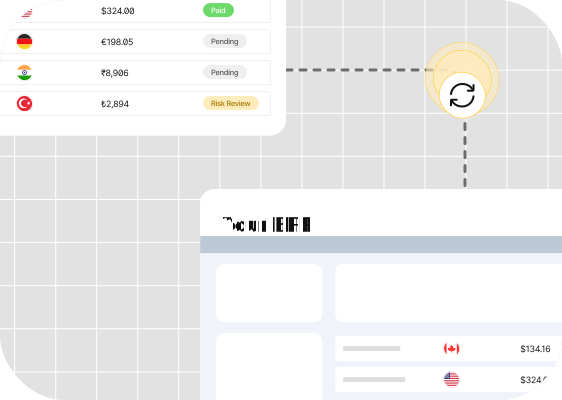
Additionally, spend analytics and insights provide real-time cash flow data and request status, allowing your AP department to track whether invoices are paid or outstanding.
Having this information at your fingertips enables better decision-making regarding budgeting and workflow efficiency improvements.
By streamlining matching, Tipalti significantly reduces AP workload and speeds up payment cycles.
Case Study: How Tipalti Accelerated Financial Close for Outset Global
After manual processes hindered scalability and efficiency, the buy-side trading solutions firm Outset Global decided to implement Tipalti.
By using Tipalti Accounts Payable to automate invoice processing (including matching) and integrate with QuickBooks, the company cut AP closing time by 50%.
The improved efficiency eased pressure on the AP team, allowing staff to focus on strategic initiatives that grow the business—all without extra headcount.
Just do it. Don’t wait to implement this solution until you have to and then you’re firefighting. If you do a simple cost analysis, it’s a no-brainer.
Cristina Escalante, Global COO, Outset Global
4 Best Practices to Streamline 3-Way Matching
To keep your 3-way matching process fast, accurate, and efficient, it’s helpful to follow best practices.
Here are some strategies to keep workflows smooth and financial controls tight as you scale.
1) Set Approval Thresholds to Reduce Payment Delays
Establishing limits to determine when you need extra approvals helps AP teams avoid bottlenecks and pay certain invoices faster.
For example, you might create a rule to auto-approve low-value or recurring purchases when the PO, goods receipt, and invoice match, while routing high-value transactions to the finance manager for sign-off.
Freeing teams from small, low-risk approvals prevents tasks from accumulating as invoice volume grows, speeding up the payment process.
In doing so, you’ll help AP teams:
- Capitalise on early payment discounts such as 2/10, net 30 (a 2% discount if you pay within 10 days).
- Avoid Commercial Debts Regulations late payment interest of 8% plus the Bank of England base rate, which applies to business-to-business (B2B) transactions that are 60 days late (30 days for public authorities).
Over time, these savings can free up significant working capital to invest in growing your business.
2) Create Exception Handling Rules
Clear exception handling rules help you resolve discrepancies such as partial deliveries, price differences, or damaged goods quickly and consistently.
Define:
- Who handles reviews for specific issues.
- What information they require.
- How decisions are documented.
For example, if you have a price variance outside of a threshold, AP might send it to procurement to confirm the agreed-upon rate.
If there’s a quantity discrepancy, it goes to the receiving department, which will then verify what the supplier delivered.
Reviewers log their findings in your system (e.g., confirming a discount or incorrect delivery). Doing so gives AP teams easy access to the documentation they need to prevent process delays.
With a structured approach to invoice management, you’ll avoid confusion, strengthen audit trails, and help AP teams focus more on supplier relationships than on navigating ad-hoc processes.
3) Use a Supplier Rating System to Improve Accuracy
A supplier rating system helps you track which suppliers regularly submit accurate invoices (and which don’t) to manage resources better.
Check factors such as:
- Error rate
- Discrepancy frequency
- Adherence to PO terms
The results will allow you to identify high-performing suppliers and assign them a high rating.
AP teams can use these to decide whether a supplier needs periodic spot checks or closer monitoring and help correct recurring issues.
You can also use insights to give suppliers feedback that drives improvement, increases efficiency, and strengthens partnerships
4) Centralise Documentation to Cut Processing Time
Keeping key documents in a central system speeds up the three-way matching process, so payment approvals and reconciliation run smoothly.
When you rely on scattered files, email threads, and siloed systems, it’s more difficult to locate information, verify details, and resolve discrepancies.
Connecting AP automation software, such as Tipalti, to your ERP and communication tools unites 3-way match stakeholders on a single platform.
It ensures everyone has access to the same up-to-date records, reducing back-and-forth communication and eliminating the risk of missing paperwork.
You’ll also have easy access to documentation such as supplier VAT details, making it easier to manage bookkeeping and meet HMRC tax compliance requirements.
Simplify 3-Way Invoice Matching with Tipalti
A robust three-way matching process protects your business from errors, overpayments, and fraud, while strengthening reporting data and supplier confidence.
Efficiency lies in your approach. Automating matching can save time, money, and resources, solving the problems that manual workflows create.
Combining automation software with 3-way match best practices will help you scale without the overwhelm of making corrections and chasing approvals as invoice volume grows.
See how Tipalti AP Automation streamlines 3-way matching to support prompt payments and maintain a comprehensive “paper trail” for auditing and HMRC compliance.