


 Back
Back 

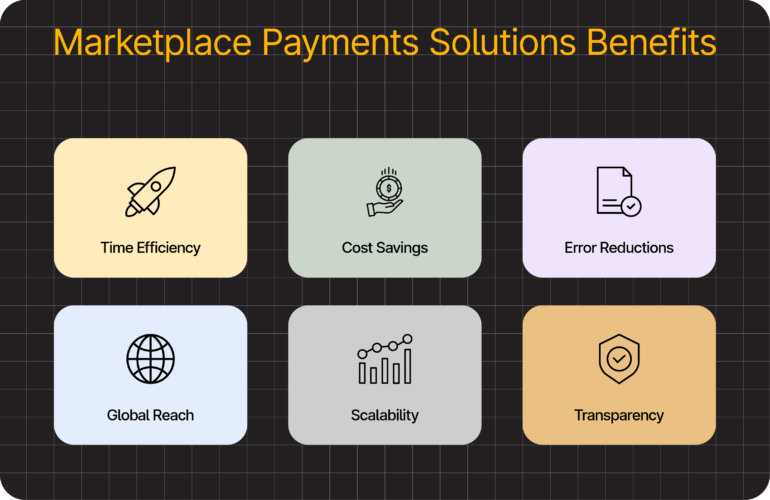
Marketplace payments impact everything: seller trust, platform growth, compliance exposure, and the cost of running your business. When payments work well, you can scale into new EU markets faster, keep operating costs low, and maintain strong supplier relationships.
Marketplace payments solutions automate the work that slows you down, from onboarding and verification to global payments and EU reporting. They give your team the time and visibility to grow sustainably.
In this guide, we’ll explore the top options for EU marketplaces and share tips to help create a clear path for choosing the one that fits your model and markets.
Key Takeaways
- A marketplace payments solution enables seamless transactions between buyers and sellers, handling payments, compliance, and end-to-end financial processes.
- Top payments software automates onboarding, tax compliance, fraud prevention, and real-time reconciliation—cutting processing time and supporting growth.
- EU marketplaces should prioritise solutions with diverse payment methods and robust regulatory coverage for EU DAC7, PSD2, DSA, and VAT compliance.
- Evaluate EU marketplace payments solutions holistically by comparing reliability, scalability, payout flexibility, support, and industry fit.
What is a Marketplace Payments Solution?
A marketplace payments solution is technology that facilitates transactions among marketplace operators, buyers, and sellers, ensuring ongoing EU VAT and regulatory compliance.
Software helps solve some (or all) of the complex, high-risk aspects of running a marketplace, such as:
- Collecting Know Your Customer (KYC) and VAT information for seller verification.
- Handling split payments, VAT treatment, and payout timing.
- Staying compliant with EU tax and Directive on Administrative Cooperation (DAC7) regulations.
- Making mass payments to vendors or creators in local currencies.
- Tracking and reconciling payments.
- Maintaining an auditable transaction history.
- Managing vendor communication.
Instead of juggling payment gateways, spreadsheets, separate tax tools, and manual workflows, a marketplace payments solution centralises your entire payout process.
It eliminates manual approvals, automates onboarding, reduces reconciliation work, and ensures accurate and up-to-date seller information across regions.
With the right software, you’ll remove the operational and regulatory friction of multi-payee transactions and scale without compromising control or vendor management.
Let’s take a look at the top solutions for your marketplace business.
Marketplaces Are Evolving—Your Payments Need to Keep Up
Learn how to overcome challenges and meet demand with a marketplace payment system that creates trust, loyalty, and long-term value.
9 Top Solutions for Managing Marketplace Payments
The top marketplace payment solutions for EU marketplaces are:
- Tipalti. AI-driven global payment automation solution that streamlines onboarding, tax/VAT compliance, and mass payouts for growing marketplaces.
- Online Payment Platform (OPP). European-based payments provider for multi-vendor marketplaces.
- Mangopay. European marketplace payment infrastructure offering wallet-based payouts and flexible payment flows.
- Lemonway. French payment institution powering marketplace payments with built-in KYC, escrow, and multi-party settlement.
- Unzer. European payments platform providing local payment methods and marketplace-ready payments across the EU.
- Fondy. Unified payment gateway supporting multi-currency acceptance and cross-border payouts.
- Adyen. Global payments platform with onboarding functionality and local EU payment methods.
- Trolley. Mass payout solution designed for creator, affiliate, and gig platforms, with global payment coverage.
- Nium. Payout platform that supports cross-border payments with EU and international coverage.
1) Tipalti
Tipalti’s global mass payments solution simplifies complex, high-volume marketplace payments for gig economy platforms, creator marketplaces, affiliate networks, and multi-vendor ecosystems.
Its biggest value lies in automating the time-consuming and error-prone manual administrative and compliance overheads associated with managing multiple sellers.
Tipalti data shows companies relying on error-prone manual processes can lose over €26K a month.
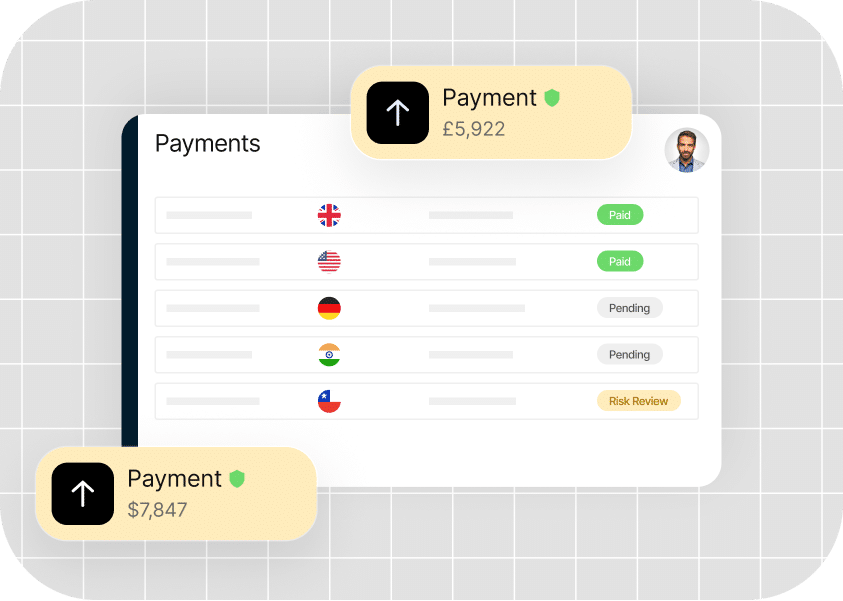
Tipalti’s API integrates seamlessly with your tech stack to help you create smooth workflows. It achieves this by acting as complete payment software.
With Tipalti, you can:
- Automate self-service supplier onboarding to securely collect business details, payment information, and VAT IDs from vendors across 49 countries, without mountains of paperwork.
- Vet and validate sellers with an automated rules engine to comply with DAC7 reporting, Anti-money Laundering Authority (AMLA) rules, the Payment Services Directive 2 (PSD2), and the Digital Services Act (DSA), minimising EU regulatory and compliance risk.
- Generate self-billing itemised invoices on behalf of payees and route them through customisable approval workflows to ensure timely and accurate payments.
- Expand your marketplace globally with cross-border payments to 200+ countries and territories in 120 currencies via 50+ payment methods, including SEPA, Global ACH, wire transfer, PayPal, and more.
- Improve cross-border vendor payment experience and reduce payee friction with built-in multi-entity and multi-language capabilities.
- Optimise cross-border transactions with transparent foreign exchange (FX) fees and lock-in rates, helping you avoid hidden costs and protect your margins.
- Create payment thresholds to hold payments and make bulk payouts when payees meet conditions for controlled disbursements and better finance efficiency.
- Reduce payment risk and minimise errors with built-in OFAC screening, real-time fraud detection, and automated approval notifications.
- Sync detailed transaction reports with your ERP system (e.g., Xero, Oracle NetSuite, or Microsoft Dynamics) to increase visibility and improve audit trails for easier tax reporting.
- Track payments and spending for better cash flow management and clearer reconciliation.
Marketplaces that use Tipalti’s AI-powered software gain stronger fraud protection, fewer payment errors, and a faster monthly close.
For example, by implementing Tipalti’s Mass Payments solution, gaming platform Crazy Games automated its developer payout process to improve visibility and accuracy.
With end-to-end automation, Crazy Games reduced payment processing time from several days to 4-8 hours, boosting developer satisfaction and eliminating the need for external assistance.
We now offer a clear developer onboarding on payments, with Tipalti troubleshooting potential issues. We are able to offer a lot more clarity and visibility on the fees, on the duration of payments, and on possible reasons for rejection, which gives us a lot more time to focus on the important stuff.
Christophe Rabet, Head of Finance and Operations, Crazy Games
| Key features | Global mass payments, automated EU tax/VAT compliance, built-in fraud protection, white-label supplier onboarding, and multi-currency support. |
| Pricing | Tipalti’s Accelerate and Plus pricing plans are customised to your needs. Pricing scales with your payout volume and compliance requirements, so you can upgrade to more advanced capabilities as you grow. |
| Best for | Midmarket or scaling marketplaces with complex payout and compliance needs. |





2) Online Payment Platform
Online Payment Platform (OPP) is an embedded payments solution for online platforms and marketplaces.
Being based within the EU regulatory environment gives OPP strong support for PSD2-compliant payment flows and vendor onboarding out of the box.
OPP says over 200 marketplaces use its technology to pay suppliers. Users get the tools to:
- Onboard sellers and verify identity to ensure KYC compliance.
- Hold funds securely via escrow.
- Set earnings thresholds to automatically release payments via virtual International Bank Account Numbers (IBANs).
- Track finance and merchant data in customisable dashboards.
- Integrate their data warehouse to manage payments and communication.
OPP supports EU online payment methods such as iDeal (to be replaced by Wero in 2026), Klarna, Bancontact, and Sofort, helping marketplace owners win trust with buyers.
Users can also make cross-border payments, with flexible conversions to pay sellers in their preferred currency.
OPP currently supports the Euro, Swiss Franc, U.S. Dollar, and British Pound. However, it lacks the global-scale payout support of other platforms in this list.
| Key features | PSD2-compliant flows, local EU payment methods, split payments, and seller verification. |
| Pricing | Custom, based on transaction volume. |
| Best for | EU-focused consumer and peer-to-peer marketplaces. |
3) Mangopay
Mangopay’s established wallet-based payment system powers marketplaces with escrow, seller ID verification features, and payout automation.
Marketplaces and digital platforms use Mangopay to accept payments and make payouts in 24 EU and global currencies, with methods including SEPA, ACH, SWIFT, and PayPal.
The tool’s standout feature is its wallet-based system. During onboarding, each user gets an eWallet to hold funds before payouts. Businesses and their customers can use a wallet to:
- Make payments in.
- Transfer funds between wallets.
- Convert funds between wallets of different currencies.
- Withdraw funds from a wallet to a bank account.
- Handle refunds and chargebacks raised by users.
For business, the secure wallet environment helps manage transactions at scale while complying with KYC and anti-money laundering (AML) obligations.
For payees, it ensures funds are protected in separate, segregated accounts. Payment into wallets is also faster than traditional methods (e.g., a cheque).
Mangopay offers mandatory compliance checks, giving users the regulatory guardrails needed to adhere to PSD2. No transaction happens without a payee having first completed the KYC process.
While wallet-based architecture is powerful and secure, it can be complex to implement and maintain. Expect to need more developer involvement during onboarding, configuration, and ongoing maintenance.
| Key features | eWallet infrastructure, escrow, full PSD2 compliance, multi-currency support, and KYC/KYB compliant onboarding. |
| Pricing | Custom. Usage-based, with tiered pricing. |
| Best for | Marketplaces needing custom wallet logic or complex split-payment flows. |
4) Lemonway
Lemonway is a pan-European payment institution built for marketplaces, crowdfunding platforms, and platform-based business models.
Lemonway’s features help marketplaces streamline payment processing, wallet management, and third-party payments in a KYC/AML-regulated framework.
Like Mangopay, it uses eWallets to help users:
- Record transactions between sellers and buyers.
- Hold merchant funds until payout.
- Ringfence funds to comply with PSD2 and avoid misuse.
- Match and reconcile payment flows.
- Automatically manage commission.
Lemoway supports classic and alternative payment methods, including credit/debit cards, SEPA, bank cheques (France only), PayPal, and Multibanco, as well as a range of global currencies.
The platform also offers detailed dashboards and reporting tools to track marketplace activity, payment data, and KYC status.
Lemonway has a broad ecosystem of plugins to help promote smooth integration for end-to-end marketplace payment efficiency. However, its size and complexity can make management technically demanding.
Note: The Bank of Italy has restricted Lemonway’s operations in Italy, prohibiting it from engaging new Italian partners or offering new products and services in the country. If you’re based in Italy or have payees in the country, you may want to consider one of the other solutions in this list.
| Key features | End-to-end payment management, escrow accounts, multi-payment and currency support, seller verification, and PSD2 compliance. |
| Pricing | Custom, based on services and transaction volume. Payout starts from €0.50, with extra fees for set-up and service, pay-in, and identification features. |
| Best for | EU marketplaces that need strong escrow and regulatory coverage. |
5) Unzer
Unzer (formerly Heidelpay) is a German-based modular payments provider offering flexible solutions for marketplaces.
While it’s best known for its online and point of sale (POS) solutions, it offers a range of newer marketplace features.
Unzer’s PCI-DSS compliant marketplace payment platform offers:
- Merchant onboarding and certification in line with the Payment Services Supervision Act (ZAG) and German Anti-Money Laundering Act (GWG).
- Automated provisioning and payout with escrow accounts to protect merchants from insolvency.
- Transparent transaction management with customisable reporting to track financial data and developments.
Unzer’s standout marketplace feature is its ability to handle payouts automatically.
The platform lets users create commission models and payout schedules for individual merchants, removing the manual effort of invoicing and calculating commissions.
However, Unzer is heavily focused on the DACH market (Germany, Austria, and Switzerland), primarily supporting payouts in EUR and CHF.
If this is your target market, you’ll benefit from strong local payment infrastructure and trust signals. If you partner with suppliers across the EU or internationally (or plan to), you may want to explore an option that supports global payouts.
| Key features | Local EU payment methods, split payments, onboarding tools, and strong ZAG/GWG compliance. |
| Pricing | Custom, depending on payment mix and volumes. |
| Best for | Marketplaces focused on DACH and wider EU local payment acceptance. |
6) Fondy
Fondy is a European marketplace payment gateway that enables EU businesses to accept 150+ currencies across 300+ payment methods and pay out sellers globally.
One of Fondy’s standout features is payout flexibility.
Its multi-vendor payment gateway allows marketplaces to set up and handle complex payment structures, including split, mass, and recurring payments with automated currency conversion.
The tool also offers payment wallets (similar to Mangopay and Lemonway) that enable master account holders to:
- Hold and transfer funds.
- Update account settings.
- Track transactions in one place.
Like other tools in this list, Fondy’s quick partner onboarding aims to protect marketplaces against fraud from the start, with automated AML and KYC checks.
Users also get a dedicated Fondy manager for support and troubleshooting.
It’s worth noting, though, that Fondy is more payment gateway than payout-oriented and best suited to ecommerce marketplaces. Complex payouts to creators, artists, or developers may require additional tools.
| Key features | Multi-currency processing, split payments, eWallets, and diverse international payouts. |
| Pricing | Transaction-based. Europe pricing for debit/credit cards and eWallets is currently 1.9%, plus €0.25 per transaction. |
| Best for | Cross-border ecommerce marketplaces that need flexible currency handling. |
7) Adyen
Adyen’s embedded payment platform helps marketplaces handle seller onboarding, KYC compliance, payment settlement, refunds, and split payments in one place.
With Ayden, users can:
- Let customers choose preferred payment methods.
- Allocate and transfer funds across accounts.
- Send on-demand and scheduled payments.
- Integrate tools with their existing tech stack to connect data.
- Track and reconcile transactions in real-time for accurate record-keeping and VAT returns.
Ayden supports popular global payment methods, including major European credit/debit cards, digital wallets, and local bank transfers (e.g., iDEAL, Sofort, and SEPA Direct Debit), online and in-person.
The platform also helps users comply with local EU regulations by offering AML checks, MATCH list checks, PSD2, PCI compliance, and European banking licences.
Additionally, users get features to manage risk with machine learning models for detecting onboarding issues, transaction scams, and high-risk users.
While Ayden simplifies complex payment processes, it’s not a plug-and-play tool. Its features are aimed at enterprise-level marketplaces with dedicated technical and developer resources for integration.
Some small and midmarket platforms may find that the platform and pricing aren’t the best fit for their needs.
| Key features | Full marketplace stack, KYC/KYB compliance, fraud prevention, local EU and global payment methods, and data insight tools. |
| Pricing | Fixed processing fee (€0.11), plus a fee determined by payment method. |
| Best for | Large, high-volume marketplaces that need global reach and unified payments. |
8) Trolley
Trolley’s mass payout platform is built for creator platforms, affiliate programs, gig marketplaces, and SaaS companies that need to pay external partners globally.
Unlike traditional gateways that focus on collecting payments, Trolley’s features help marketplaces manage cross-border payouts and tax compliance.
Trolley supports a wide range of payment methods, including SEPA, international ACH, PayPal, and card-based payouts. Users can make payments to over 200 countries and regions, in over 135 currencies.
It also offers supplier onboarding features with automated payment info and tax-form collection, identity verification, and ERP integration to ease manual effort and DAC7 compliance risk.
Additionally, users can:
- Create custom approvals to speed up payments.
- Split transaction costs to suit their business model.
- Generate end-of-year tax forms to file with the relevant authorities.
When marketplace payments are the main requirement, Trolley’s automation can streamline workflows to improve efficiency and accuracy.
However, if PayPal is a critical payment method, you may want to consider a mass payment tool like Tipalti that uses PayPal’s Mass Transaction (MD) model. Trolley uses the Account Direction model, which connects to your existing PayPal account.
This approach may have different transaction limits, processing timeframes (typically 1-6 days), and exchange rates that impact cost, reliability, and time for high-volume PayPal payouts.
The MT model, on the other hand, has no funding or payment limits and faster processing (typically 1-3 business days), ensuring suppliers are paid faster.
| Key features | Mass payouts, DAC7 compliance, automation workflows, multi-method payments, and multi-currency support. |
| Pricing | Usage-based pricing. Trolley’s Standard plan has individual components: Pay = €49.00/ month, Tax = € 149.00 / month, Sync = €35.00/ month, and Trust = €49.00/ month. Trolley Plus pricing is available on request. |
| Best for | Creator, gig, and partner marketplaces with large payout volumes. |
9) Nium
Nium’s global payout platform offers real-time cross-border payments to over 190 countries and payment methods, including:
- SEPA
- SWIFT
- Digital wallets
- International ACH and local bank transfers
- Virtual account numbers (VANs)
Nium’s biggest strength is its combination of speed, coverage, and compliance, making international marketplace payments efficient and reliable.
The platform’s payment API handles payment rails, currency conversion, account verification, and EU regulatory controls in one place.
These features allow marketplaces to pay sellers, gig workers, or creators without maintaining their own banking infrastructure.
Nuim users can:
- Onboard sellers and manage communication via a supplier portal.
- Send instant payouts in over 100 currencies.
- Set up payment schedules and currencies per seller.
- Automatically split commissions and payouts.
- Issue virtual accounts to simplify reconciliation and payment tracking.
For marketplaces with payees in emerging markets where traditional bank payments are slow or expensive, Nium can help you pay suppliers fast to improve their liquidity and maintain strong relationships.
However, the platform is built with developers in mind. It’s best suited to enterprise companies with robust technical infrastructure, rather than smaller businesses looking to scale.
| Key features | Global payouts, real-time transfers, multi-currency support, FX tools, supplier onboarding, and compliance controls. |
| Pricing | Custom, based on transfer volume and corridors. |
| Best for | Enterprise-level marketplaces with global sellers and high cross-border payout needs. |
How to Choose a Marketplace Payments Solution
Choosing a marketplace payments solution takes careful consideration. Your decision will have a significant impact on customer experience, operational efficiency, EU regulatory compliance, and the overall success of your business.
Here are some factors to look for and questions to ask when weighing up your options.
| Factor | Why It’s Important | Questions to Ask |
|---|---|---|
| Regulatory fit | Ensures compliance with EU/EEA rules, GDPR, PSD2, AML, and proper safeguarding of funds. | Is the solution licensed in the EU?Is it PCI compliant for secure payment processing (if applicable)? Is it PSD2-compliant? Does it have an EMI licence? |
| DAC7 compliance | Automates seller data collection, verification, and transaction data to reduce manual admin and legal risk. | Does the solution collect business, bank, and VAT details? Can it generate DAC7-compliant reports (XML/CSV files)? Does it connect and sync information to your ERP for clear audit trails? |
| Payment methods | Supports local preferences across Europe, increasing payee convenience and reducing payment drop-off. | Which local EU and global payment methods are available? Does the solution offer SEPA (including Instant) for fast, cost-effective transfers? |
| Payout options and currencies | Enables smooth payments across borders, supporting marketplace expansion. | Do available currencies meet payee needs? How competitive are FX fees? Are payouts automated? Can you create payment thresholds to hold and make mass payments? |
| Fraud and risk control | Protects your business against bad actors and financial crime risk. | What fraud detection and prevention tools does the software have? Are AML, KYC, and sanctions checks automated? Can you customise rules? |
| Onboarding friction | An efficient seller onboarding experience creates higher activation rates and faster platform growth. | Does the platform offer self-service onboarding? Is KYC/KYB automated? Can you embed onboarding features on your website? How fast are approvals? |
| Scalability | Prevents process bottlenecks as your online marketplace grows. | Can the solution handle high payment volume? What’s the uptime guarantee? Does it support global cross-border payments? |
| Pricing structure | Price and fees impact your marketplace margins, especially at scale. | Are fees per transaction, per payout, or fixed? Are compliance features extra? How transparent are FX costs? |
| Customer support and infrastructure | Ensures stability, effective troubleshooting, and strong user experience. | What support channels does the software include (e.g., phone, email, and live chat)? Does it have guides and documentation for self-troubleshooting? Does it include analytics tools for tracking payment performance? |
When comparing solutions, take time to learn as much as possible about what each one offers and how it helps EU marketplaces like yours.
For each tool on your shortlist:
- Read case studies, success stories, and use case pages related to your industry.
- Research independent customer reviews (especially from marketplaces in your industry or region)
- Compare software documentation and features.
- Watch or take product demos.
- Book a call with the sales or technical team to understand how the product fits with your existing workflows and tech stack.
- Ask users in your network for their thoughts on performance and usability.
Think about long-term fit. The right solution isn’t just the one that works for your marketplace now; it’s the one that scales with your business as you expand into new markets and onboard more sellers.
Marketplace Payments Solutions Future-Proof Your Business
Before selecting a tool, conduct thorough research to ensure it aligns with your needs, goals, and budget. The tool that matches your requirements doesn’t just benefit your business; it improves supplier experience and gives your marketplace a competitive advantage.
Tipalti’s Mass Payments solution can help you automate and centralise how you process payments to support ongoing efficiency and growth. Its comprehensive global payment software is designed for EU mass payouts and compliance efficiency, making it easier to maintain than wallet systems and more international than EU-only tools.
To learn how it can improve your workflows and help you manage your markets in one place, book a free personalised demo.
Marketplace Payments Solutions FAQs
What is a marketplace payment service provider?
A marketplace payment provider (or marketplace PSP) handles the financial transactions between buyers and sellers—or businesses and payees (e.g., freelancers or creators). It manages secure payment processing, VAT and EU regulatory compliance, fraud prevention, and settlement, removing manual work for marketplace operators. Many also offer features such as split payments, automated reconciliation, and seller onboarding to further streamline mass payouts.
What are marketplace transactions?
Marketplace transactions are payment flows between many people on a platform intermediary. A classic example is a freelance marketplace platform where the customer pays the site, and the site later pays the creator after taking its commission and applying the proper VAT treatment.
Marketplace payment solutions help business owners manage these transactions, allowing you to pay global payees efficiently while automating transaction fees for different payment methods.
How do payment gateways and payment processors differ?
A payment gateway is a tool that collects payments at the front end of a transaction (checkout), particularly in ecommerce. A payment processor communicates with banks and card networks to authorise, settle, and move the money.
Payment gateways focus on the secure transmission of payment data. In addition to processing transactions, payment processors provide a range of services, including fraud detection and compliance with EU and global payment regulations.
Which payment options should a marketplace payments solution support?
A marketplace payments solution should support a mix of cards, bank-based payments, and local payment methods for buyers and sellers.
This includes major cards like Visa and Mastercard, digital wallets like Apple Pay and Google Pay, and bank transfer options including SEPA, SWIFT, international ACH, and international wire.
A wide range of options ensures your marketplace payments cover global markets and are processed without friction.
What are the fees associated with marketplace payment solutions?
Marketplace payment providers typically charge transaction and FX fees, which vary by provider, payment method, and exchange rates. Some also add monthly or annual subscription fees, usually flat-rate or tiered based on features and usage.
Marketplaces often offset these costs by charging sellers a commission for accessing the platform. To keep expenses down, choose a provider with local payment methods, competitive FX, and pricing that scales with your growth.
What is the safest way to make mass payments?
The safest way to pay marketplace sellers is through an EU-regulated marketplace payment solution. Leading platforms, such as Tipalti, Mangopay, and Unzer, hold EMI licenses. Tipalti is also authorised by De Nederlandsche Bank (DNB).
EMI regulation ensures strict AML, KYC, and sanctions controls, backed by strong security standards and competent authority supervision. This level of compliance supports accurate data collection, seller verification, and reporting—helping you meet DAC7, DSA, and VAT requirements with less effort.
