


 Back
Back 
Supplier onboarding is a crucial part of accounts payable (AP) operations, but it’s not always smooth sailing.
Manual data collection, document verification, and EU compliance checks can delay invoice approvals and payments, potentially straining both your AP team and supplier relationships from the start.
This guide explains what supplier onboarding entails and how to create an efficient process that reduces AP workload while ensuring EU compliance.
Key Takeaways
- Supplier onboarding is the process of verifying, approving, and integrating new vendors to ensure payment readiness, compliance, and transparency.
- Effective onboarding helps EU businesses meet tax, VAT, and data protection regulations while building trust and strong supplier relationships.
- Automation and self-service portals eliminate manual inefficiencies, reducing AP intervention and speeding up approvals while cutting errors and procurement costs.
- Tipalti centralises supplier data to improve visibility, compliance, and payment accuracy, allowing AP teams to scale and manage suppliers easily.
What Is Supplier Onboarding?
Supplier onboarding, also known as vendor onboarding, is the process of verifying, approving, and integrating a new supplier into your accounts payable and payment systems. This enables your business to process and pay invoices securely and efficiently.
During onboarding, you collect and analyse supplier information to ensure a vendor meets your company’s standards and European Union (EU) regulatory requirements. This involves:
- Conducting due diligence and AP-relevant risk assessments, such as bank account validation, duplicate supplier detection, and fraud checks.
- Collecting business, banking, tax, and payment details needed for invoice processing.
- Validating supplier data to ensure correct VAT reporting and prevent payment mishaps.
- Integrating a supplier into your AP, ERP, and supplier management solution.
While procurement may handle sourcing and contracting, AP owns the financial, tax, and system-readiness tasks required to pay suppliers accurately and compliantly.
Getting supplier onboarding right keeps invoice payments running smoothly—reducing disruptions, EU compliance risks, and miscommunication that can impact cash flow.
A well-structured process provides the foundation for strong vendor relationships, faster invoice approvals and payments, as well as improved operational efficiency.
Why Effective Supplier Onboarding Is Important for EU Businesses
Effective supplier onboarding sets the tone for your business relationships.
A smooth process streamlines validation, approval, and integration, fostering trust in your business. It improves the supplier’s experience while boosting your team’s compliance and productivity.
Here’s why the right onboarding approach matters.
Meet Your EU Compliance Requirements
Under EU law, your business has to collect and report detailed information about suppliers for tax and regulatory purposes.
A robust early-stage due diligence and document approval process helps you gather accurate details to meet compliance obligations from the start.
AP’s role includes verifying VAT numbers, validating bank details using compliant checks (e.g., IBAN/SWIFT formats), ensuring correct tax forms, and maintaining audit-ready records. AP is typically the final control point before invoice processing and tax reporting begin.
Here are the European Commission rules you need to comply with during onboarding:
| EU Directive | Compliance Requirements |
|---|---|
| Value Added Tax (VAT) Directive (2006/112/EC) | For transactions with other EU VAT-registered businesses, you must collect and store VAT information for tax returns and audits, including: • Supplier name and business address. • VAT ID number. • Invoices copies (with information on goods or services, purchase orders, VAT, and price totals). |
| Directive on Administrative Cooperation 7 (DAC7) | If you run an online platform or marketplace, DAC7 tax transparency rules require you to collect, store, and report: • Names and addresses. • Tax Identification Numbers (TINs). • VAT numbers. • Bank details. |
| Digital Services Act (DSA) | The DSA promotes safe online spaces, transparency, and fair competition. To meet trader traceability requirements, online platforms must obtain (where applicable): • Supplier (trader) names, addresses, phone numbers, and emails. • ID documentation. • Payment account details. • Registration details. |
| EU E-invoicing Directive (Directive 2014/55/EU) | Public authorities and entities in the EU must receive and process electronic invoices (e-invoices) compliant with the European Norm. Some EU member states also mandate e-invoicing for business-to-business (B2B) and business-to-consumer (B2C) transactions. |
Collecting the correct supplier business and VAT information is crucial for accurate invoice management and tax reporting. To ensure compliance with EU rules:
- Keep records for 5 to 10 years, depending on the EU member state.
- Securely store and make records readily available for tax inspections upon request.
- Follow EU General Data Protection Regulation (GDPR) rules to protect and lawfully process data.
Failing to meet your obligations can result in a non-compliance penalty. It can also lead to reputational risks that damage trust and long-term supplier relationships.
An effective process prevents these missteps as accurate data flows through your system.
Build Supplier Trust and Strengthen Relationships
Onboarding is often a supplier’s first in-depth interaction with your business. A smooth experience lays the groundwork for a strong relationship and sets your reputation as a trustworthy buyer.
A disorganised or prolonged process can leave providers feeling uncertain about whether working with you is the right decision. Efficient onboarding, on the other hand, makes a supplier’s life easy.
By implementing a process that clarifies expectations and responsibilities from the start, you promote trust and transparency—key ingredients in a lasting partnership.
Additionally, reliable communication channels facilitate easier collaboration and nurturing of relationships. When suppliers know how to submit invoices and how payments work within your AP system from day one, it reduces confusion and accelerates time-to-payment.
The result? Less friction, 66% reduction in payment errors, faster approvals, and fewer support tickets for “Where is my payment?”. That’s more time for your AP team to focus on higher-value tasks like cash flow analysis, performance management, and process optimisation.
Streamline AP Workload and Lower Costs
Effective supplier onboarding also removes bottlenecks for faster approval and payments to vendors. In other words, it’s a cost-saving exercise.
Each time you onboard a new supplier, you have direct expenses such as:
- AP labour and procurement labour (where applicable)
- Onboarding tools
- Risk management (e.g., financial background and compliance checks)
- Training materials
Manual workflows such as data entry, collecting documents via paper or spreadsheets, and email approval chains prolong processes, significantly inflating these expenses.
Streamlining supplier onboarding with automation solves this problem. By automating document collection, validation, and invoice processing, you can reduce AP workload by up to 80%.
When your team does more with less, your business will find it easier to onboard suppliers at scale, keep costs low, and deliver value quickly.
Improve Payment Data Accuracy and Minimise Errors
Capturing accurate supplier information during onboarding gives you reliable data throughout their lifecycle.
This accuracy is crucial for EU compliance as well as for improving supplier experience and financial health.
If your invoice payment process relies on endless email chains and siloed data, you lack the visibility and accountability required for effective vendor management. And it only compounds as your business grows and manual processes become unsustainable.
Improving AP efficiency through automation and data centralisation enhances information management. By eliminating data gaps, you can reduce:
- Invoice errors.
- Payment disputes.
- Duplicate supplier entries in your enterprise resource planning (ERP) system.
Additionally, teams can better manage cash flow and financial reporting while spotting sourcing opportunities to meet business goals.
Simplify Supplier Onboarding With AP Automation Accuracy
Tipalti streamlines supplier onboarding—automating vendor data collection and validation for secure transactions and EU tax compliance. Spend less time managing AP processes without extra headcount to accelerate time to first payment.
6 Steps to Create an Efficient Supplier Onboarding Process
The goal for efficient supplier onboarding in accounts payable is to create a fast, compliant, and consistent process.
You need to reduce manual effort while improving accuracy and supplier experience. It starts with clarity and structure—understanding what suppliers need and implementing a system that meets their requirements.
Here’s how to ensure an easily manageable supplier onboarding process that’s both reliable and scalable.
1) Map and Refine the Supplier Journey
Documenting every step a supplier takes—from the first point of contact to full integration—helps you identify inefficiencies, redundant steps, and areas to automate.
While your specific process depends on your systems and procedures, here’s how you might plot out the steps in a typical supplier’s journey:
| Onboarding Stage | Onboarding Task |
|---|---|
| Registration | The supplier expresses an interest or receives an invitation to join your platform. |
| Verification | AP collects and validates business information, VAT/tax details, and banking information, applying relevant risk checks. |
| System setup | Your AP team adds the supplier to your ERP system and configures banking and product/service data. |
| Training and enablement | You provide onboarding materials and guidance on how suppliers should use your systems and meet company standards. |
| First payment | The supplier submits their first invoice for processing and payment. |
Visualising your current process makes it easier to see where you’re falling short and what to improve.
For example, if verification is taking too long, it might highlight a need to automate ID or VAT checks.
Work through each buyer journey stage with stakeholders from finance, compliance, and procurement to ensure a shared understanding of shortcomings and improvements.
Use your findings as a roadmap to build a smooth and scalable supplier onboarding experience.
2) Establish Clear AP and Payment Guidelines
AP guidelines act as your supplier onboarding playbook. They set objectives and standards that stakeholders can use to maintain strong supplier management.
Here’s what to include in your guidelines to ensure suppliers are fully payment-ready:
| Guideline Area | Key Elements |
|---|---|
| Supplier selection criteria | • Legal and financial compliance needed for AP onboarding (e.g., valid VAT ID, compliant banking details, legal entity verification). • Fraud checks and duplicate vendor controls. • Operational or compliance benchmarks relevant to invoicing and payment workflows. |
| Payment-specific document requirements | • Company registration. • VAT details. • Tax forms. • Bank details and data formats. • Payment method eligibility. • Insurance certificates. • Other regulatory documents. |
| Approval and risk assessment procedures | • Supplier evaluation process. • Supplier risk scoring (financial, operational, and compliance). • Extra due diligence steps for high-risk suppliers. • Ongoing supplier performance KPIs (e.g., quality, cost, and delivery timelines). |
| Communication and performance expectations | • Expected response times. • Communication channels. • Reporting requirements. • Escalation procedures. |
| System and process integration | • How AP ties into ERP, finance, and other integrated platforms. • Invoice and document submission standards (e.g., data quality and format requirements). |
| Invoice payment criteria | • Outline key payment terms and preferred payment methods for smooth, transparent transactions. • Invoice submission standards. |
| Monitoring standards | • How often suppliers must update documents and certifications. • Performance and compliance review schedule. • Feedback loops for ongoing process optimisation. |
Guidelines align teams on key requirements to make supplier onboarding more reliable and predictable. However, it’s important not to treat them as a one-and-done document.
Regularly review and update them in line with company growth, onboarding improvements, and EU regulations to stick to best practices.
3) Maintain an Up-to-Date Supplier Database
A supplier database serves as a single source of truth for key information about suppliers and is an essential resource for streamlining the onboarding process.
A database is usually managed in your ERP and contains detailed records for the suppliers you work with or have worked with in the past.
Employees can use the resource to quickly find supplier information without having to chase paperwork. They can also consult it to find out whether there’s a need to onboard a new vendor.
Seeing if an existing supplier already provides what you need helps avoid unnecessary onboarding and wasted spend.
Additionally, choosing to work with existing suppliers increases engagement and loyalty. It shows you value their goods or services and expertise.
To maintain up-to-date vendor master data, sync the supplier onboarding software with your ERP system.
For example, an onboarding solution like Tipalti uses pre-built integrations and APIs. This way, it creates an integrated workflow that lets you automate bank account validation, accurately confirm documents, process invoices according to global payment rules, and track payments within a single system.
Connecting Tipalti to your ERP (such as Microsoft Dynamics or Oracle NetSuite) gives teams access to real-time, synced supplier and payment data.
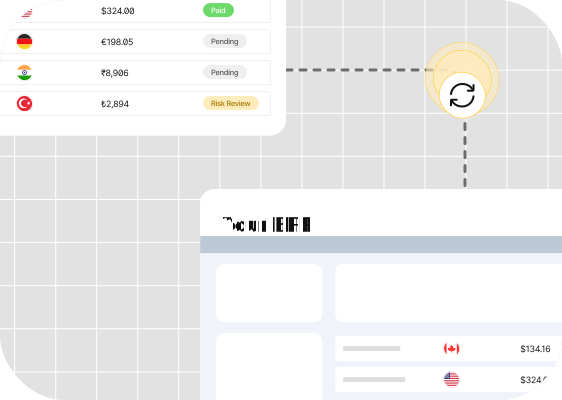
With everything on one platform, employees can manage onboarding requests more efficiently and free finance managers from redundant approvals.
4) Brief Suppliers on Their Onboarding Requirements
Efficient onboarding starts from the moment you identify a supplier. Including a clear brief with your onboarding invitation helps you avoid frustrations or questions that might arise about supplier requirements.
Your initial onboarding email should include information on:
- Documents suppliers need to complete onboarding.
- How to fill out contact information, payment details and expectations, and tax forms.
- How to submit an invoice to ensure timely payment.
- How to provide correct VAT details.
- How payment status notifications work.
- Expected timelines for approval and payment.
- Deadlines for completion.
- What happens when suppliers submit information (e.g., how you approve and confirm documentation).
- How to contact your team (including links to onboarding resources and training materials).
Create email templates to help standardise this process and ensure every supplier receives consistent information.
A set template that matches your brand style and voice will save time and allow you to scale communication as your business grows.
However, it’s important to be flexible. In the same way customers expect brands to deliver personalisation, tailoring engagement emails helps suppliers feel valued.
Small touches, such as personalising emails with a supplier’s name and including specific business details, make communication less generic, building trust and boosting engagement in your process.
With Tipalti, you can create and customise templates in your supplier management hub to streamline onboarding and ensure secure, efficient communication.
Additionally, with Tipalti’s email tools, you can automatically send bill approval alerts and payment status updates from the same email address.
Maintaining email consistency creates familiarity and connection for newly onboarded suppliers, strengthening your relationships.
5) Implement a Self-Service Supplier Portal
A self-service supplier portal lets vendors submit and manage their own information—freeing AP teams from time-consuming data entry and document chasing.
The result is fewer manual errors and a streamlined process that speeds up supplier integration and payments.
Select a self-service supplier portal that guides suppliers through the process and enables them to provide accurate information. This includes:
| Self-Service Onboarding Step | Requirements |
|---|---|
| Initial setup | Ensuring supplier information is correctly entered. |
| Payment setup | Helping suppliers choose their preferred payment methods and currencies. |
| Document submission | Helping suppliers submit the correct tax forms, IDs, etc. |
| Validation and approval | Ensuring vendor information matches EU records and VAT requirements. |
Tipalti’s self-service Supplier Hub makes the onboarding process faster and clearer, reducing back-and-forth communication and manual errors.
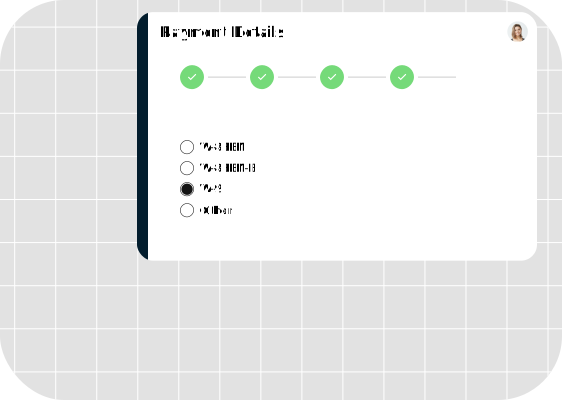
Here’s how:
- Step-by-step onboarding. Suppliers use the secure portal to enter business, tax, and payment details and method selection, ensuring all required fields are complete and validated.
- Built-in EU tax and compliance automation. Tipalti’s Tax Wizard guides suppliers to the correct tax forms, checks their information, and sends accurate data to your ERP.
- Ongoing supplier self-service. Once onboarded, suppliers can update details, submit invoices, and view payment status without AP involvement, then communicate with your team in the portal.
Giving suppliers the flexibility to manage their payment preferences and information boosts transparency and confidence in your onboarding process. As well as easing your AP team’s workload.
For example, the passive income app Honeygain struggled with slow, manual payee onboarding that delayed global payouts and caused data errors.
By implementing Tipalti’s automated onboarding and mass payments solution, payees now enter their details directly into the platform, enabling real-time processing, accurate data management, and enhanced compliance. This efficiency enables Honeygain to scale payouts without needing extra staff.
Integrating Tipalti’s IFrame technology enhanced data verification and created a seamless workflow that drastically reduced onboarding timelines. Tipalti’s solution allowed us to shift from a manual, multi-day workflow to a real-time, robust system that delivers on both efficiency and compliance.
As this case study shows, with more of the initial onboarding tasks handled by suppliers and automation, you can minimise your team’s workload so they can focus more on experience and less on admin.
6) Track Onboarding Metrics to Improve Performance
Supplier onboarding is an ongoing process of implementing and learning alongside improvements. Monitoring how suppliers navigate onboarding helps you address friction points, measure efficiency, and make informed adjustments.
Here are some key supplier onboarding areas to track:
| Metric | What to Measure | Why It Matters |
|---|---|---|
| Average approval and activation time | The time it takes for a supplier to move from registration to full approval. | Helps identify bottlenecks such as slow document verification or internal reviews. |
| Onboarding completion rate | The percentage of suppliers who start onboarding but don’t finish. | A high drop-off rate may signal unclear instructions or an overly complex process. |
| Time-to-first payment | The time it takes for a supplier’s first payment to be processed. | Helps indicate whether the correct payment details and preferences are in place for efficient invoice processing. |
| Data accuracy and payment error rate | How often supplier data or payment need correction or re-entry. | Highlights where better guidance, validation, or automation could reduce mistakes. |
| Supplier satisfaction | Run post-onboarding questionnaires to collect feedback on ease of use, systems, communication, and suggestions for improvement. | Reveals usability or communication issues you might not spot internally. |
| Compliance performance | The proportion of suppliers meeting documentation and verification requirements. | Helps identify recurring problem areas to ensure your process remains compliant with EU rules. |
Then, use your insights to fine-tune your onboarding process end-to-end. For example:
- Simplify steps or forms where suppliers consistently get stuck.
- Automate manual reviews or reminders that create delays.
- Update training materials or FAQs based on the most common support requests.
By regularly reviewing and refining your process, you’ll make onboarding smoother, more compliant, and easier to scale—while creating a better experience for new suppliers.
Pro Tip: Supplier onboarding is the first step to a successful business relationship.
To maintain a healthy partnership across a supplier’s lifecycle, build mutually beneficial connections—learn how in our Supplier Relationship Management (SRM) guide.
Common Challenges in the Supplier Onboarding Process
Most supplier onboarding challenges have the same root cause: outdated manual processes.
If your onboarding isn’t designed to scale, your current methods will get in the way of growth.
The symptoms?
- Gaps in supplier information expose your AP team to compliance risks, invoice processing delays, and payment errors. E.g., Incomplete bank details lead to failed payments, while missing VAT IDs risk incorrect tax reporting.
- Limited onboarding transparency between internal teams and suppliers creates frustration, delays, and a loss of trust in your process.
- Unclear and inconsistent onboarding steps cause suppliers to become disengaged or abandon the process. Email-based onboarding leads to higher fraud risk.
- Disorganised workflows increase human error and create additional AP work for finance teams, who have to chase suppliers and risk duplicating information.
To boost efficiency, replace manual data entry and siloed data with an accounts payable automation solution.
By automating repetitive, error-prone tasks such as data collection and approvals, you can reduce onboarding time, boost accuracy, and ease the burden on internal teams.
The result? Faster time to value and improved compliance—along with happier, more engaged suppliers.
Here’s how Tipalti’s supplier onboarding functions help you increase efficiency and refine supply chain management:
| Feature | What It Does | How It Improves Supplier Onboarding |
|---|---|---|
| Automated tax validation | Guides suppliers to the correct VAT forms and automatically validates entries. | Ensures compliance and prevents payment delays from incorrect VAT ID submissions. |
| Automated banking and payment validation | Automatically checks banking data, identifies duplicates, and flags potential fraud. | Improves payment accuracy and reduces compliance risks before payment goes out. |
| Self-service Supplier Hub | Lets suppliers manage their business, tax, and payment info and submit invoices on a single secure platform. | Reduces AP admin workload, speeds up onboarding, and minimises data entry errors. |
| Global payment support | Enables payments in multiple currencies and methods for cross-border payouts. | Simplifies onboarding and payments for EU and international suppliers. |
| System integrations and data sync | Connects directly with your existing ERP, accounting, and communication platforms. | Keeps supplier data consistent and eliminates double entry. |
| Multi-language support | Supports over 27 languages for EU and global suppliers. | Makes onboarding accessible and clear for EU and international vendors. |
| Automated invites and reminders | Sends customisable onboarding invitations and follow-up notifications for missing details. | Keeps suppliers on track without manual chasing or follow-ups. |
| Centralised supplier directory | Provides a single source for supplier records and onboarding status. | Improves visibility and makes it easier to track onboarding progress. |
| Audit-ready compliance | Logs and monitors all supplier documentation and compliance updates. | Strengthens governance and simplifies audit readiness in line with EU reporting requirements. |
With the right automation solution, you’ll swap manual headaches for a process that runs with minimal human intervention, letting you scale without increasing internal headcount.
Supplier Onboarding FAQs
Who handles the onboarding process?
Procurement teams usually manage onboarding, working with finance (AP) and legal/compliance. AP owns financial onboarding, including tax, banking, and payment readiness.
What is a supplier onboarding status?
The supplier onboarding status shows whether a supplier is fully set up and payable in your AP system. Real-time status in Tipalti (e.g., green for complete, red for incomplete) helps find bottlenecks and guide suppliers to finish the process.
What is the cost of vendor onboarding?
Supplier onboarding costs vary by process complexity and automation level. Manual onboarding is resource-intensive, while automation reduces labour, speeds up onboarding, and saves money. Focus on time and resources per supplier rather than fixed costs.
How can I automate supplier onboarding?
Use a supplier management solution like Tipalti to automate data collection, VAT checks, tax form collection, and payment preferences. Integration with ERP systems such as Oracle NetSuite, SAP, Microsoft Dynamics, Xero, and Sage keeps supplier data synced in real time.
Optimise Supplier Onboarding With Tipalti
Making supplier onboarding more efficient does more than optimise AP workflows—it builds transparency in your supply chain and trust in your business.
Helping suppliers complete the process with automation streamlines data collection, keeps you compliant, and makes your business easier to work with. The result is lasting partnerships and seamless scalability.
See how Tipalti’s Self-Service Supplier Management simplifies onboarding—giving suppliers the flexibility to manage their own details while reducing manual inefficiencies for your team.