

 Back
Back 

SAP offers several functional and technical software modules (with underlying sub-modules) that, when combined, form an ERP system to process multi-functional business transactions and generate reports.
This guide lists and describes SAP modules. SAP (S/4HANA or Business One) is a powerful, solid foundation. As organizations grow in complexity, many choose to extend their SAP environment with specialized solutions to support automation, global payments, and advanced compliance needs.
What Is SAP?
SAP is one of the world’s largest providers of enterprise resource planning (ERP) software. Its flagship solutions, SAP S/4HANA for enterprise organizations and SAP Business One for growing companies, support finance, supply chain, manufacturing, and operations across industries.
As companies expand across geographies, entities, and transaction volumes, SAP’s modular architecture allows them to scale while maintaining centralized control.
Key components of the SAP S/4HANA ecosystem include:
- SAP S/4HANA, including SAP S/4 HANA modules, as the core real-time ERP
- SAP HANA database, with in-memory technology handling transactions and analytics
- Intelligent Technologies (embedded AI/machine learning and predictive analytics)
- User Experience (SAP Fiori interface)
What Is ERP? (And Where ERP Typically Falls Short)
ERP (enterprise resource planning) software integrates multiple business functions within a unified system and database to manage processes and transactions across the organization.
ERP systems work with SAP HR modules and SAP CRM modules or integrate with third-party software for human resources, payroll, and CRM (customer relationship management). We include these modules in our SAP modules list, although they may be considered separate products outside ERP.
ERPs are built for standardization and control. They are not always optimized for automation, flexibility, or specialized workflows. For these reasons, most businesses use third-party tools alongside ERP systems.
Core SAP ERP Modules: Functional & Technical Overview
SAP ERP system modules comprise both functional and technical modules. SAP modules manage core transactions, but many organizations extend them to support real-world operations as they scale.
Note: SAP’s official Help documentation provides a searchable technical product hierarchy for deeper reference.
The following table highlights key functional and technical SAP modules.
| Category | Module Name (Abbreviation) | Primary Function & Business Use Case |
|---|---|---|
| Functional | Financial Accounting (FI) | Manages core accounting, including Accounts Payable (FI-AP), General Ledger, and legal consolidation. |
| Functional | Controlling (CO) | Handles internal cost center accounting, budgeting, and profitability analysis. |
| Functional | Materials Management (MM) | Oversees procurement, inventory, and PO-matching workflows. |
| Functional | Sales and Distribution (SD) | Manages the “Quote-to-Cash” cycle, including shipping, billing, and sales orders. |
| Functional | Human Capital Management (HCM) | Administers the employee lifecycle, including payroll and workforce planning. |
| Functional | Production Planning (PP) | Facilitates manufacturing processes, capacity planning, and Bills of Materials (BOM). |
| Technical | SAP NetWeaver and SAP BASIS | The underlying system administration and runtime environment for all SAP applications. |
| Technical | SAP ABAP (Advanced Business Application Programming) | The proprietary programming language used to customize SAP workflows and integrations. |
| Technical | Business Technology Platform (BTP) | A cloud platform for AI-driven analytics, data integration, and IoT. |
Functional Modules
SAP functional modules are used to process transactions and reports in a business area of the company.
The functional ERP SAP modules list includes:
- Human Capital Management (SAP HCM)
- Financial Accounting and Controlling (SAP FICO)
- Production Planning (SAP PP)
- Material Management (SAP MM)
- Financial Supply Chain Management (SAP FSCM)
- Sales and Distribution (SAP SD)
- Project System (SAP PS)
- Plant Maintenance (SAP PM)
- Quality Management (SAP QM)
- Investment Management (SAP IM)
Technical Modules
Technical modules perform technical processes in the information system and functions in the ERP system, including providing an advanced programming language (ABAP) to use with SAP, system administration, and evaluating and maintaining SAP solutions that may be combined with third-party software.
Technical SAP modules, tools, and platforms include:
- SAP NetWeaver (formerly SAP BASIS)
- SAP EP (Enterprise Portal)
- SAP PI (Process Integration)
- SAP Solution Manager
- Advanced Business Application Programming (SAP ABAP)
- SAP Application Server
- Business Technology Platform (SAP BTP)
SAP offers AI-driven business analytics and business intelligence (BI) solutions within the SAP Business Technology Platform.
Main SAP ERP Functional Modules
Descriptions of the main SAP ERP functional modules that are in demand from users follow.
Human Capital Management (SAP HCM), also known as Human Resource Management (SAP HRM) or Human Resources (SAP HR)
The SAP Human Capital Management (HCM) module goes beyond human resources personnel administration to treat employees as valuable assets. Human Capital Management commonly integrates with payroll and HXM tools.
Features relating to HCM include:
- Employee experience management
- Talent management from recruiting and onboarding to employee training
- Core HR and payroll
- HR analytics and workforce planning
As part of the SaaS HR suite, the SAP SuccessFactors modules provide cloud-based HXM (human experience management) features. Human experience management includes using built-in Qualtrics surveys to track employees’ needs and experiences. SAP Success Factors modules add strategic Human Resources components and use embedded AI to improve employee engagement and drive change.
SAP Supply Chain Modules (SAP SCM modules) include these SAP S/4HANA modules:
- Production Planning (PP)
- Material Management (SAP MM)
- Extended Warehouse Management (EWM)
- Transportation Management (TM)
- Sales and Distribution (SD)
SAP supply chain management modules also include a set of cloud modules grouped under SAP IBP modules (Integrated Business Planning).
Integrated Business Planning (SAP IBP)
The purpose of the SAP Integrated Business Planning modular solution is to unify sales and operations planning, forecasting/demand, response and supply, demand-driven replenishment, and inventory planning.
SAP Integrated Business Planning (IBP) sub-modules include:
- SAP IBP for Sales & Operations (S&OP)
- SAP IBP for Demand
- SAP IBP for Response & Supply
- SAP IBP for Inventory
- SAP IBP for Demand-Driven Replenishment (DDMRP)
These IBP modules integrate with SAP Supply Chain Control Tower.
Financial Accounting and Controlling (SAP FICO)
The SAP modules for finance are Financial Accounting (SAP FI) and Controlling (SAP CO) modules, combined as FICO to handle accounting and planning.
Although SAP for Financial Accounting and Controlling (FICO) handles accounting and reporting well, it has limitations. Organizations often extend it (with integrated add-on software) for:
- AP automation
- Global payments
- Tax and regulatory compliance
- Multi-entity scalability
FI (SAP Financial Accounting)
The Financial Accounting SAP FI module includes SAP sub-modules for accounts receivable, bank accounting, asset accounting, accounts payable, travel management, fund accounting, general ledger accounting, and legal consolidation.
FI-AP is a core accounts payable sub-module in SAP S/4HANA Cloud, on-premises, and hybrid deployments.
CO (SAP Controlling)
Controlling (SAP CO) is used for planning by account category for each cost center and profit center (rolled up). Enterprise Controlling accomplishes actual cost vs budget variance analysis in conjunction with cost and profit center accounting. CO functionality includes profitability analysis by market segment, product cost and pricing for profitability analysis, activity-based accounting, and internal orders with cost tracking.
SAP offers another product for Treasury and Risk Management that integrates with the S/4HANA SAP system.
SAP Modules Most Relevant to Accounts Payable
SAP finance modules and integrated Material Management modules support AP processes for supplier invoice processing from receipt through payment, provide purchase orders and goods receipt notices (GRNs), and integrate with planning and budgeting (CO) and cash flow management.
SAP FI-AP integrates with Material Management (for procurement and goods receipts), Production Planning, and General Ledger Accounting. Your company needs to pay for invoices for materials purchased under Production Planning and other departments’ triggered Materials Management purchase orders. Accounts payable works with the CO-PC (Product Cost Controlling sub-module) to help determine standard costs.
For SAP accounts payable (FI-AP), your accounts payable team uses SAP Fiori and SAP Graphical User Interface (GUI) transaction codes to manage its vendors, invoices, and supplier payments.
Migrated to SAP Business One? Close the Last-Mile Finance Gaps
Even after moving to SAP B1, finance teams often face manual AP processes, payout bottlenecks, and reconciliation delays. Learn how to automate Accounts Payable and global payouts with a structured 90-day framework.
Production Planning (SAP PP)
The SAP Production Planning module is used to plan and accomplish manufacturing tasks with materials requirements planning (MRP). The Production Planning module does capacity planning, uses the hierarchical bill of materials (BOM) from master data for each product and subcomponent with underlying parts, accomplishes master scheduling of resources, and handles inventory movement.
Production Planning can perform lot size optimization, sequence planning, and exception handling as part of data management.
Material Management (SAP MM)
The SAP Material Management module handles supply chain logistics, sourcing, inventory procurement (via purchase requisitions and purchase orders), and inventory management. The master data file, vendors file, and bill of materials are part of SAP MM.
Invoice matching, supplier onboarding, and exception handling often require additional automation beyond core MM and FI.
SAP Material Management (MM) is categorized within Supply Chain Management (SCM). SAP provides Supply Chain Execution functionality (similar to Logistics Execution used in SAP ECP) to execute logistics processes. These logistics processes, executed within the SAP S/4HANA core, work with integrated or embedded warehousing, Extended Warehouse Management (EWM), Transportation Management (TM), and inventory management.
Material Management is used in conjunction with accounts payable in the Financial (SAP FI) module for the invoice verification process, for matching POs and receivers.
SAP offers a separate web-based Supplier Relationship Management (SAP SRM) platform.
The add-on Warehouse Management System (WMS) SAP solution maps and manages inventory to the storage bin level.
SAP HANA S/4 has an Advanced Planner and Optimizer (SAP APO) for supply chain management (SCM).
SAP also offers Product Lifecycle Management (PLM) software.
Financial Supply Chain Management (SAP FSCM)
The SAP Financial Supply Chain Management module redefines the meaning of the supply chain, relating it to customer functions for risk management assessment, billing, accounts receivable, and collections.
SAP FSCM focuses on accounts receivable-centric processes, although financial managers often think of supply chain management’s relationship to accounts payable. This SAP module addresses billing and speeding cash inflows before paying for supply chain purchases through accounts payable.
Note: Many organizations rely on external tools for AP, payments, and compliance workflows. They also use add-on cash forecasting and cash management software.
Sales and Distribution (SAP SD)
The SAP Sales & Distribution module handles sales, pricing, shipping, credit management, billing, and foreign transactions. SAP offers an add-on CRM product for customer relationship management in addition to its SAP SD module.
Project System (SAP PS)
The SAP Project System module is project management software used for customer and internal projects, including capital investment and overhead. Project System includes a work breakdown structure (WBS), processes consisting of individual activities in a work package, and planning and scheduling tasks. Procedures include budget allocation and management for the project.
Plant Maintenance (SAP PM)
SAP’s Plant Maintenance module is used for planned maintenance, predictive maintenance, and plant shutdown. SAP offers embedded IoT (Internet of Things) capabilities through sensors connected to plant equipment and software, within its Business Technology Platform.
SAP Plant Maintenance can be used with Amazon’s AWS IoT to accomplish predictive maintenance and operational cost savings.
Quality Management (SAP QM)
The SAP Quality Management module is used for quality planning, inspection, and control. You can create quality certificates and get quality notifications for exception handling. An impressive capability of the Quality Management module is its ability to implement a quality system that meets ISO 9000 goals.
Quality Management integrates with other SAP modules, including Materials Management (MM), Sales and Distribution (SD), and Production Planning (PP). And Quality Management works with cost accounting data within the SAP ERP system.
Investment Management (SAP IM)
The SAP Investment Management module in ERP Central Component (ECC) is used to plan, budget for, finance, and manage investment projects, including capital expenditures, R&D, maintenance projects, market expansion, and employee training.
GRC (Governance, Risk, and Compliance) and Cybersecurity Software
SAP GRC software includes comprehensive modules used to implement a SAP S/4HANA integrated framework for:
- Enterprise risk and compliance
- Identity and access governance
- Cybersecurity and data protection
- International trade management
Why Most Companies Use Add-Ons Alongside SAP ERP
Add-ons aren’t a workaround; they’re standard practice. Automation tools that integrate with your SAP ERP extend functionality, eliminate gaps, and maximize the value of your existing system without requiring a full replacement.
Add-ons to SAP for accounts payable and mass payouts:
- Scale transaction volumes
- Pay global supplier networks
- Automatically perform complex global regulatory and tax compliance
- Give your company faster automation vs custom development
Add-ons for SAP enterprise resource planning systems are available for SAP S/4HANA integration and SAP B1.
SAP Business One (B1): When Growth Triggers Migration or Add-Ons
SAP Business One is effective for smaller or early-stage organizations. But SAP B1 users face a decision path as their companies grow and face more complexity.
Growth inflection points for SAP B1 users include:
- Increased AP volume
- International expansion
- More entities and currencies
As their business grows, SAP Business One users must decide whether to purchase add-ons for SAP B1 integration or migrate to a higher-level ERP system. They face the following choice:
- Should we extend SAP B1 with specialized solutions?
- Is it time to migrate to SAP S/4HANA with purpose-built extensions?
- Is using add-ons with migrated SAP S/4HANA the best decision?
SAP ERP: Built to Scale With the Right Extensions
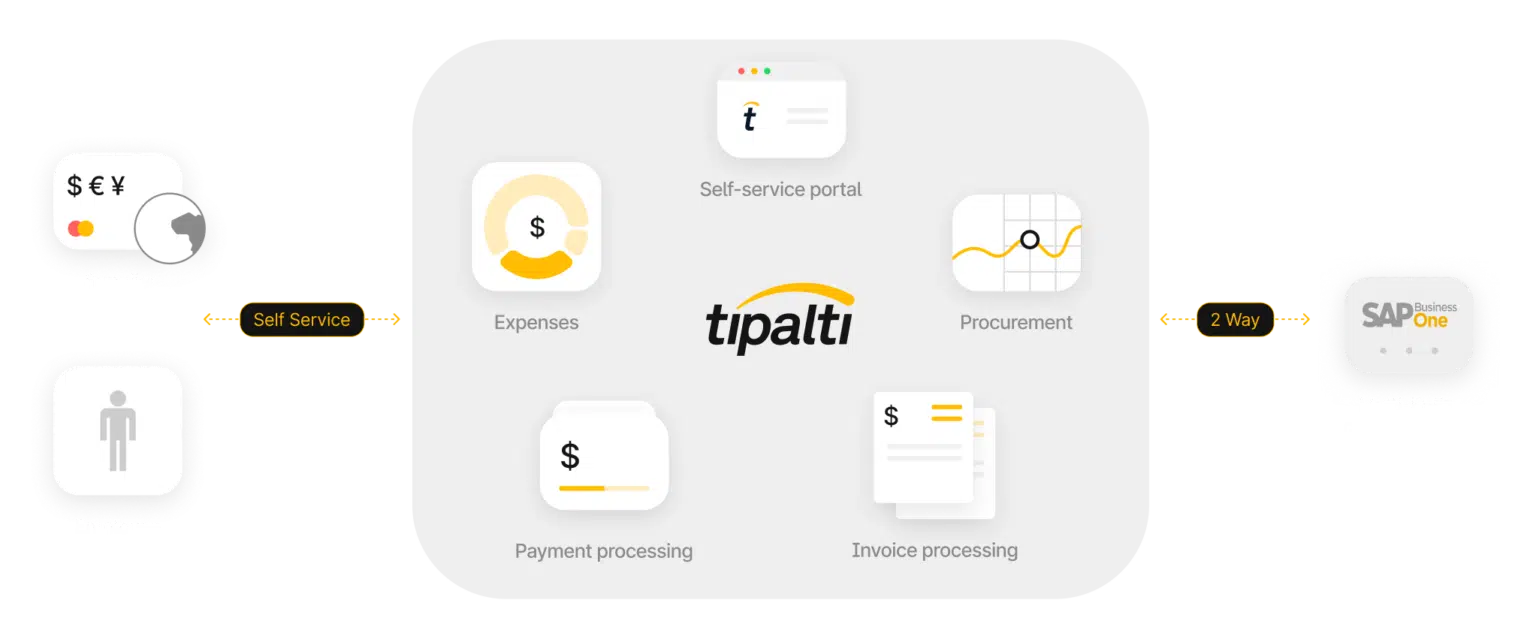
SAP modules alone aren’t enough to maximize your growing business for payables and global payments. Modern finance and accounting operations require scalable add-ons that integrate with your SAP ERP system to efficiently and securely meet your growing business needs.
Add-ons:
- Add AI-powered automation for efficiency and error reduction
- Enable your business to take suppliers’ early payment discounts, saving money
- Add fraud risk controls to reduce fraudulent payments
- Improve global regulatory and tax compliance
- Use AI Assistants to improve spend analysis with custom report queries
- Instantly reconcile payments to synced ERP sub-ledgers
- Scale with growth and business complexity
With an AP automation add-on, your business can onboard suppliers through guided self-service onboarding and achieve automated AP supplier management.
Tipalti’s unified finance automation software for accounts payable and global payouts also provides automated tax compliance and global regulatory compliance. It handles multi-entity and multinational business operations.
In terms of scaling, we’re definitely set up for success. Our payments process is no longer a huge burden on finance anymore.
Nas Yaqoobi, Accountant at Splice, a Tipalti customer
As your next step, assess how well your current SAP Business One ERP aligns with your growth stage — and whether strategic integrations can help close operational gaps. Explore Tipalti’s SAP ERP integration.
SAP Modules FAQs
What are SAP Modules?
SAP modules are optional functional, administrative, and technical ERP components (provided by SAP) that integrate with the core ERP system. Modules (and add-ons) provide a unified platform that supports different business functions and industries.
How many SAP modules are there?
The total number of SAP S/4HANA modules is about 25, including core functional, industry-specific, and technical modules. The total number of SAP Business One modules is about 16.