AP automation built for manufacturing complexity
Connect supplier onboarding, invoice processing, PO matching, approvals, payments, and reconciliation in one AI-powered platform—across every plant, distribution center, entity, and market.
Trusted by manufacturing and distribution leaders






































Manufacturing and Wholesale Challenges
The AP challenges behind every growing manufacturing operation

Keep production moving—not paperwork
When supplier volume, locations, and inventory complexity grow, manual AP creates more than back-office work. Tipalti brings the entire AP process together—from intake to ERP sync—so your team can stay in control without more systems or manual effort.

Match complex invoices and POs with precision
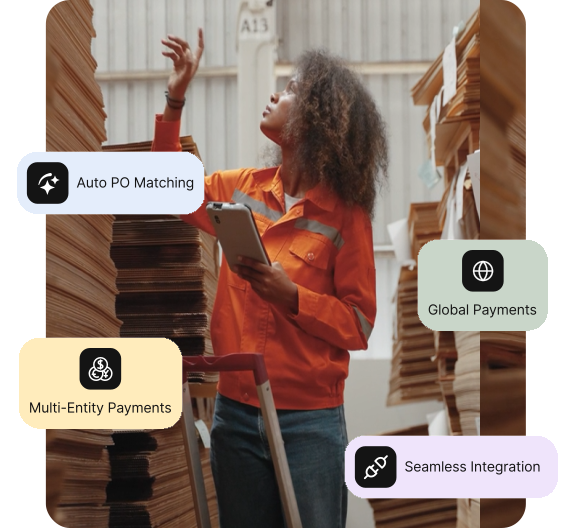
High-volume, multi-line invoices make manual matching slow and error-prone. Automate two- and three-way PO matching with configurable tolerance thresholds and support ERP-specific workflows for landed costs, drop shipments, and lotted inventory.

Manage suppliers around the world
Onboard suppliers with self-service tools, collect and validate tax information, and send payments across 200+ countries and territories using 120 currencies and 50+ payment methods.

Scale AP across entities and locations
Manage AP across plants, warehouses, distribution centers, and business entities from one platform—with consolidated visibility and entity-specific controls, workflows, and user permissions.
Manufacturing and Wholesale Features
Turn complex AP into a connected operation
Bring suppliers, invoices, approvals, payments, and reconciliation together with trusted AI embedded throughout the AP workflow—and built-in controls that keep your team in control.

AI-powered invoice processing
Capture, code, and route invoices with AI agents embedded across the AP workflow. Automated data capture and GL coding help account for every line item, identify duplicate invoices, and keep invoices moving toward approval.

PO matching
Match invoice lines to purchase orders and, for three-way matching, goods receipts. Configurable matching rules and tolerances flag discrepancies for review before payment, while ERP integrations keep invoice and payment records connected.

Self-service supplier management
Give suppliers one place to enter payment and tax details, select payment methods, and check payment status—reducing manual data collection and routine inquiries for your AP team.

Global supplier payments
Pay raw materials suppliers, component vendors, contract manufacturers, distributors, and logistics providers in 200+ countries and territories—without stitching together banks and payment systems.

Multi-entity AP
Standardize AP across entities while preserving the workflows, payment approvals, tax requirements, payment methods, and permissions each location needs. See consolidated and entity-level activity from one headquarters view.

Manufacturing ERP integrations
Connect Tipalti with your accounting system or manufacturing ERP, including Oracle NetSuite, Sage Intacct, Microsoft Dynamics 365 Business Central, SAP Business One, Acumatica, and more. Sync financial data and support ERP-specific workflows with less manual work.
Products
One platform for all your global finance operations
Start with complete AP automation, then connect procurement, cards, expenses, mass payments, and treasury as your business needs grow.



How It Works
Get up and running in weeks, not months
Tipalti’s implementation team works with you to configure the platform around your entities, ERP, approval workflows, payment needs, and supplier base—then supports your team through launch and beyond.

Step 1
Plan
Map your current AP processes, confirm technical requirements, and create an implementation plan aligned with your operations and goals.

Step 2
Configure
Set up entities, approval workflows, payment methods, email connections, and ERP integrations around the way your business operates.

Step 3
Train
Give AP administrators and users practical training on Tipalti’s workflows, controls, and day-to-day functionality.

Step 4
Launch
Support internal adoption, onboard suppliers, validate payment processes, and prepare your team for its first payment run.

Step 5
Optimize
Continued technical support by phone and email. The Tipalti customer success team learns your goals and offers solutions to reach them.
Customer Stories
Built for the way manufacturers operate
See how manufacturing and distribution finance teams use Tipalti to reduce manual AP work, strengthen internal controls, and accelerate the month-end close as operations grow.




Ready to save time and money?
Book a demo to get started today.
Take control of your finance operations with Tipalti.


Recommendations
Access All Insights on Manufacturing

FAQs
Manufacturing Payment Solutions FAQs
What is AP automation for manufacturing?
AP automation for manufacturing streamlines supplier onboarding, invoice capture and coding, PO matching, approvals, payments, and reconciliation. It can also automate non-PO invoices and duplicate detection, helping manufacturers process high invoice volumes with fewer manual steps, stronger controls, and clearer visibility across their financial operations.
How does Tipalti AP automation integrate with existing manufacturing systems?
Tipalti integrates with accounting and ERP systems, including Oracle NetSuite, Sage Intacct, Microsoft Dynamics 365 Business Central, SAP Business One, and Acumatica. Synced data can include supplier records, invoices, payments, purchase orders, and goods receipts, with supported data, sync timing, and workflows varying by ERP and configuration.
APIs and file-based options support custom integrations and additional data exchanges with your manufacturing systems.
How can AP automation improve efficiency in manufacturing supply chains?
AP automation significantly improves efficiency in manufacturing supply chains. Some benefits include:
Improved Accuracy
Minimize human error associated with manual data entry, leading to more accurate financial records, fewer bottlenecks, and fewer payment disruptions.
Reduced Processing Times
AP automation speeds up invoice processing and the entire AP cycle, helping ensure timely payments and stronger supplier relationships.
Streamlined Manufacturing Operations
AP automation should integrate seamlessly with other business processes, facilitating smoother operations throughout the entire organization.
Improved Cash Flow Management
Accounts payable automation provides better visibility into cash flow and upcoming liabilities, enabling AP departments in the manufacturing industry to make more informed decisions.
Optimized Compliance and Audit
AP automation solutions help manufacturing companies maintain accurate audit trails and records, which allows them to comply with financial regulations and approval processes.
What is the accounts payable process in manufacturing?
The manufacturing accounts payable process typically follows these steps:
- Invoice receipt: OCR scans invoices to capture data using artificial intelligence and machine learning.
- Verifying invoice data: PO matching involves pairing invoices with purchase orders and other documents.
- Approval workflows: Routing invoices for approval from relevant managers or departments is an automated process.
- Payment processing: Invoice automation also includes scheduling and processing supplier payments based on agreed terms.
- Recording transactions: Payment details are recorded in the accounting system, and transactions are reconciled automatically.
- Reporting and analytics: Generating reports to analyze cash flow, spend, and supplier performance.
What should manufacturers look for in AP automation software?
Manufacturers should look for AI-powered invoice processing, two- and three-way PO matching, self-service supplier onboarding, deep ERP integration, multi-entity management, global payment capabilities, configurable approvals, fraud and compliance controls, and complete audit trails.
The right solution supports current workflows while adapting as supplier volume, locations, and business complexity grow.
How does AP automation help wholesale distributors manage supplier payments?
AP automation provides wholesale distributors with a single workflow for onboarding suppliers, processing invoices, routing approvals, scheduling vendor payments, and reconciling activity. By accelerating approvals and improving visibility into payment terms, it can also help teams take advantage of an early payment discount when offered.
It also helps teams manage high invoice volumes, multiple warehouses or entities, domestic and international suppliers, and ERP data without relying on disconnected systems and spreadsheets.