How Finance Teams Can Implement AI Agents Without Losing Control

Your CFO asks an AI assistant: “What’s our total AP liability right now across all entities?”
The answer comes back instantly. It sounds confident. It looks complete. But your controller knows it’s wrong. Three entities closed their books on different dates, and two are still syncing stale ERP data.
The AI didn’t fail. The foundation did.
That’s the real risk with AI agents in finance. Not that they can execute work autonomously, but that they can execute the wrong work faster if the data, controls, and approval paths underneath them aren’t ready.
This guide shows finance teams how to deploy AI agents in accounts payable without losing control—starting with the workflows, data structures, and governance layers that make agentic AI reliable, auditable, and scalable.
Looking for the bigger picture?
Agents are just one layer of a broader shift across finance, from fraud detection to forecasting. For the wider view, see our guide to AI in finance and what it means for teams.

Data sources:
Tipalti commissioned Rob Roy Consulting and Cambia Information Group to conduct an independent survey of 500 finance professionals. All responses were collected online in September 2025. All respondents worked in the finance department of their respective organizations and were either regularly using or experimenting with AI as part of their job responsibilities. Tipalti also commissioned Speero to conduct a separate survey of 30 US-based finance professionals on AI adoption readiness in accounts payable, split evenly between senior finance leadership and mid-level finance roles at companies with 50–999 employees. Responses were collected in April 2026.
What an AI Agent Is (And What It Isn’t)
If you need a full breakdown of how AI agents work, Tipalti’s guide to AI agents in finance covers the architecture in depth. For deployment purposes, the distinction that matters is simpler:
Type
What It Does
Who Makes the Decision
Automation tool
What It Does:
Executes fixed, rules-based instructions
Who Makes the Decision:
No human is involved at the point of execution. The decision was made when the instructions were originally configured. The system runs it automatically every time.
AI assistant
What It Does:
Surfaces insights, initiates tasks, and can act on behalf of users
Who Makes the Decision:
The AI surfaces relevant information. The human then reviews it and decides what to do with it.
AI agent
What It Does:
Executes defined tasks autonomously within guardrails
Who Makes the Decision:
The human authorizes what the agent is allowed to do and sets the guardrails. Within those boundaries, the agent executes the task without waiting for human input on each step.
AI Agents Require a Different Implementation Playbook
Machine learning made predictions more accurate. Generative AI made information easier to access. AI agents now take the next step by executing work across systems with minimal human intervention.
Because they execute work rather than simply analyze or retrieve information, they depend on clean, real-time data, connected systems, well-defined business rules, and governance that keeps every action within approved guardrails.
That higher bar creates what we call the AI trust gap. Finance leaders see the opportunity, but they also have concerns about how executing work autonomously introduces risk:
55%
of professionals are “extremely optimistic” about AI’s potential benefits1
48%
are either extremely or somewhat concerned about risk (data privacy, security, and compliance)1
That means where and how you deploy AI agents into your organization’s workflow is critical to whether they deliver value or create costly mistakes.

Why Accounts Payable Is the Highest-Value Entry Point for Agentic AI
Accounts payable runs on structured, transactional data where the rules are clear and the answers aren’t dependent on human context or judgment. An invoice either matches a purchase order (PO) or it doesn’t. That makes it the place where agents can work reliably from day one, at high volume, with measurable results.
When finance professionals were asked what they’d want to test first before any live payments were involved, invoice matching and validation was the top answer. It ranked first among both senior finance leaders (10 of 15 respondents) and mid-level respondents (nine of 15), ahead of reporting, fraud detection, and workflow automation.2

Where AP Teams Lose Time Without Agentic AI
- Manually keying in invoice data from PDFs and emails
- Chasing the right approver for every invoice
- Cross-referencing invoices against POs line by line
- Diagnosing ERP sync failures across systems
- Collecting and validating supplier tax forms during onboarding
- Building one-off reports by hand across suppliers, time periods, and entities
- Routing expense receipts, assigning categories, and managing approval queues
What AP Teams Achieve After Deploying AI
For teams that deploy on a clean data foundation and follow a structured rollout sequence, the results are measurable:
Up to
80%
reduction in AP workflow time
Up to
50%
faster book close
50%
of AP team time redirected to higher-value strategic work
Source: Tipalti research and customer case studies. Results reflect companies upgrading from manual processes.

How AI Agents Change AP Workflows: Before and After
For each agent below, the “After” column shows what the agent handles. In every case, exceptions are flagged for human review and nothing moves without your approval.
An Invoice Capture Agent
Before
Manual data entry from PDFs, emails, and paper invoices. Your staff manually enters header and line-item data, assigns GL codes, and routes for review.
After
Agent extracts header and line-item data, assigns GL codes, and flags anything unusual for human review. Nothing unusual passes without a human decision.
Tipalti’s Invoice Capture Agent automatically gathers all necessary invoice information, eliminating manual typing…Now we have more time for more meaningful work.
Kanan Mammadov, VP of Procurement
A Tax Form Scan Agent
Before
Manual W-9 collection, chasing suppliers for missing forms, and validating data by hand before onboarding continues.
After
Agent extracts W-9 data, validates it against requirements, and flags any issues before onboarding moves forward. Tax compliance is embedded in the workflow.
A PO Matching Agent
Before
Line-by-line manual cross-referencing of invoices against purchase orders. Discrepancies create manual queues.
After
Agent handles two- and three-way matching at header and line level, flagging discrepancies before any payment is triggered.
A Bill Approvers Agent
Before
Manual approval routing, chasing approvers across email threads, and unclear escalation paths when approvers don’t respond.
After
Agent learns from past approvals, predicts the right approver, and surfaces the request with full context. A human makes the decision. The agent removes the search.
We used to catch billing issues 2 or 3 weeks later. Now we can dispute invoices in real time and get the right stakeholders reviewing upfront, improving both our vendor experience and our month-end close.
Terri Haney, Accounts Payable Manager,
An ERP Sync Resolution Agent
Before
Hours manually tracing sync errors across systems, often requiring IT involvement to diagnose what failed and why.
After
Agent identifies the error, explains it in plain language, and walks through the fix. Nothing changes until a human confirms.
An Expense Receipt Scan Agent
Before
Employees submit receipts manually, assign their own expense categories, and wait for approval.
After
Agent extracts receipt data, assigns expense categories, and routes for approval. Employees submit. The agent handles the rest.
Tipalti Expenses has been a big win across the board: managers love approving in-app, our AP team has fewer touches, and the finance team gets faster visibility because they’re saving over 16 hours monthly in manual work.
Terri Haney, Accounts Payable Manager,
An Reporting Agent
Before
Manual report building across suppliers, time periods, and entities. Each custom report is a one-off project.
After
Agent generates custom reports from plain-language prompts in real time. Ask in natural language and you get the report.
Just used the Reporting Agent and love it! I created a report in minutes that would have taken a lot longer, as it involved multiple vendors.
Sondra Brandt, Accounting Manager
See How Tipalti’s AI Agents Work in Practice
How AI Agents Strengthen Fraud Defense in AP
Faster invoice processing is one of the core benefits of deploying AP agents. It’s also what makes fraud controls a deployment requirement. AP fraud has evolved and the same technology that makes agents powerful has made fraudulent invoices harder to detect, supplier impersonation more convincing, and business email compromise easier to execute at scale.
AI-Generated Invoices
Fake invoices are no longer visually detectable. AI-generated documents can look clean, unique, and polished, making traditional visual inspection unreliable.
14%
of all fraudulent documents submitted were fake AI receipts, up from zero the prior year
70%
of CFOs believed employees were using AI to falsify expenses or receipts
In our survey, controllers specifically named fraud detection as a core operational concern, with one noting they receive many fraudulent invoices each week to their AP alias2. Because approvers for the same supplier sometimes differ, pattern-based detection becomes unreliable without trainable models.
Agents flag what visual inspection misses, including inconsistencies in supplier behavior, duplicate submissions with minor variations, and invoices that don’t match historical patterns.
Supplier Impersonation
Fraudsters construct fake supplier profiles or impersonate legitimate suppliers to redirect payments to accounts they control. This is often done by using AI-generated tax documents and bank records, engineered specifically to pass static KYC checks.
45%
of companies were targets of supplier impersonation fraud in 2024, up from 34% the prior year
33%
of the largest organizations by payment volume were affected by invoice fraud in 2025
Sources: 2025 AFP Payments Fraud and Control Survey, 2026 AFP Payments Fraud and Control Survey
This mirrors a broader shift in fraud defense. As Tipalti’s Chief Customer and Operating Officer put it, staying ahead means moving “beyond one-time methods involving documents…to more adaptive systems.”
AI agents cross-reference every new supplier account against historical risk data, flagging accounts that share payment details, tax IDs, or ownership links with known bad actors before they ever reach the payment queue.
Business Email Compromise (BEC)
In a common BEC tactic called conversation hijacking, attackers don’t announce themselves. They insert themselves into an existing email thread about an ongoing financial transaction, gain access to your mailbox, and go quiet. They study your payment schedule, learn your approval patterns, and wait. When the moment is right, they surface with a routine-looking request, and by the time it’s flagged manually, the payment has already been processed.
76%
of organizations experienced attempted or actual payments fraud in 2025
17%
of organizations currently use AI to combat payments fraud
Sources: 2026 AFP Payments Fraud and Control Survey, LevelBlue SpiderLabs
Manual review has a structural blind spot with BEC because the attack is designed to look legitimate to a human reviewer. AI agents monitor every change to banking details, every new payment instruction, and every supplier update. When something doesn’t fit the pattern, it gets flagged before payment is triggered, with a full record of what was caught, why, and what happened next.
The Controls Layer: How AI Agents Stay Auditable and Compliant
The goal is 99% automation, 100% control. Tipalti’s State of AI in Finance study, which surveyed 500 finance professionals, asked which capabilities matter most in any AI product. The answers were clear:
- 55% want visibility into what AI does1
- 55% want to configure exactly how it automates specific tasks1
- 46% want full autonomy (the lowest-ranked capability of all)1
In every case, finance professionals ranked visibility and configurability above AI that operates independently.
A separate survey we conducted reinforces this. Across CFOs, VPs of Finance, and Controllers, zero respondents selected full autonomy2.
When asked what would most increase their confidence in an AI-powered AP tool, they pointed to ERP integration and audit logs as the top confidence drivers, each cited by eight of 15 respondents2. Security certifications and case studies ranked last. Teams aren’t looking for external reassurance. They want operational controls they can see and use themselves.

The Four Controls That Make Agents Auditable
- Audit trails: Every decision the agent made, the data it used, and the policy it applied is recorded. This is non-negotiable for audit readiness.
- Role-based access: Agents operate within your existing access control framework. Agents can’t see or act on data the user doesn’t have permission to access.
- Approval chains: Approval workflows remain intact. Agents route to the right human and never bypass the chain.
- Duplicate and anomaly detection: Agents flag duplicate invoices, unusual supplier activity, and out-of-policy spend in real time, before payment is triggered.
When someone internally asks what happens when it gets it wrong, the answer is: it gets flagged, a human reviews it, and there’s a full record of what happened.
According to our survey, 52% of finance professionals want stronger governance frameworks, and 47% want clearer accountability for AI decisions.1 The controls layer isn’t optional—it’s what finance teams are explicitly asking for before they expand what AI handles.
Where to Start with AI Agents in AP (And Why)
Start with the reporting agent. It has no payment risk, delivers immediate visibility, and shows you where your data quality problems are before you deploy agents that touch approvals or payments. From there, expand into agents where the data is already structured and errors are visible before money moves.
That sequencing matters for a reason. When an agent processes bad data at volume, the problems compound quickly. If invoice capture goes live before GL coding is clean, your team will spend weeks in remediation rather than realizing value. Starting where the data is already reliable keeps the cost of an error low and builds trust before you expand scope.
Team Readiness Matters as Much as Data Readiness
Deploying agents changes what the AP role looks like. It means your staff shifts from processing transactions to managing exceptions, reviewing flags, and overseeing agent behavior.
In that scenario, you need a plan for upskilling before rollout begins. Formal AI training programs are best. Ad hoc learning typically isn’t enough at scale.
If you’re concerned about what this means for your team, the data is reassuring. Our study found that 57% of finance professionals said they plan to keep staffing levels steady, and 45% said AI is allowing them to shift headcount into different roles within the finance function rather than reduce it1.

How to Roll Out AI Agents With 100% Control
Deployment sequence matters. Teams that get these steps right avoid the rework, the trust erosion, and the stalled rollouts that pull momentum out of a program before it has a chance to prove itself.
Start With the Right Finance Workflow
AP is the right entry point because the data is structured and the rules are clear. Teams that start in expense management, strategic reporting, procurement, or another area often discover too late that the underlying data isn’t clean enough for agents to work reliably. It leads to errors, manual intervention, and a lack of confidence in the system. Start with AP. It’s where the data is already transactional and the failure modes are visible before money moves.
Get Your Data Ready Before You Deploy
Bad data becomes a bigger problem at volume once an agent is processing it. GL coding and PO records are the two most common failure points, and skipping this check is how teams end up spending their first weeks in remediation instead of seeing results. Confirm three things before deploying any agent that touches approvals or payments:
- Are your GL codes clean and consistently applied?
- Are your PO records structured and current?
- Do your ERP integrations sync in real time?
AI doesn’t magically fix bad data. It accelerates whatever exists—good or bad.
Paul Henderson, Tipalti Chief Accounting Officer
Treat Agents as Agents, Not Automation
Agents work differently from the automation tools your team already knows. Define the guardrails and approval points upfront. The agent can then handle exceptions within those boundaries. Pre-configuring every possible scenario is automation thinking. Agents are built to learn from your data and route the exceptions that genuinely need a human decision.
Integrate With Your ERP in Real Time
When we surveyed finance leaders on what they’d need in place before handing agents autonomous action, ERP integration ranked among the top answers. That’s because agents working from live data produce reliable outputs. Before committing to a platform, confirm it integrates natively with your ERP rather than relying on flat-file exports or manual syncs. Workarounds break at scale.
Define Human Approval Points Upfront
Decide early on which decisions need human review and which ones the agent can handle alone. Do this before deployment, not after an exception catches your team off guard. If you get it right, you’ll avoid micromanaging every agent action and missing oversight on the decisions that matter most.
Build in Fraud and Supplier Risk Detection from Day One
AP automation increases transaction velocity, which is the point. Make sure fraud detection moves at the same speed. AI-generated invoices, supplier impersonation, and BEC are all designed to exploit the gaps manual review misses, so build detection into the workflow from the start rather than adding it after go-live.
Make Every Agent Decision Auditable
When an agent flags an invoice, routes an approval, or resolves a sync error, your team should be able to explain what happened and why. Require complete audit trails before go-live. Every decision the agent makes, the data it uses, and the policy it applies should be recorded and reviewable. That’s what lets you stand behind the output.

How to Evaluate AI Agent Platforms for AP
Most platforms now claim agentic AI capabilities. Those claims are not all equivalent. Here’s a practical framework for separating substance from marketing.
- Autonomy controls: Can you adjust the level of autonomy by workflow, risk level, or entity? A platform that only offers full automation or full manual review isn’t built for how finance actually works. Finance teams want guardrails, not binary choices.
- ERP integration depth: Does it integrate natively with your ERP, or does it rely on flat-file exports and workarounds? Workarounds break at scale and create data quality problems that make agents unreliable.
- MCP integration: Can the platform connect AI agents to your existing tools through standardized connectors? Real-time data access is what makes the structured AP argument real in practice.
- Exception handling design: How does the system route exceptions? Who gets notified, with what context, and how fast? This is where most platforms differentiate in practice, and it’s where poorly designed agents create more manual work than they save.
- Audit trail completeness: Can you see every decision the agent made, the data it used, and the policy it applied? If a platform can’t show you the reasoning, you can’t stand behind the output.
- Compliance update cadence: How does the platform handle regulatory changes? Manual updates are a liability. This is especially critical for teams operating across multiple countries and entities.
- Human escalation design: Is the escalation path clearly defined and easy to follow? Agents that escalate poorly create confusion, not confidence.
The right platform depends on your ERP environment, your data maturity, and where you’re starting. Evaluate against your actual deployment sequence, not a theoretical full rollout.
How Tipalti Deploys AI Agents Across AP
Tipalti’s AI agents capture invoice data, auto-generate complete purchase requests, automatically match bills and POs, validate supplier tax forms, eliminate approval bottlenecks, resolve ERP sync errors, capture employee expenses, and generate real-time reports from natural language prompts.
Boost Productivity Without Sacrificing Control

Invoice Capture Agent
Cut manual invoice coding time with AI invoice automation that captures invoice data and fills fields instantly.
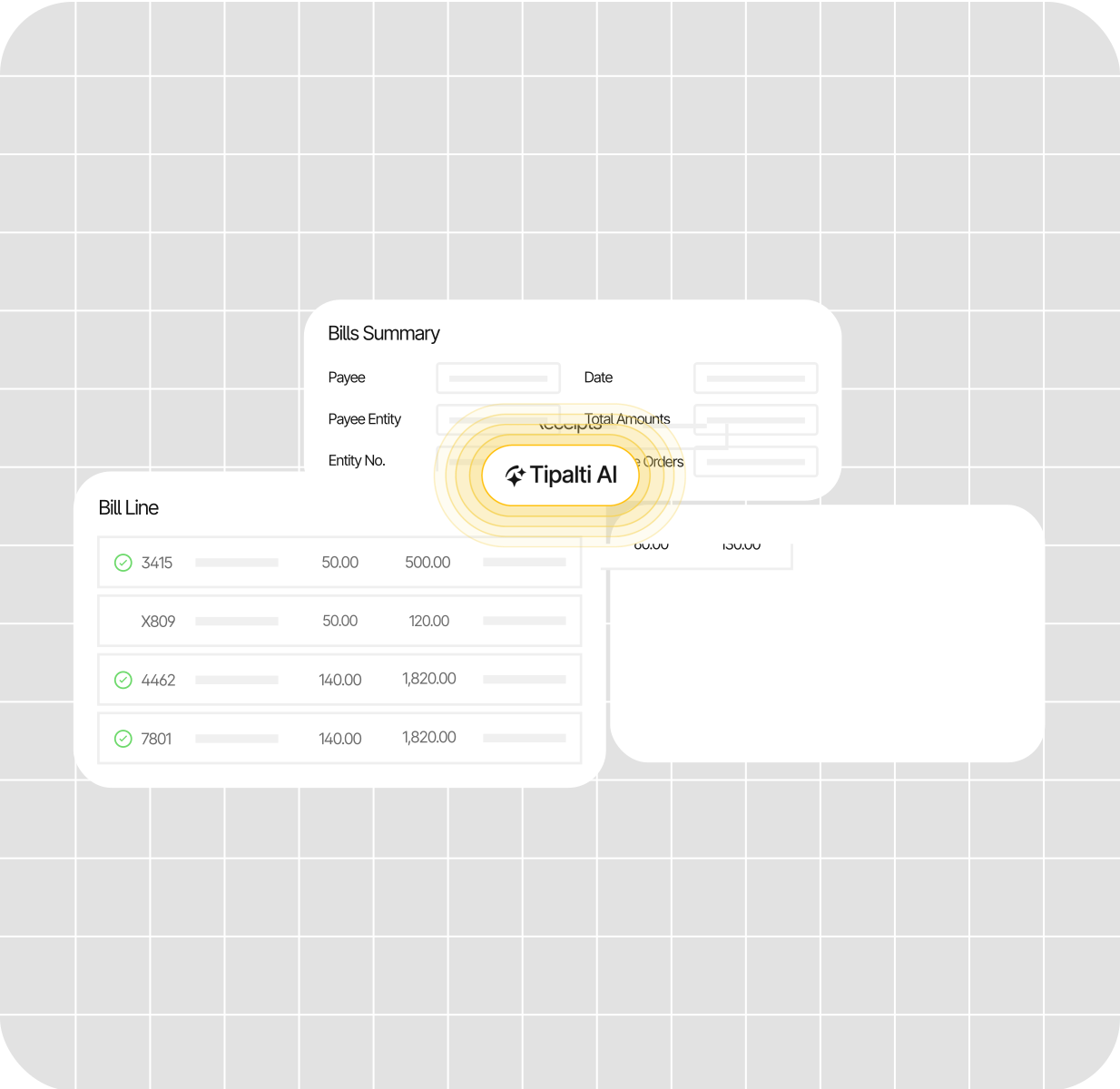
PO Matching Agent
Reduce manual matching tasks—let AI analyze contextual descriptions to automatically match bills and POs.

Reporting Agent
Get spend and payment insights fast with custom reports generated from natural language prompts.

Bill Approvers Agent
Keep approvals moving with AI-powered recommendations for the right approver.

Purchase Request Agent
Auto-generate complete purchase requests from simple employee descriptions.
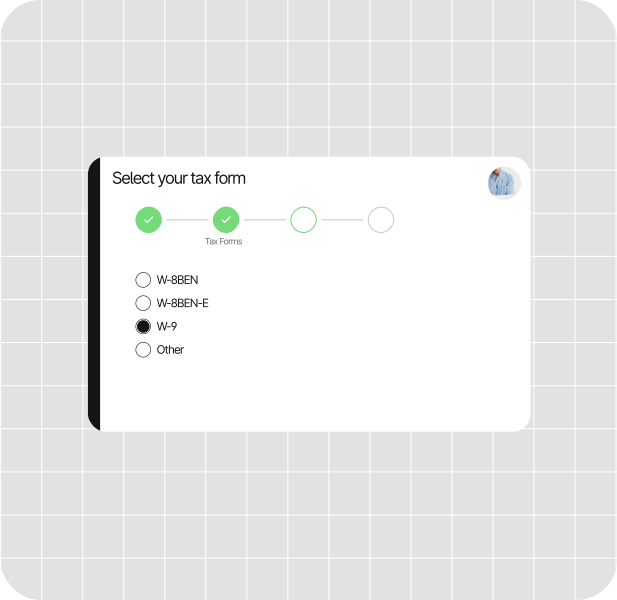
Tax Form Scan Agent
Ensure supplier tax compliance with automated extraction of W-9 data and accelerated onboarding.

ERP Sync Resolution Agent
Resolve ERP and accounting software sync issues in minutes, not hours, with automation that diagnoses and guides every fix.

Expense Receipt Scan Agent
Capture employee expenses effortlessly with automation that extracts receipt data and accelerates expense reporting submission.
In addition, the Tipalti AI Assistant is a 24/7 conversational tool that combines deep knowledge of your finance workflows with advanced reasoning, answering questions about invoices, purchase requests, and POs in real time, with multilingual support built in. For teams operating across entities and geographies, that multilingual capability is a practical differentiator.
Tipalti’s platform is trusted by over 6,500 global companies to manage billions in payments and millions of transactions across the globe. This scale and expertise are the foundation of Tipalti AI. From spend patterns to cash flow optimization, Tipalti can surface unique insights with AI to help finance teams see their financial big picture and lead their business with confidence.

We’re redefining what’s possible when humans and AI agents work together in finance.
Roby Baruch, Tipalti CPTO
See How Tipalti’s AI Agents Can Help Your Organization
Your AP team shouldn’t spend their time chasing approvers, keying invoice data, or tracing sync errors. Our agents handle the operational work so your team can focus on decisions that actually require judgment.
Frequently Asked Questions (FAQs) About AI Agents in Finance
How Do You Implement AI Agents in Accounts Payable Without Losing Control?
Start with the reporting agent, then expand into agents where the data is structured and errors are visible before money moves. Make sure every agent operates within your existing approval chains and access controls. Require full audit trails. Run agents alongside your current process before fully transitioning. And prepare your team for the reality that the AP role shifts from processing transactions to reviewing exceptions and overseeing agent behavior.
How Do I Know If My AP Data Is Ready for AI Agents?
Ask yourself three questions:
- Are your GL codes clean and consistently applied?
- Are your PO records structured and up to date?
- Do your ERP integrations sync in real time or rely on manual exports?
If the answers are yes, your data foundation is solid enough to start. If the answers are mixed, you have gaps to address before deploying agents that touch approvals or payments.
What AP Tasks Are Best Suited for AI Agents?
Agents perform best on high-volume, structured tasks with clear rules and transactional data. Strong starting points include:
- Invoice capture and coding
- PO matching
- Supplier tax form validation
- Approval routing
- Reporting
Tasks that require human judgment stay with your team. Negotiating with a supplier, resolving a dispute, or making a capital allocation decision are not agent work.
What Are the Risks of Using AI Agents in Accounts Payable?
The two main risks are data quality and accountability. Agents are only as reliable as the data underneath them, so messy GL coding or unstructured invoice data leads to wrong outputs. And if something goes wrong, you need a clear record of what the agent did and why. Both risks are manageable with full audit trails, a review process where humans approve before anything moves, and starting in areas where the data is already clean.
How Do AI Agents Handle Multi-Entity or Multi-Currency AP Environments?
AI agents handle multi-entity and multi-currency AP by operating within a consolidated platform that manages entity-level rules, currency conversions, and approval hierarchies centrally. Each entity can have its own approval chains and GL coding structures while the agent applies the correct rules automatically based on which entity the transaction belongs to. Exceptions are flagged at the entity level with full context, so the right person reviews the right transaction without manually sorting across subsidiaries.
When we surveyed finance leaders, 9 of 15 said multi-entity and multi-currency complexity was a significant factor in their need for AI assistance in AP2. Manual processing across subsidiaries and geographies creates volume and variability that becomes unsustainable without adding headcount.
For teams operating across countries, agents can also handle multi-language invoice capture and regional e-invoicing requirements within the same workflow rather than routing international transactions into a separate manual process.
How Do I Make the Case Internally for AI Agents in AP?
Start with the data your leadership team already cares about. If your team is processing invoices manually, calculate what that costs today. Then map that against what automation delivers: Tipalti customers report up to 80% reduction in AP workflow time and up to 50% faster book close.
Frame the conversation around risk as much as efficiency. Finance leaders respond to the fraud argument: 76% of organizations experienced attempted or actual payments fraud in 2025, and manual review has structural blind spots that agents close. That reframes AI adoption from an efficiency project into a risk management decision.
Finally, address the control question before it gets asked. The most common objection is loss of oversight. Lead with the governance layer and position agents as a way to strengthen controls, not as a way to bypass them.
References:
1 Tipalti. The State of AI in Finance: Exploring the AI Trust Gap. Conducted by Rob Roy Consulting and Cambia Information Group, September 2025. https://info.tipalti.com/rs/934-OPL-911/images/EB_State_of_AI_Usage_Finance.pdf
2 Tipalti. AI-Powered AP Automation Brand Awareness Survey, April 2026. Survey of 30 US-based finance professionals (15 senior finance leaders, 15 mid-level finance) at companies with 50–999 employees.