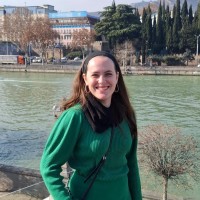

I didn’t have a classic “lightbulb” moment where I suddenly knew I wanted to be an engineer. It was more of a slow, steady realization that logic and problem-solving were where I felt most at home.
My passion for technology is likely genetic. I grew up watching my father—who studied programming in the early 90s—maintain an infectious enthusiasm for science and new tech. While I briefly considered architecture, engineering felt like the natural fit. There is a specific kind of satisfaction that comes from solving a complex problem. For me, that’s where the fun is.
From Writing Code to Empowering Teams
I’ve been at Tipalti for four years, and if you had asked me on day one, I wouldn’t have predicted I’d be managing a team this early. My transition from full-stack engineer to manager started with a four-month project leading five interns. I took it as a test: Do I like this, and am I good at it?
What I discovered is that management is just a different kind of engineering. Instead of optimizing code, you’re optimizing workflows and team dynamics. I realized that my focus shouldn’t only be on the product, but on believing in my team and helping them achieve their goals, like my mentors did for me.
Authenticity as a Technical Tool
In our industry, we talk a lot about “Women in Engineering,” but for me, the most important factor has been choosing authenticity over a stereotypical leadership mold.
I’ve found that my greatest advantage is leaning into the social, empathetic side of the role. When you foster an environment where connection and trust are as important as the code, the team becomes more resilient. This isn’t “soft” management—it’s the core of building a high-performing team that can stick together through the most challenging technical problems.
My “Gold Standard” for Engineering Workflows
In a fast-paced environment, the standard of work might drop because of burnout or unclear priorities. I see it as my responsibility to protect our quality bar by actively combating context switching. I take ownership of ongoing operations tickets and monitoring work so my engineers can dedicate themselves to deep, focused progress. To me, a successful Tuesday is one that is perfectly balanced:
- The Morning: Focused, deep work on a complex technical or architectural problem.
- The Afternoon: Intentional 1:1s to connect with the team on their long-term growth.
- The Result: A clean, merged pull request or a code deploy that we are all proud of.
Staying Sharp on the Cutting Edge
Engineering requires a constant curiosity for what’s next. Right now, I’m focused on how Agentic AI and Claude Code can transform our development workflow. To illustrate the impact this has on our daily output, here is a recent project I implemented:
- The Challenge: Diagnostic Complexity
In Purchase Order matching, customer tickets are a diagnostic puzzle. Our domain involves a high-stakes mix of ERP integrations, multi-currency logic, and a polyglot stack ($C\#$, TypeScript, MongoDB, and SQL). Tracing a transaction through this intricate pipeline is sometimes complex. - The Solution: Agentic Investigation
I built a suite of Claude Code skills and MCP servers to act as a co-investigator. These agents augment the process by cross-referencing disparate databases and verifying logic against our codebase. I treat the agent as an “analytical partner”—challenging its reasoning, stress-testing its conclusions, and continuously refining its skills to capture new domain edge cases. - The Result: High-Precision Triage
We’ve transformed complex diagnostics into a high-velocity operation. We can resolve investigations in a fraction of the time with higher output. This workflow has not only boosted team efficiencies; it provides customers with faster, data-backed resolutions that I can stand behind with 100% confidence.
Seeing these kinds of tangible improvements is why I find this field so rewarding. The speed of innovation in this space is a puzzle that keeps me excited to start work every morning.
Advice to My Day-One Self
If I could go back four years to my first day as a full-stack hire, my advice would be simple: Believe in yourself, be real, and communicate openly. For a long time, I tried to fit a specific mold. I eventually realized that your authentic perspective is actually your biggest asset. Once you trust your own abilities, you stop trying to fit in and start moving the needle.
Stay tuned for our next Employee Spotlight as we continue to highlight the brilliant minds driving innovation at Tipalti.
