


What is an International Bank Account Number (IBAN)?
An International Bank Account Number (IBAN) is a standardized code used to identify bank accounts for international payments. It helps banks route transfers accurately by identifying the country, bank, and account involved.
An IBAN contains up to 34 letters and numbers, depending on the country. It’s commonly used for payments across Europe and many other countries, but US bank accounts do not use IBANs.
IBAN Number Format and Example
An IBAN starts with a two-letter country code, followed by two check digits and a country-specific bank account identifier.
For example, a UK IBAN might look like this: GB82 WEST 1234 5698 7654 32
- GB: Country code (United Kingdom)
- 82: Check digits used to validate the IBAN
- WEST: Bank identifier
- 123456: Sort code
- 98765432: Account number
IBAN lengths vary by country, but the maximum is 34 characters.
Key Takeaways
- IBAN is short for International Bank Account Number and is used to identify an individual bank account in cross-border payments.
- IBAN codes facilitate international money transfers.
- SEPA is a euro payment area that uses IBANs for euro transfers across participating European countries.
- An IBAN can be located on your bank statement, through online banking, an IBAN calculator, or the IBAN Registry
- The SWIFT network is the registration authority for standardized formats for the IBAN system and administers the ISO 9362-defined BIC system.
What Does an IBAN Look Like?
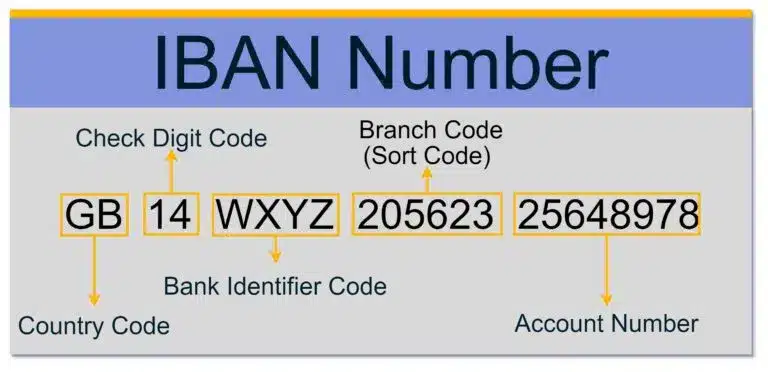
In general, an IBAN number is divided into a numbering system comprised of codes (sometimes in the order presented, although it does vary by country):
- Country code (sometimes called location code)
- Check digit code
- Bank identifier code
- Branch code
- Account number
The last three (bank, branch, and account numbers) collectively make up the Basic Bank Account Number (BBAN) and are used to locate a specific bank.
The IBAN format is the same across countries, although the number of digits may vary. For example, Norway uses 15 characters, while Liechtenstein uses 21. The maximum number that any country can use is 34.
Please note that the IBAN method is used in most European Union countries and other European countries. Always check with your bank if you’re unsure about an international transfer.
IBAN vs. SWIFT/BIC Code
An IBAN identifies a specific bank account, while a SWIFT code, also known as a Bank Identifier Code (BIC), identifies the financial institution involved in a payment.
An IBAN contains up to 34 alphanumeric characters, while a SWIFT/BIC code contains 8 or 11 characters.
Depending on the destination country and payment network, an international transfer may require an IBAN, a SWIFT/BIC code, or both.
IBAN Examples by Country
IBAN lengths and formats vary by country. Here are some examples:
| Country | IBAN length | Example |
|---|---|---|
| United Kingdom | 22 | GB82 WEST 1234 5698 7654 32 |
| Germany | 22 | DE89 3704 0044 0532 0130 00 |
| France | 27 | FR14 2004 1010 0505 0001 3M02 606 |
| Spain | 24 | ES91 2100 0418 4502 0005 1332 |
| Italy | 27 | IT60 X054 2811 1010 0000 0123 456 |
These are illustrative examples, not payment instructions. Always confirm the recipient’s IBAN with their bank before initiating a transfer. For a complete list of countries using IBANs and their required formats, refer to the official SWIFT IBAN Registry.
Pay International Suppliers Without the Complexity
Managing IBANs, SWIFT codes, payment methods, tax requirements, and banking details across countries can quickly become overwhelming. See how leading finance teams simplify global payments while reducing errors and compliance risk.
How to Find Your IBAN Number
You can typically find your IBAN through your bank using one of these methods:
- Online or mobile banking: Check your account details or international payment information.
- Bank statements: Some banks display the IBAN alongside your account details.
- Contact your bank: Ask your bank to provide or confirm the correct IBAN for your account.
- Check country requirements: If your bank account is in a country that doesn’t use IBANs, such as the United States, you may need an account number and routing or SWIFT/BIC information instead.
Always verify the recipient’s IBAN before sending an international transfer to avoid delays or rejected payments.
Does It Cost Money to Use an IBAN?
An IBAN itself doesn’t carry a fee. However, banks and payment providers may charge fees for transfers, depending on the payment method, destination, currency conversion, and provider.
Some domestic and SEPA transfers may be free, while international transfers involving currency conversion or intermediary banks can have additional costs.
Which Banks Use IBAN Numbers?
IBANs are used by banks across Europe and in many countries in the Middle East, Africa, and the Caribbean.
Banks in the United States, Canada, Australia, and New Zealand generally do not issue IBANs for domestic accounts. However, customers in these countries may need a recipient’s IBAN when sending payments to countries that use the IBAN system.
IBAN formats and lengths vary by country. Check the official SWIFT IBAN Registry for country-specific requirements.
Is an IBAN Number Used in the US?
IBAN numbers are used only in the US to send money to a foreign bank account that participates in the International Bank Account Number System. Currently, US banks do not use IBANs domestically. Instead, US banks use ABA routing numbers (for domestic transfers) and SWIFT codes (for international transfers).
What Is the Difference Between IBAN and SEPA?
The Single Euro Payment Area (SEPA), as the name suggests, is a payment network in Europe that provides digital transfers within the European Union. This includes places like Spain, Ireland, Hungary, the United Kingdom, and more. It also covers a few countries outside of the union, including Norway, Iceland, Switzerland, and Liechtenstein.
It’s overseen by the European Committee for Banking Standards (ECBS), which helps set national standards for business identifier codes.
In total, the SEPA network works across 41 countries and territories. By comparison, over 89 countries currently use the IBAN system, according to the SWIFT IBAN registry. Multiple currencies can also be sent via IBAN, whereas only Euros can be sent via the SEPA network.
Since its adoption throughout Europe in the late 1990s, some countries in the Middle East and the Caribbean have also begun using the IBAN system for digital money transfers.
Beyond IBAN: Simplifying International Payments at Scale
An IBAN is an important part of cross-border payments, but it’s only one piece of the process. As businesses expand internationally, finance teams often need to manage IBANs, SWIFT codes, local banking requirements, tax documentation, currencies, and payment regulations across dozens of countries.
While IBANs help reduce errors, payment failures can still occur when supplier banking information is incomplete, outdated, or entered incorrectly.
The Challenge of Managing Global Supplier Payments
For organizations managing large supplier networks, collecting and maintaining banking information manually can create significant operational risk and administrative overhead. Spreadsheets, email chains, and country-specific payment requirements make it difficult to ensure banking details remain accurate and up to date.
That’s why many companies automate supplier onboarding, banking validation, and global payment workflows. Instead of relying on manual processes, finance teams can centralize supplier information, verify banking details before payments are sent, and streamline international payments from a single platform.
Whether you’re paying a handful of overseas suppliers or managing a global payment operation, understanding IBANs is the first step. Building scalable processes around them is what helps finance teams reduce errors, improve efficiency, and support international growth.
Simplify International Supplier Payments
Managing international payments involves more than collecting IBANs. Tipalti helps finance teams streamline supplier onboarding, manage payment information, and automate global payment workflows across supported countries and currencies.
IBAN Number FAQs
Do US Banks Have IBAN Numbers?
US banks do not use IBANs for domestic bank accounts. However, when sending money from the US to a country that uses IBANs, you may need the recipient’s IBAN to complete the international transfer.
Can I find an IBAN using an account number?
In some countries, an IBAN can be generated from domestic banking details using the correct country-specific format. However, an account number alone is generally insufficient. Confirm the resulting IBAN with your bank before using it.
How many digits are in an IBAN?
An IBAN contains up to 34 alphanumeric characters, including a two-letter country code, two check digits, and a country-specific account identifier. The exact length depends on the country.
Is it safe to give out an IBAN number?
It is generally safe to share your IBAN when needed to receive a payment, but you should only share banking details with trusted parties and avoid sending them through unsecured channels.
