

 Back
Back 

My path to becoming a CFO was anything but traditional.
I started my career as an engineer, moved into consulting, and later spent time in corporate strategy and business development at American Express before moving deeper into technology strategy.
I did not come up through the traditional accounting path. Instead, I spent years learning how businesses are built: how products evolve, how customers make decisions, and how operational choices translate into financial outcomes.
That perspective has shaped how I think about finance leadership today.
The CFO role has always been about understanding the numbers. But the most capable CFOs need to interpret what’s behind those numbers—the market forces, customers, and products that are directly influencing them.
My unconventional background allows me to look at finance in this way. Not just as a reporting function, but as a partner that helps direct where our business goes next.
That same mindset shapes how I think about AI. Similarly, the most valuable AI opportunity is not just automating existing processes—it’s transforming how the finance function fundamentally operates. It’s our responsibility to define what gets automated, what requires human judgment, and how the two interact.
As CFOs, we’re facing a major transition industry-wide. And it’s happening whether we’re ready for it or not.
Key Takeaways
- According to CFO Dan Barzily, the biggest AI opportunity in finance isn’t automating tasks—it’s redesigning the function, so teams spend less time reconciling data and more time applying judgment.
- A State of AI in Finance report cited by CFO Dan Barzily found that 98% of finance professionals say AI saves them time and improves work quality, 97% say it enhances decision-making, and 96% say it helps their organization grow and scale.
- Modern CFOs are shifting from financial reporters to “business stewards,” professionals who combine financial oversight with direct understanding of customers, products, and market forces to guide company strategy.
Market Forces Are Redefining the CFO Role
The CFO role today is not about managing certainty. It’s about helping the business make confident decisions in an environment where uncertainty is constant.
Running a global finance operation has become increasingly complex. Cross-border payments, compliance, government regulations, operational risk—the pace of change is faster than many finance processes were designed to handle.
The challenge we need to address head-on is not “How do we react to every new challenge?” but “How do we build a finance function that is resilient enough to adapt?”
Tariffs, currency volatility, geopolitical shifts, and supply chain disruptions are no longer isolated events. They’re now part of our everyday operating models. For CFOs, that creates a constant balancing act: how do we invest in growth while maintaining enough flexibility to respond when market conditions change?
The answer isn’t a perfect forecast—it’s having the visibility and agility to make decisions as conditions evolve. Finance teams need real-time insight into cash flow, spending, supplier exposure, and operational performance to quickly understand what is changing and determine the right response.
We don’t need to predict the future perfectly, but we do need to prepare the business for multiple possible outcomes. And that requires a finance function that is more connected to the business than ever before.
Championing an AI-First Finance Team
The finance team of the future will look very different from the finance team of the past.
I can see it changing in real time. As businesses become more complex and decisions need to happen faster, looking backward and explaining what happened won’t help the business understand what is happening now or determine what comes next.
Finance is moving beyond simply producing accurate reports. Our teams are evolving into AI-enabled business stewards who directly understand how decisions impact operations, customers, products, and future growth.
Technical accounting expertise will always matter, but it’s the foundation, not the differentiator. Today’s actual differentiators are judgment, curiosity, adaptability, and the ability to learn quickly. We want our finance teams to be interested in the problems our customers are solving, not just the numbers behind them.
If you asked me to redefine accounting from scratch today, I would not build a system where teams spend most of their time collecting information, reconciling data, and producing reports after the fact. I would build an AI-first finance function—one where data is continuously available, routine workflows are intelligently managed, and finance teams spend less time preparing information and more time interpreting it.
That’s the approach we’re taking today. AI-first does not mean removing the human element from finance. It means redesigning how work gets done so our teams can spend less time on repeatable, periodic tasks and more time directing and managing a system that does the work. This, in turn, will free them to go deeper on understanding value drivers, applying judgment, and focusing their expertise where it has the greatest impact.
AI Transformation Starts with Rethinking How We Work
When we talk about automation and AI in finance, the conversation often starts with removing repetitive tasks from the everyday workload. But the bigger opportunity lies in complete operational transformation: fundamentally shifting where finance teams spend their time and create value.
We’re already seeing this today. Finance professionals are not viewing AI as just another productivity tool—they see it as a way to operate with greater insight, speed, and strategic influence. According to The State of AI in Finance report, 98% say AI is saving them time and improving the quality of their work, 97% say it’s enhancing decision-making, and 96% believe it’s directly helping their organizations grow and scale more effectively.
This mindset is also reinforced by The Global Finance Outlook study, which found that 77% of finance professionals believe AI and automation are essential to performing more strategic finance work, and 50% rank AI as their top future investment priority.
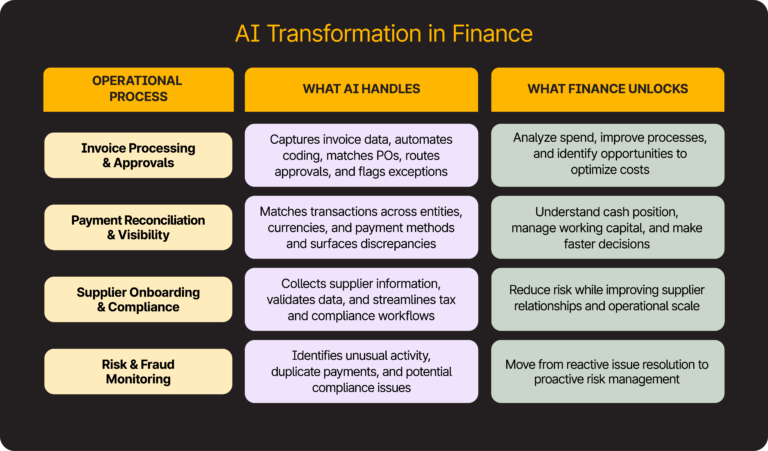
That’s the opportunity here. Yes,AI can manage the repetitive workflows that slow teams down (from invoice processing and approvals to reconciliation, supplier management, and fraud prevention), but the real value is what it enables finance teams to do next.
CFOs Should Rely on Curiosity, Not Convention
Future finance leaders won’t be defined by a traditional path. They’ll be the ones who see beyond the numbers—understanding how customers, technology, operations, and market conditions directly shape the business.
My unconventional career path has taught me that finance does not operate separately from the rest of the organization. The CFOs who will have the greatest impact in an AI-first world will be those who stay connected—to their customers, their teams, and the decisions impacting the company’s direction. They’ll be curious, willing to experiment, challenge assumptions, and rethink how work gets done.
My advice is to start here:
- Understand what your customers are actually experiencing. The best business decisions come from knowing real customer problems.
- Invest deeply in an AI transformation strategy. Focus not only on how AI improves your internal finance function, but also on how it helps develop the products and experiences your company delivers.
- Know that the best finance teams aren’t just financial stewards. They’re business stewards who understand how the company creates value.
The CFO role is changing once again, and my own journey proves there is no single blueprint for success. Sometimes, an unconventional path provides the exact perspective you need most.
