

 Back
Back 
In a high-growth finance organization, contractor and creator payments have become a real operational system. One that scales cleanly, reconciles accurately, and holds up under compliance scrutiny.
Today’s payee mix is more complex than ever: traditional corporate suppliers alongside a growing volume of freelancers, creators, and project-based specialists. And the “hybrid” reality introduces a real triple threat for finance teams: manual workload that slows execution, compliance gaps that increase risk, and fragmented processes that create bottlenecks at quarter-end and year-end.
With 64 million Americans now freelancing (that’s 38% of the workforce, according to Upwork), spreadsheet-based workflows and ad hoc payment approvals don’t just create inefficiency—they create exposure.
This guide provides a practical playbook for managing 1099 contractor payments at scale, with automation that supports stronger controls and cleaner reporting. By the end, you’ll know how to reinforce worker classification, automate W-9 collection and TIN matching, and build a streamlined global payment process that reduces effort for your team while improving compliance and audit readiness.
Key Takeaways
- Paying 1099 contractors requires more than sending payments; you need a clear process for onboarding, tax collection, and compliance.
- With strict IRS rules and rising penalties, collecting W-9s, validating TINs, and maintaining accurate records is non-negotiable. A proactive approach prevents costly filing errors.
- Many companies now manage both AP invoices and large-scale mass payouts, making unified automation essential.
- Automation tools, such as self-service onboarding, tax validation, and 1099 form automation, help eliminate manual work and reduce compliance risk. The payoff is faster, more accurate global contractor payments.
Independent Contractor vs. Employee: Why Classification Matters
Let’s start by clearing up a common misconception often found in search results and boardroom discussions: the term “1099 employee.” To be clear, a 1099 employee does not exist. You either hire employees, who receive a Form W-2 and enjoy legal benefits and protections, such as health benefits and retirement plans, or you engage self-employed independent contractors (usually referred to as 1099 workers).
| Category | 1099 Contractor (Independent Contractor) | W-2 Employee |
|---|---|---|
| IRS classification/relationship | Self-employed worker providing services under a contractor relationship | Employee working under employer direction and control |
| IRS form used to document tax information at onboarding | Form W-9 (payer collects name + address + TIN) | Form W-4 (employee provides withholding details) |
| Payment type | Contractor payments (project-based, hourly, retainer, milestone, etc.) | Wages / salary (regular payroll) |
| How the worker is paid | Paid through AP/vendor or mass payout workflows (often outside payroll) | Paid through payroll with withholding handled by employer |
| Tax withholding responsibility | Contractor is responsible for paying their own taxes (unless backup withholding applies) | Employer withholds taxes from each paycheck |
| Taxes typically withheld by payer | None by default; backup withholding (24%) may apply if TIN is missing/incorrect | Federal income tax withholding + Social Security + Medicare (and often state/local) |
| Payroll tax responsibility | Contractor pays self-employment taxes (Social Security + Medicare equivalents) | Employer pays its share of payroll taxes + employee portion withheld |
| Year-end tax reporting form issued by payer | Form 1099-NEC (for services; typical for contractor payments) | Form W-2 |
| Common tax reporting mistake to avoid | Misclassifying worker or using the wrong 1099 form (i.e., 1099-MISC instead of 1099-NEC for services) | Misclassification risk is lower, but errors often involve payroll withholding/reporting accuracy |
The IRS Test
The IRS uses three specific criteria (Behavioral, Financial, and Relationship control) to determine this worker classification. If you dictate exactly when a worker logs in, provide their laptop, and integrate them into your indefinite long-term plans, the IRS likely views them as W-2 employees, regardless of what your contract says.
How to Protect Your Business
Smart business owners and finance leaders build a defense before an audit happens. Under the “Safe Harbor” provisions of the Revenue Act of 1978, you can sometimes avoid penalties if you demonstrate a “reasonable basis” for treating workers as contractors.
The trick is documenting this justification at the time of hiring, not scrambling to find it years later. The stakes are tangible as unintentional penalties for misclassified workers can include 1.5% of wages plus 40% of the payroll taxes (including Social Security and Medicare) you failed to withhold.
What the IRS Requires for 1099 Contractor Payments
Before you issue a single dollar to a US-based contractor, you must collect a completed Form W-9. This form provides critical information, such as Name, Address, and TIN, that are required for year-end reporting. Treating this as a “nice-to-have” step that can wait until January can become a costly error.
Validating Data to Avoid “B-Notices”
Collecting a W-9 is just the starting point. Best-in-class AP teams know that validation is where risk is reduced and compliance is ensured. The IRS TIN Matching Program enables you to verify vendor names and TINs directly against IRS records.
Automated platforms can perform this check in real-time during the onboarding process. This prevents the dreaded CP2100A Notice, also known as a “B-Notice,” which alerts you that the IRS cannot match your payee data. Receiving this notice sometimes triggers a painful operational requirement for the payer to start backup withholding on future payments.
The Cost of Missing Data
If you pay a contractor who fails to furnish a correct TIN, you are legally required to begin backup withholding. This means you must withhold 24% of the payment and remit it directly to the IRS. If you fail to do this, your company becomes liable for that tax.
Understanding the Filing Thresholds
Once the tax year concludes at the end of the year, your reporting obligation kicks in if you have paid a contractor $600 or more in 2025, increasing to $2,000 in 2026. You must file 1099-NEC forms (Nonemployee Compensation) to report payments for these services.
Do not confuse this with Form 1099-MISC, which is reserved for non-service payments such as rent, royalties from music, publishing, software, or other intellectual property licensing, prizes and awards, and certain legal settlements. Keeping these buckets separate throughout the year saves your team from a chaotic manual sorting process in January.
Step-by-Step: How to Pay 1099 Contractors Efficiently
Efficiency is the difference between a finance team that drives strategy and one that just processes paperwork. To build a scalable process, you need to move away from ad-hoc emails and bank portal logins. Here are four critical steps for a streamlined payment cycle.
Step 1) Move Onboarding to a Self-Service Portal
Emailing PDF tax forms is a security risk and an operational bottleneck. Modern finance teams use a self-service onboarding portal where contractors securely enter their own bank details, contact information, and tax data. This removes manual data entry from AP, ensures required fields like TINs are captured upfront, and keeps the payment process moving without delays.
Step 2) Automate Verification and Screening
Once the data is in, validate it immediately. Beyond the TIN check, you must screen every payee against the Office of Foreign Assets Control (OFAC) Specially Designated Nationals (SDN) list. Paying a sanctioned individual can result in severe penalties. Automation enables this screening to run instantly in the background, flagging potential issues without slowing your workflow.
Step 3) Choose the Right Payment Method
You have several rails for moving money, each with a specific use case. Direct deposit (ACH) is the standard for domestic payments, offering reliability and low costs for any small business. Wire transfers are faster but come with a hidden “lifting fee” where intermediary banks deduct fees from the principal amount.
An emerging payment option is a virtual card. By paying vendors with a single-use virtual card number, you could extend your days payable outstanding (DPO) and potentially earn cash-back revenue on the spend. When evaluating the best ways to pay contractors, verify the pricing models of each method to balance speed against cost.
Step 4) Execute and Sync to Your ERP
When it’s time to pay 1099 contractors, do not log in to a bank portal to manually key in transfers. This creates a data silo. Instead, use a payment automation platform that pushes the payment instructions to the bank and simultaneously writes the reconciliation data back to your ERP.
This ensures your general ledger is always up to date and accelerates your month-end close.
Deliver a First-Class Global Payouts Experience
Pay vendors, contractors, and partners worldwide with less manual work and fewer compliance risks. Get practical guidance for streamlining onboarding, tax form collection, and global payouts at scale.
Best Practices to Stay Compliant and Avoid Penalties
Compliance is a moving target. Sanctions lists change daily, and tax regulations evolve every year. To protect your business from fines and fraud, it is essential to embed active risk mitigation into your daily operations. Follow these best practices to maintain a secure payment process as you scale.
Screen Before Every Payment, Not Just Once
Many companies screen for sanctions only when they first hire a contractor. This is a critical gap. Sanctions lists change daily. An automated system should re-screen your entire payee database against the OFAC SDN list before every single payment run.
Build a Digital Audit Trail
In an audit, if it isn’t documented, it didn’t happen. You need more than just the payment receipt or a written contract. You need a digital audit trail that logs metadata for every action.
Examples include who approved the payment terms, the payment schedule (whether hourly or a retainer), and when the W-9 was collected. This data proves commercial reasonableness and shows you took every step to verify the payee’s identity.
Separate the Roles to Prevent Fraud
Internal fraud often happens when one person has too much control. Enforce a strict segregation of duties. The person who adds a new contractor to your Vendor Master File should never be the same person who approves the payment. Modern software enforces this by requiring distinct user roles and approval workflows.
Stop Emailing Sensitive Tax Data
Requesting a W-9 via email places a Social Security Number (SSN) directly into an unencrypted inbox. This creates a major data security vulnerability. Since contractors are responsible for their own taxes, like filing their own tax return and paying income tax (including federal income tax, self-employment taxes, and local taxes), protecting their identity is a number one priority.
Move this process to a secure, encrypted portal, similar to how you would manage payroll software, where the data is entered directly by the contractor.
Streamlining 1099 Payments with Automation
One common efficiency challenge for digital businesses is the “hybrid” workflow—where invoice-based payments are managed in an ERP while creator or affiliate payouts are handled in a separate mass-pay tool.
This fragmentation can increase operational workload and split your data across systems. A more scalable approach is a “Payment Hub” strategy.
Consolidate to a Single Payment Hub
By consolidating both AP invoices and mass payments into a single automated system, you create a unified source of truth for 1099 payments. This applies whether the payee is a corporate vendor or a freelance designer.
Hybrid AP and Mass Payments in Action
- The scenario: Your finance team pays invoice-based vendors through AP and issues high-volume, non-invoiced payouts to contractors, creators, or affiliates.
- The challenge: AP tools are designed for invoice workflows, while mass payment tools may lack tax, compliance, and audit controls. Managing both can create duplicate work, fragmented data, and compliance risk.
- The solution: A unified payment hub that supports both AP and mass payments, with shared onboarding, tax validation, approval workflows, and ERP reconciliation.
- The result: One system of record for 1099 payments—whether they’re tied to an invoice or generated through self-billing—without switching tools, re-entering data, or compromising compliance.
The Power of Self-Billing
For AdTech companies or marketplaces operating in the gig economy, waiting for thousands of partners to send PDF invoices isn’t always practical. Automation enables a “self-billing” workflow (often referred to as evaluated receipt settlement), where your system generates the invoice on behalf of the payee based on performance data (ad impressions, clicks, or sales).
Tipalti can ingest a simple payment instruction file from your backend to trigger these payments, reducing invoice processing effort while still supporting the tax records needed for 1099 reporting.
Turn AP Into a Revenue Generator
AP automation can do more than reduce manual work—it can also improve payment economics. By offering virtual card payments to eligible domestic payees, businesses may earn rebates on spend while maintaining control and visibility.
For teams with significant contractor volume, this benefit can help offset the operational costs of running an efficient payment process.
With payment workflows centralized, the next step is ensuring your reporting and filing process stays just as streamlined—especially when it’s time to generate and deliver thousands of 1099 forms.
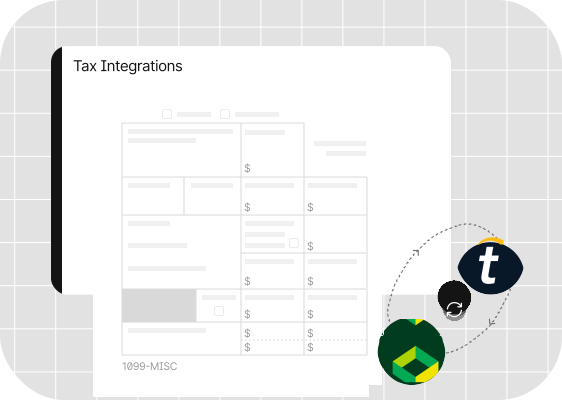
Streamline 1099 E-Filing with Tipalti’s Zenwork Tax1099 Integration
Even with clean payee data and consolidated payment workflows, year-end filing can still become a bottleneck if teams are relying on manual exports, spreadsheet formatting, and repeated uploads.
To reduce that friction, Tipalti recently launched a native integration with Zenwork Tax1099, enabling finance teams to streamline 1099 e-filing and recipient delivery using validated payee and payment data flowing directly from Tipalti into Zenwork. This helps minimize CSV rework, reduce filing errors, and accelerate year-end reporting with stronger accuracy and control.
Handling Mass 1099 Contractor Payouts Across Countries
The moment you hire outside the US, the rules change. A common compliance failure is sending a 1099 to a foreign contractor, or worse, failing to collect the necessary W-8 form. Manual processes rely on your AP team to recognize individuals.
The W-9 vs. W-8 Decision Engine
Automation solves this by incorporating tax logic into the onboarding flow. The system asks the contractor a series of questions (where they live, where they pay taxes) and automatically presents the correct form (W-9, W-8BEN, or W-8BEN-E). This ensures that you capture the right data without requiring your team to intervene.
Pay in Local Currency to Avoid Hidden Costs
Your international contractors likely want to be paid in their local currency, but wire transfers are expensive. Banks often charge high fees and offer poor exchange rates. A mass payment platform enables you to utilize Global ACH (local bank transfers) to pay thousands of contractors in their own currency, leveraging local payment rails.
This avoids the fees associated with wire transfers and provides a transparent FX rate, keeping your contractors happy and your costs down, which is crucial for affiliate and influencer solutions where margins matter.
Managing the “Hybrid” Reality
For any forward-thinking finance leader, the goal is a unified view of the organization. You need a system that can handle a 1099-NEC for a designer in New York and a tax-compliant payout for a developer in Ukraine in the same payment run.
By centralizing these diverse workflows, you eliminate the risk of managing multiple banking portals and navigating conflicting international tax regulations on spreadsheets.
Final Tips for Year-End 1099 Filing
January is the ultimate stress test for your AP process. If you have maintained clean data throughout the year, tax season is a simple export. If not, it becomes a frantic accounting project. These final tips will help ensure your year-end reporting is accurate, timely, and drama-free, keeping you off the IRS radar.
The End of Paper Filing
The IRS has fundamentally changed the game by lowering the electronic filing threshold to just 10 returns. If you have a combined total of 10 or more information returns (including W-2s and 1099s), you are now required to file electronically.
If you are still relying on paper forms or manual mailing processes, you are likely already non-compliant and need to transition to a digital solution immediately.
Watch the Calendar
Mark January 31st on your calendar, as this is the hard deadline for filing Form 1099-NEC with the IRS and furnishing it to your contractors. Missing this date triggers automatic penalties that escalate the longer you wait.
Compliance is a Year-Round Habit
Ultimately, successful contractor tax compliance is not a panic-ridden event that happens in January. It is a continuous, year-round workflow that begins the moment a contractor is onboarded.
By maintaining clean data and valid W-9s throughout the year, year-end filing becomes a simple export rather than a gruelling accounting project.
Streamline 1099 Contractor Payments with Tipalti
Paying 1099 contractors efficiently requires a fundamental shift from manual spreadsheets to automated governance. You cannot scale today’s hybrid workforce on the back of bank portals and email chains.
By centralizing your domestic and international payouts into a single system, you protect your organization from compliance risks while providing your partners with the fast and transparent payment experience they expect. It is time to stop managing payments and start managing strategy.
Explore Tipalti Mass Payments today to make efficient contractor payments a reality for your business.