

Finance teams have been bombarded with glossy pitches detailing the AI revolution—utopian visions where autonomous algorithms effortlessly steer multinational enterprises into hyper-efficient, perfectly optimized futures.
The excitement is understandable. The potential is real. But talk to any finance director managing an EMEA or global footprint today, and the reality looks a bit different.
Global finance is not a clean digital playground. It’s a complex operating environment shaped by volatile foreign exchange markets, fragmented banking rails, shifting regulatory requirements, and countless local processes that don’t always fit neatly together.
In this environment, the popular AI challenges we know about (like inaccurate outputs or hallucinations) are not just technical imperfections. They’re operational risks.
This is why the conversation around agentic AI needs to move beyond the hype. The real opportunity is not creating fully independent systems that run finance without oversight. It’s implementing technology that can execute predictable, multi-step workflows while operating within the controls finance teams already depend on.
Key Takeaways
- While early generative AI merely summarized or analyzed information, agentic AI connects directly with financial infrastructure to smoothly execute multi-step workflows across separate global systems.
- Trust in AI requires clear logic, strict governance, and visibility, meaning the technology must be embedded within existing international compliance rules and approval thresholds.
- To effectively manage the growing complexities of cross-border operations, such as FX volatility and global tax regulations, agentic capabilities must be built directly into current finance platforms rather than acting as a separate layer.
Moving Past the Chatbot: What Makes AI Actually Agentic?
The first wave of generative AI introduced finance teams to tools that could summarize documents, analyze information, and draft communications in seconds.
Useful? Absolutely.
But these tools are still largely waiting for instructions. They respond to a prompt, generate an output, and hand the next step back to a person.
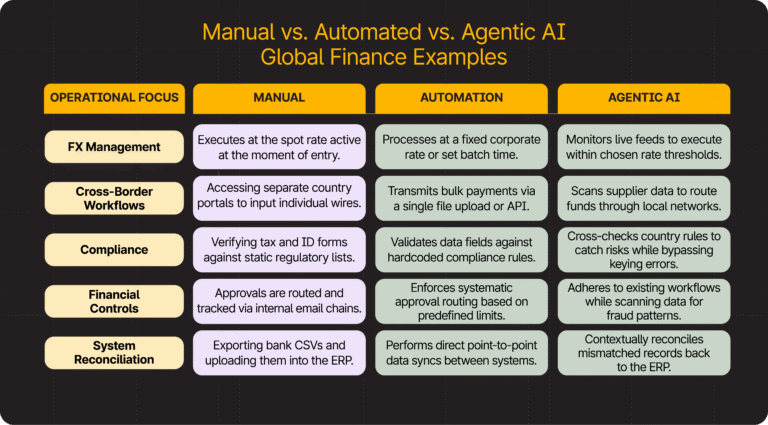
Agentic AI changes the equation. Rather than simply generating information, agentic systems are designed to interact directly with the technology infrastructure that keeps businesses running. They can connect workflows across finance systems, payment platforms, treasury tools, and compliance processes to execute a sequence of actions based on defined conditions.
Imagine a system that identifies a transaction in a local ledger, checks whether it meets specific criteria, calculates a variance, updates the appropriate record, and routes the issue for human review only when something falls outside the expected parameters.
Far from replacing humans, this approach simply frees them from acting as that manual bridge between disconnected systems.
Today, many global finance teams still spend significant time exporting files, reconciling spreadsheets, checking regulatory requirements, and moving information between platforms. Agentic AI aims to take on those repetitive, predictable steps—while keeping humans firmly in control of the decisions that require experience and judgment.
AI Trust Requires Logic, Not Blind Confidence
The biggest barrier to AI adoption in finance is not a lack of imagination. It’s trust.
Finance leaders are comfortable with technology when they understand the rules behind it. What creates hesitation is uncertainty: How was a decision made? What data influenced it? Can the process be reviewed and audited?
For agentic AI to work in global finance, it needs to follow clear logic that aligns with the controls finance teams have spent years building. Approval thresholds, segregation of duties, and role-based access should not be optional settings. They should be directly embedded into how the AI operates.
Industry research reflects this need for more control. The State of AI in Finance report found that finance professionals are looking for stronger governance frameworks (52%), clearer accountability for AI decisions (47%), and improved data lineage and quality controls (45%) to close the AI trust gap. Additionally, 55% said it’s extremely important to be able to see and review the actions AI takes rather than letting it operate completely autonomously.
Future adoption of agentic AI in global finance will not be built on blind confidence. It will be built on systems that operate with clear logic and guardrails—giving finance teams the visibility and control they need to trust in the technology.
Why AI Can’t Be Another Tool Sitting on the Sidelines
It’s no secret that global finance teams operate with little room for error.
A failed international payment, an incorrect tax treatment, or an overlooked compliance requirement can create severe financial and operational consequences. As companies expand into new markets, these challenges only increase.
The Global Finance Outlook study highlights this growing complexity. Among those surveyed, 55% reported that their role requires more cross-border collaboration than in previous years, while another 55% say they are spending significantly more time focused on international business. At the same time, 72% are struggling to keep up with evolving international tax regulations, 68% find global supplier management difficult, and 63% say currency management and foreign exchange fluctuations are becoming even more challenging.
This is why finance leaders are unlikely to adopt agentic AI as a disconnected experiment.
The practical path forward is technology that’s already embedded into the platforms finance teams depend on. AI should not become another layer of complexity requiring separate integrations, additional controls, and more manual oversight.
When agentic capabilities are built into existing finance infrastructure, they can operate within the context of the systems already in place—understanding workflows, data structures, compliance requirements, and approval processes from the start. The result is a more controlled approach: intelligence working inside the operating environment, rather than outside of it.
The Agentic World
The future of global finance does not belong to unconstrained decision-making, nor does it belong to teams clinging strictly to rigid legacy systems out of fear.
The truth is much more practical: a dual-engine operation that pairs the ironclad, predictable guardrails of traditional finance with the flexible, context-aware reasoning of agentic AI. This is the actual reality our teams are experiencing—one where the real story is better than the hype.
