

 Back
Back 
While automation is common in finance, manual exceptions and complex workflows often continue to require significant human oversight. True efficiency comes from automation that can adapt, decide, and scale intelligently.
This is where the next wave of finance operations begins: agentic artificial intelligence (AI). Unlike rule-based automation, agentic AI introduces autonomous, goal-driven agents that can sense, reason, and take action within financial workflows.
This guide provides a practical introduction to understanding what AI agents are, how they are already transforming core processes such as accounts payable and procurement, and what this shift means for finance teams.
With Gartner predicting that 33% of enterprise software will include agentic AI by 2028, understanding how these capabilities fit into finance operations is becoming increasingly important.
Key Takeaways
- An AI agent is far more than just automation. It’s an autonomous, goal-oriented tool that can perceive its environment, make decisions, and take independent actions within your financial workflows.
- Unlike rigid RPA “bots” that follow a script, an AI agent is adaptive. You give it a goal, such as “process this invoice,” and it determines the best sequence of actions to achieve it, even when faced with new formats or exceptions.
- The primary benefits of using AI agents in your finance operations are a dramatic increase in speed by accelerating the financial close, improved accuracy by reducing human error, and greater scalability by allowing you to handle business growth without a proportional increase in headcount.
- The true value and security of this technology come from AI agents that are embedded directly into your core financial system, not from standalone chatbots, ensuring every action operates within your established controls and audit trails.
What Are AI Agents in Finance?
You’ve likely heard the term “AI agent” gaining traction, but what AI agents mean for your finance department is far more specific than the general hype suggests. Think of an AI agent in finance not as a simple chatbot or a rigid bot, but as an autonomous, goal-oriented digital team member.
It’s a piece of software designed to understand the desired outcome, reason through the steps needed to achieve it, and then take independent actions within your financial systems to accomplish it.
The Agent’s Brain
To truly understand what makes an agent distinct, you need to examine its three core components. First is its brain: a specialized language model. Unlike general large language models (LLMs) that just read the internet, think of it as an AI that went to accounting school.
These specialized AI models have been fine-tuned on millions of financial documents, including invoices, purchase orders, and tax forms, enabling them to understand the unique context of a finance department with a high degree of accuracy.
The Agent’s Senses
Next are its eyes and ears: a perception module. This is the agent’s technical ability to ingest and interpret unstructured information from the real world. It can read a PDF invoice attached to an email, understand a scanned image of a paper receipt, or pull financial data from a supplier’s portal, sensing and digitizing the information your team needs to work with.
The Agent’s Hands
Lastly, an agent has a secure set of hands: an action module. This is a pre-defined and secure set of tools that the agent is allowed to use. These are specific functions such as “Create a Draft Bill,” “Flag for Review” or “Initiate a Three-Way Match.”
For CFOs and finance teams, this evolution is significant because it represents a fundamental shift, from automation that merely follows a script to an intelligent system that can manage entire workflows.
How Finance Teams Use AI Agents in Practice

To move from the abstract concept to the real world, it’s helpful to use a simple framework for how an agentic AI in finance operates: it can sense, think, and act. The process is a logical sequence that mirrors how a human would approach a task. This is one of the core agentic AI applications in the finance sector.
Sense: The Starting Point of Automation
First, an agent must perceive its environment and recognize a trigger. This “Sense” phase is where the automation begins. For your AP team, this could be an Invoice Capture Agent continuously monitoring your dedicated AP email inbox, using APIs to connect to other data sources.
It not only sees a new email but also senses a PDF attachment, recognizing it as a potential invoice that needs to be processed.

Think: From Raw Data to Intelligent Decision
Once the agent has sensed the invoice, it moves into the “Think” phase. It reads the unstructured PDF, identifies the vendor, and extracts the key data points: invoice number, due date, and line-item details.
Based on historical data, the agent can predict the correct GL code for the expense. It also identifies a purchase order number on the invoice and prepares to take the next logical step, generating clear outputs for the system to use.
Act: Taking Secure and Autonomous Action
Finally, the agent takes a secure, autonomous “Act.” It creates a draft bill within your AP system, pre-populating all the fields it just extracted. It then initiates a three-way match between the open purchase order and receipt data, performing an automated validation.
Because the match is accurate, the system automatically routes the invoice to the designated approver—no manual intervention required.
AI Agents in Action
This Sense–Think–Act cycle applies across numerous workflows, allowing agents to handle a variety of tasks that once required arduous human effort. The chart below provides a few clear examples of these agentic AI use cases in finance, breaking down how they work and the value they deliver for modern financial institutions.
| Finance Workflow | Scenario | AI Agent | AI Agent in Action |
|---|---|---|---|
| Accounts Payable | An invoice PDF arrives in the AP team’s email inbox | Invoice Capture & PO Matching Agent | Auto-extracts invoice data, predicts the GL code, matches line items against the open PO and routes the bill for approval |
| Supplier Compliance | A new supplier submits a W-8BEN form during onboarding | Tax Compliance Agent | Scans the tax form, extracts the Taxpayer Identification Number (TIN) and validates its format against IRS rules to ensure compliance |
| Procurement | An employee sends a vague email requesting new equipment | Purchase Request Agent | Uses natural language processing to identify the item and urgency, then auto-generates a structured purchase requisition for approval |
| Financial Reporting | The finance leader needs an immediate spend breakdown | Reporting Agent | Interprets a natural language query like “Show me last month’s marketing spend by vendor” and instantly generates the report from live ERP data |
Taken together, these use cases show how agentic AI shifts finance operations from manual task execution to intelligent workflow orchestration. Instead of reacting to exceptions, finance teams gain systems that proactively handle complexity at scale.
What AI Agents Actually Do in Finance Operations
Beyond the hype, AI agents are being used to automate approvals, flag anomalies, and manage workflows. Learn how finance teams are putting them into practice across core financial processes.
The Benefits of AI Agents in Finance
Understanding how AI systems work is important, but for you and your finance team, the real question is: what impact will they have on your business? The value of agentic AI applications in finance is not only incremental efficiency but also the fundamental transformation of the speed, accuracy, and strategic capacity of your entire finance function.
The benefits of AI agents in finance teams can be grouped into four key areas.
1. Speed in Financial Workflows
The most immediate benefit you’ll experience is a dramatic increase in speed. When an agent can process an invoice in seconds instead of minutes, that time savings is multiplied across thousands of transactions.
This acceleration directly impacts your ability to close the books more quickly, obtain approvals in hours instead of days, and onboard new suppliers without delay, ultimately leading to faster decision-making throughout the business.
2. Accuracy in Compliance
AI-driven agents are designed for precision and consistency. By automating data entry, GL coding, and PO matching, they virtually eliminate the human errors that can lead to costly overpayments or duplicate payments.
Strategically, this level of accuracy strengthens your financial controls and regulatory compliance, creating a clear, consistent, and fully auditable trail for every transaction.
3. Visibility in Reporting
Examining recent historical data is vital, but true financial visibility must also encompass a detailed understanding of current events. Because AI agents process and reconcile data in real-time, they give you an up-to-the-minute view of your company’s financial position.
This enables your team to transition from reactive data gatherers to proactive strategic advisors, providing on-demand financial analysis to support informed business decisions.
4. Scalability Without the Increased Headcount
This is perhaps the most powerful benefit for a growing company. A manual AP process scales linearly: as your invoice volume doubles, so does the workload. AI agents break this relationship.
They can handle a significant increase in transaction volume without a proportional increase in your finance team’s headcount, allowing your business to optimize its resources and grow globally without being constrained by back-office capacity. This also improves the customer experience, as suppliers are paid more quickly and accurately.
Pro Tip: See how AI is reshaping accounting with faster closes, smarter controls, and strategic insights.
Why Agentic AI Is Different
To understand how AI agents differ in finance, it helps to distinguish them from more familiar technologies. While terms like “bots” and “AI” are widely used across financial services, agentic AI goes beyond earlier, rules-based approaches such as Robotic Process Automation (RPA) and basic chatbots, enabling more adaptive and autonomous workflows.
Beyond RPA
Think of a traditional RPA “bot” as a highly specific macro or a brittle script. You program it to follow a very rigid set of on-screen steps: “Click this button, copy text, paste text.” It is effective for simple and repetitive tasks, but its weakness is its lack of adaptability. If a website’s layout changes, the RPA script breaks.
An AI agent is fundamentally different. You don’t give it a script; you give it a goal, such as “process this invoice.” The agent then uses machine learning and autonomously determines the best sequence of actions to achieve that goal, adapting to new formats and exceptions rather than simply failing.
Beyond Chatbots
You may also be familiar with chatbots, which are excellent tools for customer support. A chatbot can answer a question like “What is the status of invoice #123?” with a text-based response. The rise of generative AI and GenAI like ChatGPT has made these conversations more fluid, but they remain informational tools.
An embedded AI agent, however, is a workflow tool that takes action. Its AI-powered capabilities might not only tell you the status but also add, “Invoice #123 has a price mismatch. Would you like me to flag it for the vendor?” It moves beyond conversation to autonomously drive the workflow forward, a key differentiator for financial services.
We’re not replacing people. We’re redefining what’s possible when humans and AI agents work together in finance.
Tipalti CPTO
Tipalti’s AI Agent Ecosystem
The real power of AI agents emerges when they’re embedded directly into your financial operations. Tipalti’s embedded agentic AI ecosystem is purpose-built for finance, ensuring each agent acts within your audit controls, permissions, and compliance frameworks.

Accounts Payable Agents
- Invoice Capture Agent: Cuts manual coding time with AI invoice automation that extracts invoice data and fills fields instantly.
- PO Matching Agent: Automatically analyzes contextual descriptions to match invoices with POs, reducing the burden of manual matching.
- Tax Form Scan Agent: Accelerates supplier onboarding by extracting W-9 and W-8 data, validating compliance against IRS rules.
Expense and ERP Agents
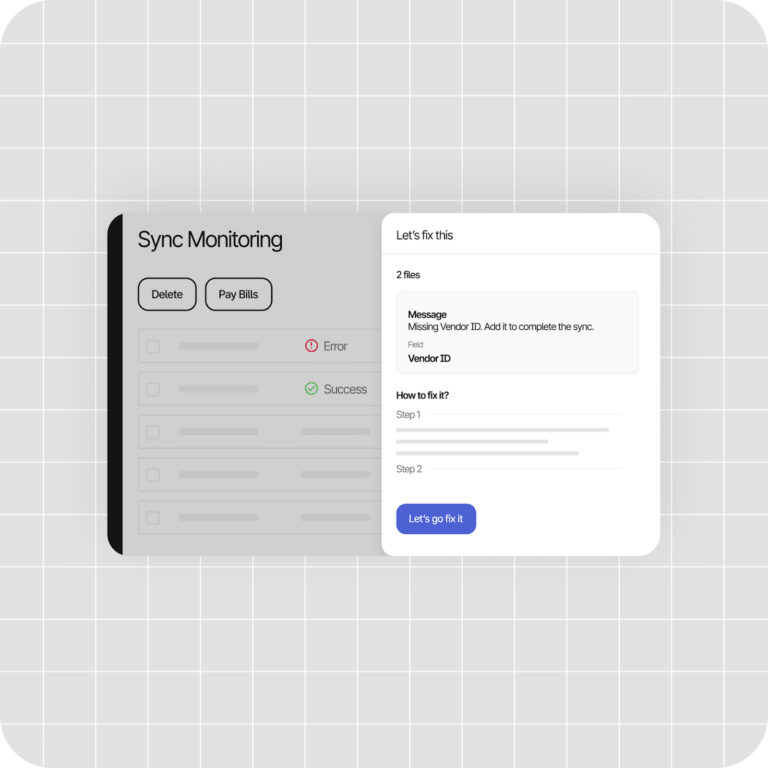
- Expense Receipt Scan Agent: Captures employee expenses from images or receipts and auto-fills fields to speed up expense reporting.
- ERP Sync Resolution Agent: Diagnoses sync failures between Tipalti and ERP/accounting systems and guides quick resolution.
Procurement and Reporting Agents
- Purchase Request Agent: Translates unstructured requests (email, Slack) into structured, approvable purchase requisitions.
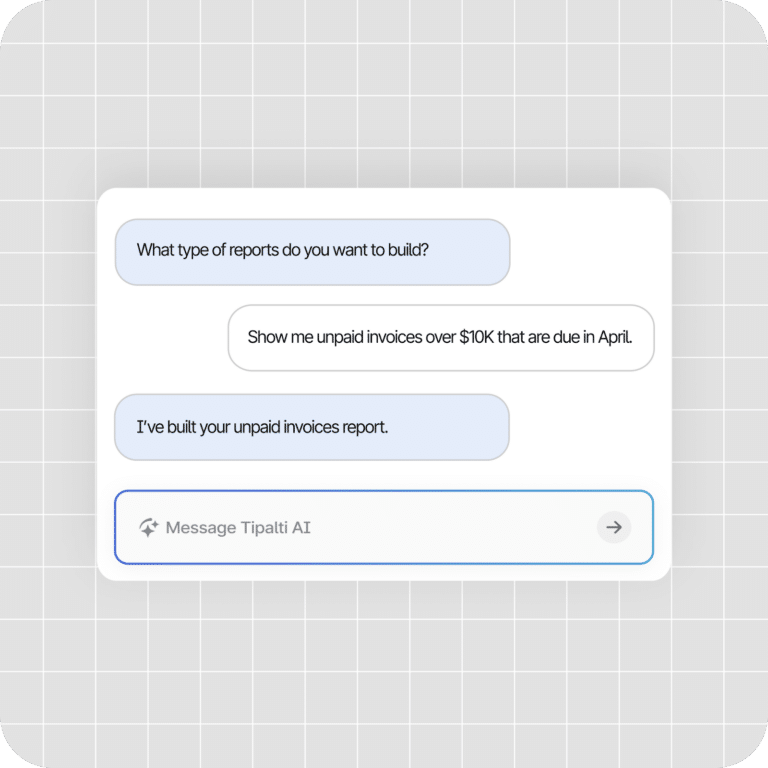
- Reporting Agent (Beta): Answers questions like “What was our Q1 marketing spend?” using natural language, returning real-time results from live ERP data.
- Conversational AI Assistant (Beta): An interactive command center that lets users direct agents or query spend data with plain language.
Pro Tip: See how AI is transforming procurement in The Complete Guide to Artificial Intelligence in Procurement.
These agents work as a unified system rather than isolated automations. By embedding agentic AI directly across accounts payable, procurement, expense management, and reporting, Tipalti enables finance teams to move from task-level automation to true workflow autonomy, while ensuring every action remains governed by built-in controls, compliance requirements, and a complete audit trail.
Create Autonomous Workflows with Agentic AI in Finance
The conversation in your department is about to shift from “automation,” which focuses on doing tasks faster, to “autonomy,” which focuses on handling entire workflows intelligently. For you, as a finance leader, this isn’t a choice between software features. It’s a choice between two operating models for your department.
Your primary mandate is to support the company’s growth without increasing your team’s size in proportion. AI agents in finance and accounting are the key to breaking this linear relationship, enabling you to absorb a massive increase in transaction volume with minimal additional headcount.
This technology is now being embedded in leading finance platforms, and your competitors are likely already using it to close their books faster and make smarter decisions.
Explore Tipalti’s Finance AI Assistant to see how embedded AI agents can transform your finance workflows today.
AI Agents in Finance FAQs
What is an example of an AI agent in finance?
A great real-world example is an Invoice Capture Agent. It monitors an email inbox, reads a new PDF invoice, extracts key data such as vendor and amount, and automatically creates a draft bill in your accounting system without any human intervention.
How are AI agents used in accounting?
In accounting, agents automate complex tasks like GL coding predictions, invoice-to-PO matching, and real-time reconciliation. They can also assist with the financial close by identifying anomalies in journal entries, significantly speeding up the process.
Are AI agents secure?
Security depends on the implementation. Standalone agents can pose risks, but embedded agents within a secure SOC-compliant finance platform like Tipalti are designed to be safe. They operate within your established financial controls, user permissions, and a detailed audit trail.
How do they differ from automation or chatbots?
Traditional automation, like RPA, follows a rigid script. An AI agent is adaptive and goal-oriented. A chatbot is a conversational tool that can answer a question, whereas an embedded AI agent is a workflow tool that can take action.