

Modern marketplaces have evolved from online stores into complex financial ecosystems responsible for payments, compliance, and global seller operations. While some look to the coming years for advancements in financial infrastructure, this foundation is already a reality for high-growth platforms. Modern digital marketplaces are multi-sided online businesses that bring together product sellers, creatives, service providers, buyers, and other participants, such as hirers or donors.
All types of marketplaces, e-commerce, business, services (and more) have one thing in common: they’re expanding rapidly due to consumer behavior. Digital convenience is a major reason why live shopping dwindled, online shopping exploded, and business marketplaces, like Amazon Business, grew so quickly. More than a third (35%) of finance professionals we surveyed for The Global Finance Outlook said their business priorities are becoming increasingly global in scope, with plans to expand in the next 12–24 months.
AI-Powered Ecosystems
Rapid expansion changed functionality across all types of digital marketplaces. Now they function as AI-powered financial ecosystems that manage seller onboarding, payouts, compliance, and global payments at scale. Key drivers are:
- Intelligent Infrastructure: AI automates critical front-end and back-end operations, including product matching (understanding semantic and visual similarities), dynamic pricing (adjusting in real time based on demand), and fraud detection (flagging behavioral anomalies).
- Global Expansion: AI handles cross-border payments, localization, and tax compliance. Expansion without compliance automation exposes the marketplace to regulatory penalties.
- Embedded Finance: Platforms have evolved from simple payment APIs into financial hubs, integrating services such as lending and insurance.
- Regulatory Complexity: Marketplaces navigate a fragmented landscape of global and local laws. Automating compliance is the only way to keep pace with increasingly complex, fast-changing regulatory shifts.
- New Monetization Strategies: Innovation drives new revenue streams, such as charging for fulfillment services.
In this article, we will explore the marketplace trends to watch in 2026 and beyond.
Trend #1: AI-Driven Marketplace Operations
Autonomy is Out, Auditable is In
AI is not creating a new type of failure. It is simply revealing the limits of systems built for lower volume and more stable conditions. Because of this system volatility, the market is experiencing a massive behavioral shift, where autonomous AI is out, and auditable AI is in.
According to Tipalti research, business and finance leaders are actively rejecting black box automation: In a study of 30 finance professionals, 14 out of 15 senior leaders rated explainability, the ability to drill down into model logic and see confidence scores, as an absolute, non-negotiable requirement.
When AI moves fast, humans refuse to be left out of the loop. To scale marketplaces safely, platforms must move away from the anxiety of replacing humans with autonomous agents, and instead embrace the framework of an AI teammate–providing automation, but with 100% human control.
When Operations Don’t Match AI Speed
AI now influences how marketplaces match products, set prices, evaluate sellers, and detect fraud. While the immediate benefit is increased efficiency, the long-term impact is a continuous growth in transaction activity and diversity.
AI increases transaction volume and accelerates pricing changes. Higher transaction volume directly drives increased payout volume, and fluctuations in pricing and promotions generate more exceptions that require reconciliation. As a result, systems designed for predictable flows are now forced to operate under changing conditions throughout the day.
The strain manifests as a series of small inconsistencies. Reconciliation begins to fall behind transaction volume. Payment timing becomes less predictable. Exceptions require manual review because the system cannot resolve them automatically.
Improved conversion rates add another layer. As transactions close more quickly, the time between transaction and settlement narrows while operational buffers that once absorbed delays disappear. And when an issue occurs, it surfaces immediately, often impacting downstream processes before it can be contained.
What is Changing
Marketplace data is prime for AI optimization. Platforms that fail to operationalize AI across business areas such as pricing, fraud, and seller performance will struggle to scale efficiently. Today, trust and governance have become the primary gates to adoption, meaning these optimizations must include visible guardrails:
- Product matching: AI-powered product matching automatically links identical or similar products across different retailers, catalogs, and databases.
- Dynamic Pricing: AI adjusts prices in real time based on demand, competition, and inventory. Better matching and pricing increases conversions and order value, but requires transparent tracking to prevent reconciliation nightmares.
- Fraud Detection: AI flags anomalies based on behavioral and transactional patterns. Real-time fraud detection reduces risk for buyers and sellers, but the models must be highly trainable by controllers to avoid blocking legitimate transactions.
- Seller Performance Monitoring: AI scores sellers on quality, delivery, and reliability.
- Customer Experience Automation: AI is critical for enhancing the user experience by reducing search abandonment and streamlining operations, enabling faster, more personalized interactions that increase customer retention.
- The Guardrail Layer (Shadow Mode): To unlock true scale, marketplaces are adopting a ‘see-and-review’ layer. A Tipalti-commissioned study of 500 finance pros found that 55% ranked the ability to review AI actions before finalizing as their #1 trust attribute. Platforms are implementing Shadow Mode protocols in which AI simulates and demonstrates its accuracy before taking over live operational workflows.
Why it matters
- Marketplaces rely on data-heavy interactions, making them ideal for AI optimization.
- AI improves trust, personalization, and operational efficiency, but trust and governance are the ultimate performance metrics.
- Agentic velocity without a visible guardrail is a conversion killer. True marketplace scale belongs to the platforms that can operationalize trust.
How Marketplaces Should Prepare
They need to invest in AI that is connected, trusted, and actionable. The key focus areas are:
- Unify Data Sources: Connect payments, user behavior, listings, and support data to power models.
- Real-Time Decisioning: Prioritize tools that score risk, pricing, and instant matching.
- Human-in-the-Loop combined with AI Moderation: Use AI to flag, but humans handle edge cases and train models.
- Adaptive Fraud Models: Use AI to continuously learn attack patterns instead of static rules.
- Operationalize Insights: Turn model outputs into actions to mitigate risk and provide support.
- Build Feedback Loops: Teams need to build confidence in AI-driven decisions, so feed outcomes back into models to boost accuracy.
Trend #2: Rapid Expansion of Online B2B Marketplaces
B2B marketplaces are among the fastest-growing segments of e-commerce. Online marketplaces are rapidly expanding into the B2B sector.
This growth spans platforms for wholesale sourcing, manufacturing, logistics, and professional services, like legal advice or graphic design. Companies can streamline procurement, compare vendors, and even prioritize sustainability or ethical sourcing in one place.
What is Changing
Like individual consumers, businesses increasingly prefer digital procurement channels. Right now, B2B e-commerce is expected to exceed B2C e-commerce in volume. But this shift introduces much more complex financial workflows.
How Marketplaces Should Prepare
There’s operational complexity that comes with scaling a B2B marketplace. Build infrastructure for:
- Bulk Transactions: Support tiered pricing, negotiated contracts, and simple checkout processes.
- Multi-Party Payments: Split payments across vendors and partners while maintaining compliance and clear tracking.
- Complex Invoicing Workflows: Streamline accounts payable processes by managing approvals, net terms, and reconciliations across multiple entities.
- Global Supplier Onboarding: Streamline identity verification, tax documentation, and regulatory checks across regions.
- Leverage Specialized Payment Platforms: Use a purpose-built freelancer and gig economy payment platform to automate high-volume onboarding and ensure a consistent experience across digital touchpoints.
Trend #3: Embedded Payments and Marketplace Payout Infrastructure
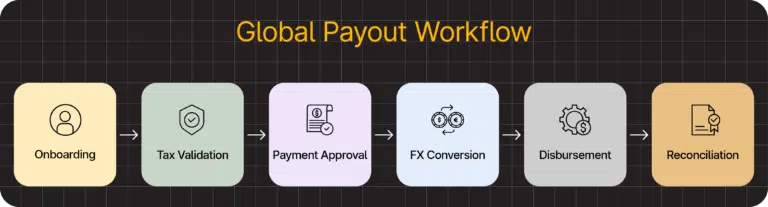
As marketplaces mature, payout infrastructure moves beyond the back office to become a critical driver of seller retention. Payment infrastructure now includes:
- Embedded Payments: Integrate payments into the platform to control the entire transaction experience.
- Payouts in Real Time: Make faster payments to global partners to improve supplier satisfaction.
- Multi-Currency Settlement: Support multiple currencies to reduce friction in cross-border transactions.
- Automated Revenue Splits: Handle complex, multi-party transactions by automatically distributing funds to the right parties.
What is Changing
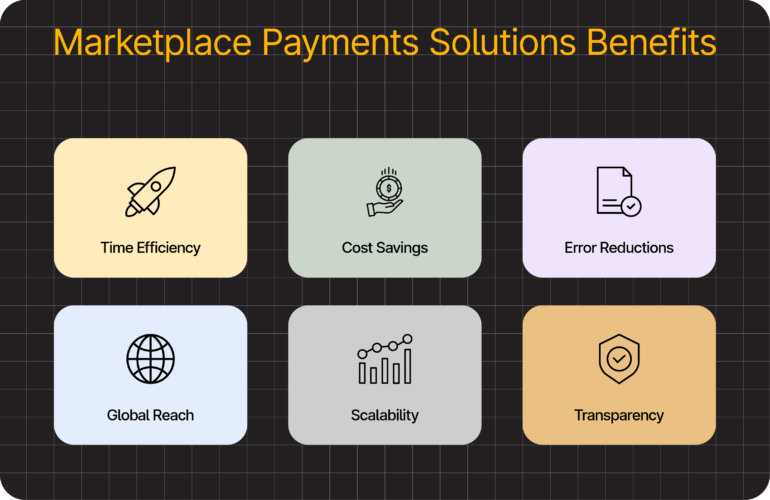
Smooth, reliable payouts are key to scaling. Platforms that streamline global payments and automate payouts improve the payee experience, which helps retain sellers.
How Marketplaces Should Prepare
To manage fast-growing seller ecosystems, marketplaces must invest in financial automation that seamlessly integrates into their tech stack. This turns complex global payouts processes into smooth workflows that upgrade the payee experience, automate tax compliance, and scale as the business grows. A scalable payout infrastructure supports:
- Mass Payouts: Process high-volume global payouts efficiently with automated workflows that reduce manual effort and support scale.
- Tax Compliance: Automate tax form collection, validation, and reporting to meet regulatory requirements across jurisdictions.
- Global Payment Methods: Support multiple currencies and localized payment options.
- Automated Reconciliation: Reconcile transactions, fees, refunds, and seller payouts in one system for audit readiness.
Marketplace Growth Requires More Than Transactions
Learn how leading marketplaces streamline payouts, onboarding, compliance, and financial operations as they scale.
Trend #4. Regulatory Pressure and Compliance Complexity
The global e-commerce landscape is facing growing regulatory pressure across payments, tax reporting, and seller verification. Governments are expanding oversight, requiring platforms to take greater responsibility for financial compliance across their seller ecosystems. What was once a back-office function is now a core part of marketplace infrastructure.
This is a significant shift in operational complexity, especially for platforms managing global marketplace payments and multi-party transactions.
What is Changing
As regulatory requirements expand, marketplaces are increasingly liable for ensuring seller compliance. Failure to meet these requirements can result in financial penalties, delayed payouts, and restrictions that limit growth.
How Marketplaces Should Prepare
- Automate Tax Compliance: Collect, validate, and manage tax forms (such as W-9 and W-8).
- Strengthen Seller Verification: Implement automated identity verification to onboard trusted sellers and reduce fraud risk.
- Enable Continuous Transaction Monitoring: Leverage AI-driven monitoring to detect suspicious activity and support compliance.
- Centralize Compliance Workflows: Manage tax, regulatory, and payment compliance in a unified system to reduce manual effort and errors.
- Build Audit-Ready Infrastructure: Maintain accurate records and reporting to meet regulatory requirements across regions and entities.

Trend #5: Global Seller Expansion in Online Marketplaces
As cross-border commerce accelerates, digital marketplaces are rapidly expanding global seller networks. Platforms are leveraging strategic partnerships to onboard sellers across regions, enabling them to compete with established e-commerce platforms by:
- Increasing product diversity, improving pricing
- Introducing new inventory or services
- Responding to shifting consumer behavior
Marketplaces that integrate omnichannel workflows can provide a frictionless customer experience. For example, a customer might use integrated ‘buy now’ features in a mobile app to purchase products found on an influencer’s social media.
This expansion introduces complex financial workflows across currencies, tax jurisdictions, and payout requirements. Payment infrastructure must deliver a high-quality user experience and enable seamless transactions on social media platforms, mobile devices, and web apps.
What is Changing
Global expansion drives growth but increases operational risk. Without adequate infrastructure, platforms face currency friction, compliance gaps, and delayed payouts that impact purchasing decisions and seller retention.
How Marketplaces Should Prepare
- Support Multi-Currency Payments: Enable seamless cross-border transactions to capture local market share.
- Enable International Payouts: Deliver fast, reliable payouts to sellers worldwide to improve retention and build trust.
- Meet Regional Compliance Requirements: Build trust with local sellers and avoid penalties for noncompliance.
- Manage Multi-Entity Operations: Unify workflows across multiple entities to eliminate manual processes and ensure real-time financial transparency.
- Optimize Global Onboarding: Reduce onboarding errors and streamline operations by implementing a self-service portal that automates tax form collection (W-8, W-9, VAT) and verifies bank details in real time.
Trend #6: Monetization Innovation in Marketplace Business Models
Marketplaces are diversifying revenue streams beyond transaction fees as they evolve into full-service platforms. In the coming years, digital marketplaces will continue to optimize monetization strategies through value-added services and AI-powered, valuable insights.
Examples include subscription programs, seller advertising, premium product listing placement, fulfillment services, and embedded financial services. These existing and emerging trends allow marketplaces to generate revenue while improving the user experience and supporting more informed purchasing decisions.
What is Changing
Marketplaces that offer high-quality, cost-effective services, such as sustainability reporting or carbon-offsetting logistics, can improve seller retention. The marketplace becomes an ecosystem instead of a simple intermediary.
How Marketplaces Should Prepare
- Introduce Layered Monetization Models: Combine subscriptions, advertising, and service-based revenue streams.
- Leverage AI-Powered Insights: Use algorithms to optimize pricing, offerings, and seller performance benchmarks.
- Enhance Seller Value: Provide tools and services that improve visibility.
- Align Monetization with Customer Experience: Ensure revenue strategies support a seamless omnichannel user experience across mobile apps and digital channels.
Trend #7: Trust, Safety, and Fraud Prevention Becoming Core Infrastructure
As digital marketplaces scale, fraud, fake sellers, and payment abuse are increasing risks. Marketplaces must embed AI-powered fraud detection and continuous transaction monitoring to safeguard their ecosystems and preserve user trust.
Marketplaces rely on algorithms to analyze consumer behavior and identify suspicious activity in real time. Chatbots and automated workflows also support faster issue resolution, improving both operational efficiency and the user experience.
What is Changing
Weak fraud controls lead to financial loss, low retention, and damaged platform credibility.
How Marketplaces Should Prepare
- Strengthen Seller Verification: Ensure only legitimate sellers are onboarded to the platform.
- Implement AI-Powered Fraud Detection: Use algorithms to flag anomalies across transactions and payouts.
- Monitor Transactions Continuously: Detect suspicious activity across payments, refunds, and seller payouts.
- Secure Payment Workflows: Protect financial data and reduce fraud risk.
- Build Trust Signals: Deliver the transparency customers need to support confident purchasing decisions.
Trend #8: Marketplace Platforms Are Becoming Full Business Ecosystems
Leading digital marketplaces are transitioning or have evolved into full business ecosystems that support every stage of the seller journey. Beyond product listing and transactions, platforms now offer integrated services such as logistics, payments, financing, analytics, and seller management tools.
This shift reflects changing expectations as sellers look for cost-effective platforms that deliver valuable insights into performance and growth opportunities.
What is Changing
Demand is driving growth for digital procurement channels, as B2B e-commerce prepares to overtake the B2C market in total volume. Sellers expect an end-to-end infrastructure that helps them scale. Marketplaces that deliver high-quality tools and integrated financial workflows will attract and retain top sellers.
How Marketplaces Should Prepare
- Unify Platform Capabilities: Integrate payments, logistics, and analytics into a seller ecosystem that reduces operational friction.
- Deliver Actionable Insights: Provide data that helps sellers optimize conversion rates and improve purchasing decisions across their e-commerce operations.
- Support Mobile-First Experiences: Ensure functionality across mobile apps and smartphones.
- Automate Operations: Use AI-powered tools to streamline workflows.
- Build Cost-Effective, Scalable Infrastructure: Enable growth without increasing operational complexity.
See How Finance Operations Are Evolving in 2026

Marketplace growth increasingly depends on modern financial operations. Watch our latest video to learn how accounting and finance teams are adapting to AI, automation, compliance demands, and global expansion.
Preparing Your Marketplace for the Next Wave of Growth
Marketplaces are entering a new phase defined by AI-powered operations, B2B expansion, and global seller ecosystems. These emerging trends are reshaping how platforms scale in digital e-commerce marketplaces.
To succeed, marketplaces must invest in financial infrastructure that supports automation. Platforms that prioritize optimizing financial workflows will unlock new growth opportunities.
Marketplaces are either transitioning or already are complex financial ecosystems, and infrastructure is the differentiator. Tipalti enables marketplaces to manage payouts, tax compliance, and automated reconciliation in a unified platform that helps them scale efficiently and build trust with sellers.
Online Marketplace Trends FAQs
What are the new trends in marketplaces?
The primary trends are the shifts toward AI-driven automation and Agentic AI. AI-driven automation allows marketplaces to handle complex payout workflows without increasing headcount. Agentic AI introduces autonomous, goal-driven agents that can sense, reason, and take action within financial workflows.
Other key trends include growth in B2B marketplaces, global seller expansion, and evolving monetization strategies.
What are examples of marketplace trends?
Examples include automated payouts, multi-currency settlement, AI-driven fraud detection, subscription-based monetization, and integrated financial infrastructure.
What is the future of online marketplaces?
Financial infrastructure and automation will continue to drive growth in these marketplaces that are moving or have evolved into full business ecosystems. This will improve the user experience and support better purchasing decisions.
Scale Marketplace Operations With Confidence
Manage global payouts, seller onboarding, tax compliance, and reconciliation from a single platform built for marketplace growth.
