

 Back
Back 

The moment your company starts paying creators, affiliates, or partners internationally, it enters multiple regulatory environments, making compliance much more complex.
The more payments you make, the harder it becomes to keep up with local laws while still paying suppliers securely, accurately, and on time.
This guide to cross-border compliance explains what to expect from a regulatory perspective as you expand into different countries. You’ll learn the key factors affecting mass payments and how successful businesses stay compliant at scale using the right systems.
Key Takeaways
- Cross-border compliance means ensuring that international transactions comply with the laws and regulations of every country or jurisdiction involved.
- As international trade grows, more businesses must navigate multiple rules and frameworks within each payment run.
- Global payouts demand several compliance controls, including sanctions screening, anti-money laundering monitoring, and data protection measures.
- Managing cross-border compliance manually is time-consuming and error-prone at scale, but payment automation handles checks to increase accuracy and free teams’ time.
What Is Cross-Border Compliance (and Why Does It Matter)?
Cross-border compliance refers to the processes companies use to ensure that international payments comply with the laws and regulations of all jurisdictions involved.
It typically involves:
- Anti-money laundering (AML) and Know Your Customer (KYC) verification.
- Sanctions screening.
- Tax compliance.
- Data privacy and transfer regulations.
- Mandatory reporting requirements.
For example, a US company that pays only US freelancers must follow a single domestic regulatory framework. Tracking changes is relatively straightforward.
But if the same company pays contractors in Europe and Asia, it must account for the rules in each relevant jurisdiction, such as the European Union’s VAT and reporting requirements or China’s foreign exchange controls. That is where cross-border compliance becomes more complex.
Non-compliance with international regulations can lead to:
- Disruptive investigations.
- Fines.
- Sanctions.
- Blocked and delayed transactions.
These issues can, in turn, cause reputational damage and strain supplier relationships.
In an American Express survey, 26% of business decision-makers cited late or slow payments as a common reason for stopping work with a buyer or supplier. Some American states are even working on new regulations to reduce late payment practices at the source. Why It Pays to Operationalize Cross-Border Compliance Early
Every international payment triggers regulatory requirements. Companies that fail to verify payee information and screen transactions appropriately risk fines, blocked payments, and other disruptions.
Without the right systems in place before you start making global payouts, the following issues can quickly appear in workflows:
- Payee onboarding gaps. Invalid tax details, identity information, or banking data delays payouts.
- Late sanctions and anti-money-laundering (AML) screening. If checks happen too late, payments may need to be stopped or reversed.
- Manual FX and payment rail exceptions. Different currencies and financial institutions often require manual handling, leaving audit trails scattered across multiple systems.
As global transactions increase, so do these cross-border compliance risks—simply because there are more payees, jurisdictions, and regulatory frameworks to satisfy simultaneously.
The Risks of Delaying Cross-Border Compliance
When cross-border compliance isn’t addressed early, operational and regulatory challenges can quickly emerge. Alongside overlapping rules across jurisdictions, finance teams often have to deal with:
- Fragmented payment infrastructure. Payment data and compliance checks spread across different systems make oversight difficult.
- Manual compliance checks. Processes built on spreadsheets and ad hoc notes increase the risk of incomplete documentation or missed sanctions screening.
- Changing requirements. New tax rules, sanctions updates, and reporting standards need systems that can adapt fast, without developer support.
These challenges become more significant as payments and the number of involved jurisdictions increase, which is why many larger organizations invest in dedicated mass payment systems.
Key Regulatory Areas Affecting Cross-Border Payments
Cross-border compliance complicates payment workflows by adding many new regulatory requirements to monitor and enforce. Most fall into four categories:
| Regulatory area | What it involves for payment operations |
|---|---|
| Anti-money laundering (AML) and Know Your Customer (KYC) | Verifying payee identities during onboarding, conducting due diligence, and monitoring transactions to detect and prevent financial crime (e.g., terrorist financing). This process may include customer due diligence (CDD) checks, beneficial ownership verification, and ongoing transaction monitoring. Example framework: Bank Secrecy Act (BSA) (US) |
| Sanctions screening | Checking payees against global sanctions lists and restricted jurisdictions before releasing funds. This process may involve screening against OFAC, EU, or UN sanctions lists, as well as monitoring restricted jurisdictions. Example framework: Office of Financial Sanctions Implementation (OFSI) sanctions list (UK) |
| Data privacy and data transfer | Protecting people’s financial and personal data when transferring information across jurisdictions through robust cybersecurity. Key requirements affecting many global organizations include GDPR compliance and data residency rules. Example framework: General Data Protection Regulation (GDPR) (EU) |
| Tax and reporting requirements | Collecting tax forms, applying withholding where required, and keeping records for local tax reporting and audits. Considerations include FATCA compliance, withholding tax obligations, and OECD CRS reporting requirements. Example framework: OECD Common Reporting Standard (CRS) (Global) |
Each category includes different country-specific frameworks and regulations, and more businesses now have to navigate them as international trade becomes the norm.
Over half (55%) of the finance teams surveyed for our Global Finance Outlook report spent more time on international business in 2025 than in previous years. Also, 43% said they’re dealing with more compliance issues than ever before.
For these companies, running smooth, compliant payout cycles requires a mix of stringent risk management, robust internal controls, and the right technology.
5 Steps to Manage Cross-Border Global Compliance
Cross-border activities are much easier to manage with organized, repeatable processes.
These five steps help build a system that can adapt to regulatory change and scale as payment volumes rise.
1) Conduct a Cross-Border Risk Assessment
Start by determining which jurisdictions and regulatory frameworks apply to your business right now.
This step involves mapping how payments flow through and out of your business, including where funds originate and where they’re sent.
Business operations may occur in one country, with payments made to one or two other jurisdictions. International compliance challenges should be minimal in that case. But if your company runs a global marketplace through multiple entities, the regulatory landscape will be far more complex.
Factor in your growth strategy here, too. If expansion is on the horizon, your company’s specific requirements could change fast. Having the right payout systems in place before you need them will help to keep payments running smoothly.
2) Standardize Global Payee Onboarding
Ensure every international payee provides the required tax, identity, and payment information before any work or payouts begin.
Create a consistent onboarding process that makes it fast and easy for all service providers to upload that crucial information to your systems.
Branded self-service onboarding tools collect new payees’ information without any manual effort from finance teams. Some even automate payee communications to keep relationships strong.
Here’s what automated messaging looks like in Tipalti:

At a minimum, your onboarding workflow should capture the following information from payees, regardless of their location:
- Legal entity or individual name and contact information.
- Tax identification details and the appropriate tax forms for reporting or withholding.
- Banking and payment details, including supported payment methods and currencies.
- Identity verification documentation for KYC compliance.
- Business registration details, where applicable.
- Sanctions screening information confirming the payee is not under trade restrictions.
Consistently collecting payees’ data before any work or payments happen reduces the risk of compliance issues later in the payout process. It demonstrates due diligence, helping you avoid potential penalties.
3) Embed Compliance Into Payment Workflows
Run compliance checks within the same system that executes payments, so transactions are always verified before funds leave company accounts.
When compliance and payments are part of the same workflow, sanctions screening, AML monitoring, and tax validation happen consistently, and teams can stop non-compliant payments while maintaining clear audit trails.
If these checks are done in separate software (or, worse, manually), there’s a greater risk of discrepancies across ecosystems, especially if the data isn’t synchronized in real time.
Embedding compliance checks into payment workflows helps finance teams keep work moving. It reduces the time spent investigating issues or recovering funds after preventable errors.
4) Centralize Global Compliance Management
Keep compliance information in a single system so records and standards remain consistent across all global payment operations, especially when funds flow through multiple legal entities or subsidiaries.
With a centralized system, teams can manage payee documentation, tax forms, screening results, and transaction records without switching between systems or digging through entity-specific records.
Centralization also reduces the time teams spend searching for information. Research shows that knowledge workers spend, on average, 3.2 hours a week looking for the data they need to do their job.
Centralized documentation supports audit-readiness, too. If regulators ask for evidence of compliance, teams can present the relevant records without having to pull from multiple sources.
5) Automate Monitoring and Regulatory Checks
Automate the most repetitive aspects of your cross-border compliance strategy so that regulatory checks scale sustainably with volume.
Advanced mass payment automation systems use machine learning and AI to run regulatory checks and data synchronization at scale, with two major benefits:
- Consistent checks reduce human error, like payment issues going unnoticed or data being entered incorrectly.
- Fewer manual processes free up teams’ time for strategic initiatives such as risk mitigation and collaboration with finance, legal, and compliance stakeholders.
As a result, operational efficiency increases, fewer payments fail, unusual patterns show up quickly when they’re easiest to address, and the company builds reliable, audit-ready financial records.
As an extra benefit, automation helps organizations keep up with changing regulatory requirements. When rules or screening lists change, systems can update processes centrally rather than relying on finance teams to manually adapt to new measures.
Scale Global Payments Without Compliance Risk
Learn how to build a first-class payments process, ready for scale, while keeping full control over compliance with international regulations.
Why Automation Is Critical for Smooth, Compliant Global Mass Payments
Mass payout automation allows global companies to handle higher transaction volumes while maintaining consistent cross-border compliance controls.
By automating routine work, finance leaders can focus on growth without overloading manual processes or increasing the risk of errors.
That makes it a direct solution to a major concern in manual processing: according to the Tipalti Global Finance Survey, over a third of finance teams say they’re struggling to manage the challenges posed by the pace of business growth.
One IT industry CEO told the survey: “Ensuring accuracy and efficiency while managing increasing financial transactions worries me the most.”
Among the top challenges cited by the same survey’s respondents were:
- Keeping up with evolving international tax regulations (72%).
- Managing global suppliers (68%).
Automation addresses these pressures and more by consistently applying all relevant checks, improving visibility across global payments, and enabling teams to manage more transactions with less manual effort.
It also ensures payouts can be reconciled across entities, currencies, and payment rails, creating the audit-ready financial records required for global compliance.
How Tipalti’s Embedded Compliance Infrastructure Supports Global Payouts
Tipalti Mass Payments provides the foundations that large and fast-growing organizations need to run fully compliant cross-border payments at any scale.
Trusted by thousands of companies globally, the solution enables teams to:
- Collect contractors’ and gig workers’ tax details and payment preferences through a self-service portal, with no manual effort required from finance teams.
- Apply rules, validations, and tax compliance controls consistently before any funds leave company accounts.
- Monitor real-time payment statuses and unify records across multiple entities and regions without separate fintech systems.
- Spot discrepancies early and address them in context rather than during reconciliation or close when they’re harder to fix.
- Keep payout data aligned with the general ledger by integrating ERP and accounting systems, improving international compliance and audit readiness.
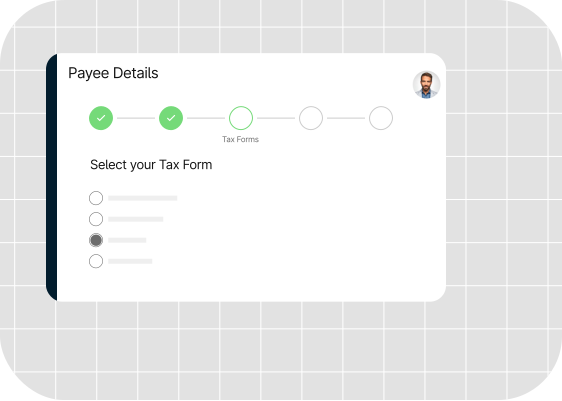
For example, here’s a view of Tipalti’s built-in tax compliance in action, collecting a payee’s tax form details as part of a user-friendly onboarding experience:
Putting the right payment automation infrastructure in place early prevents costly issues that can disrupt growth and damage valuable relationships.
It also gives finance teams greater peace of mind, knowing that payments, compliance checks, and reporting processes will continue to run smoothly as the business expands.
For example, AdTech firm Sovrn was handling international payments to publishers manually because its outdated system didn’t support the right payment methods.
Every new payee and transaction added more cross-border compliance checks.
The process was time-consuming and inefficient, as Financial Controller Abby Herlein explains:
It was essentially impossible to keep up. We needed to either hire more people or find a technology solution that could help us.
Upgrading to Tipalti Mass Payments cut Sovrn’s monthly payout process to less than two hours, with the automation collecting publishers’ banking information and W-9 forms, significantly reducing onboarding time.
In addition to saving 48 days of work each year, automating global payments and compliance checks eliminated the need for two full-time hires. Instead of recruitment, the company can prioritize supporting publishers and building its brand.
Building Compliance Into Global Payment Operations
As international trade becomes the norm in many industries, finance teams increasingly need to balance speed and accuracy with cross-border compliance requirements.
Meeting more diverse rules and regulations doesn’t have to slow growth or hinder payee experiences.
With the right payment infrastructure in place, teams of any size can confidently expand into new markets and work with suppliers worldwide.
Mass payments automation helps make this possible by improving accuracy, visibility, and control across global payment operations.
See how Tipalti Mass Payments simplifies cross-border compliance, saving teams time and stress.
Cross-Border Compliance FAQs
How is cross-border compliance different from cross-border regulations?
Cross-border regulations are the legal frameworks governing transactions involving people, businesses, or financial services in different countries or jurisdictions.
Cross-border compliance is how companies build those regulatory requirements into their workflows to keep payments running smoothly and avoid penalties.
What regulatory frameworks affect cross-border payments?
Cross-border payments are affected by regulations on financial crime prevention, sanctions enforcement, tax reporting, and data protection.
These regulations vary across countries and jurisdictions, which is why cross-border compliance is difficult to manage solely through manual processes.
What happens if a company fails to meet cross-border compliance requirements?
Non-compliant companies may face financial penalties, blocked payments, or disruptive regulatory investigations.
Compliance failures can also delay payouts, strain relationships, and slow the supply chain.
Which industries are affected most by cross-border compliance?
The following business types often face the most complex cross-border regulatory compliance demands because their payees and partners are spread across more jurisdictions:
• Marketplaces
• SaaS platforms
• Gig economy platforms
• Adtech networks
• Affiliate programs