

Are you trying to make an international money transfer? Then you’ll need to know what IBAN and SWIFT BIC codes are and where to find them.
IBAN and SWIFT codes are both internationally recognized for identifying bank accounts when making a transfer. The specific identifier required depends on the countries involved and the recipient’s bank.
A SWIFT BIC code identifies a specific financial institution in an international transaction, whereas an IBAN identifies an individual account and the country of business. It’s the global equivalent of a bank account and an ABA routing number in the United States.
Key Takeaways
- IBAN and SWIFT BIC codes both facilitate international money transfers.
- IBAN is short for International Bank Account Number and is used to identify an individual account in cross-border payments.
- A SWIFT (Society for Worldwide Interbank Financial Telecommunication), a.k.a. BIC code (established by ISO 9362), is used to identify a specific bank during an international transfer.
- SWIFT serves as the ISO 9362 registration authority and administrator.
- ISO defines the IBAN standard, and SWIFT serves as the ISO 13616 registration authority, publishing the IBAN registry.
- Oftentimes, both codes are required for an international transaction.
Key Differences Between IBAN and SWIFT
| IBAN Code | SWIFT/BIC Code | |
|---|---|---|
| Definition | IBAN is short for International Bank Account Number. | SWIFT is short for Society for Worldwide Interbank Financial Telecommunication, a.k.a. BIC code (Bank Identifier Code). |
| Main Functions | Used to identify an individual account in cross-border payments. | Used to identify a specific bank during an international transfer. |
| Examples | LU 28 001 94006447500003(Luxembourg) | UNCRITMMXXX(UniCredit Banca in Milan, Italy) |
| Costs | Bank transfer fees, commission, and exchange rates (3-5%). | Bank transfer fees, commission, and exchange rates (3-5%). |
| Use Cases | Used for transfers between banks and financial institutions. | Used by banks, service providers, clearinghouses, corporate business houses, brokers, etc. |
| Where to Find | Bank statement, bank website, online calculator. | Bank statement, bank website, online calculator. |
| Region | Primarily used in Europe, the UK, the Middle East, parts of Africa, Latin America, and other countries that have adopted the IBAN standard. | Used globally by banks and financial institutions in more than 200 countries and territories. |
In many international payments, IBAN and SWIFT are not alternatives – you may need both.
IBAN vs SWIFT
The main difference between IBAN and SWIFT is what each code identifies in an international payment. An IBAN identifies the recipient’s bank account, while a SWIFT code (or BIC) identifies the bank handling the transfer.
How IBAN and SWIFT Work Together
Think of an international payment like sending a package through the mail. The SWIFT code helps route the payment to the correct bank, while the IBAN identifies the specific account to which the funds should be credited. In other words, the SWIFT code tells the payment system which bank to send the money to, and the IBAN tells it which account to credit.
Because they serve different purposes, many international transfers require both codes. If you’re sending money to a country that uses the IBAN system (such as most European countries or the UK), you’ll typically need both the recipient’s IBAN and the bank’s SWIFT/BIC code to ensure the payment is processed correctly.
What is an IBAN Code?
An IBAN code is a long number that identifies an individual foreign bank account. It’s short for “International Bank Account Number” and includes various numeric identifiers, like the account number and country code.
This information helps financial institutions process international wire transfers faster and with fewer errors. It serves as a double-check to ensure the transaction and bank details are correct.
What Does the IBAN Code Look Like?
The IBAN code has up to 34 alphanumeric characters that consist of:
- A two-digit country code
- A check digit code (used for detecting errors)
- A Basic Bank Account Number (BBAN) (bank, branch, and account number)
This method of bank identification is used in most European Union countries and other European countries.
Examples of an IBAN Code
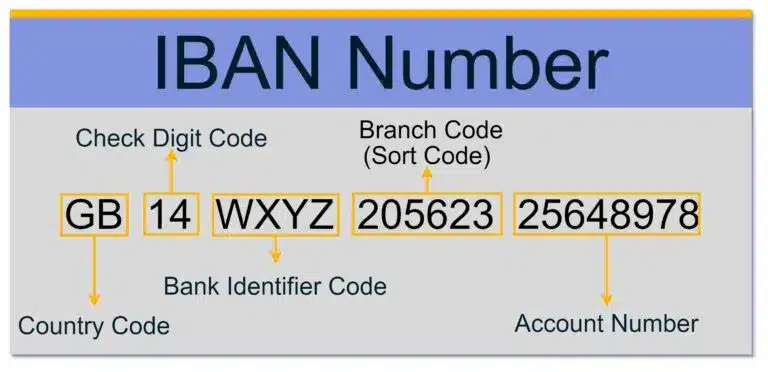
A UK IBAN Number format
In the register of countries that currently use an IBAN code, here are a few examples:
- Luxembourg: LU 28 001 94006447500003
- Cyprus: CY 17 002 00128 00000012005276002
- Kuwait: KW81CBKU0000000000001234560101
- Norway: NO 93 8601 1117947
Does it Cost Money to use an IBAN?
IBAN codes are needed for international bank transfers, and thus, if you’re using one, expect to pay bank transfer fees. The cost varies by country, but there is usually a processing fee and a commission charged by one or both banks.
Main Functions of an IBAN Code
In international banking, IBANs are a critical piece of information. It serves three main functions for sending and receiving cross-border payments, which are:
- Allows banks and other financial institutions to quickly note the country of origin for the bank.
- IBAN pinpoints the exact account number to which the money will be sent.
- It’s an easy way to double-check the accuracy of a bank’s details and ensure a transfer will be successful.
Where do I Find My IBAN Code?
Your IBAN number can be found on the top, right-hand side of your bank statement. If you can’t find the code on your paperwork, you can also find the number through online banking or an IBAN calculator tool.
Does the United States Use the IBAN System?
The United States does not use IBANs, and U.S. bank accounts do not have them. Instead, they use ABA routing numbers (for domestic transfers) and SWIFT codes (for international transfers).
IBAN is an international account-numbering standard used in many countries, especially across Europe, as well as parts of the Middle East, Caribbean, Africa, and Latin America.
Choose the Right Method for Global Payments
IBAN and SWIFT codes help route international transfers, but they’re only part of the payment process. Learn how the most common global payment methods compare on cost, speed, reach, and recipient experience.
What is a SWIFT BIC Code?
SWIFT is an acronym for the Society for Worldwide Interbank Financial Telecommunication. It’s a messaging network that banks and other financial institutions use to securely transmit instructions and data via a standardized code system.
A SWIFT code is a standard format of a BIC. BIC is short for Bank Identifier Code. It identifies the country, city, bank, and branch when making an international transaction.
Other names for the SWIFT code include:
- SWIFT ID
- SWIFT number
- BIC ID
- BIC code
- ISO 9362
What Does a SWIFT Code Look Like?
While an IBAN identifies a bank’s country of origin and the precise account number, a SWIFT code breaks it down into three more specific elements. The unique code is comprised of 8-11 alphanumeric characters and includes:
- A four-letter bank code
- A two-letter country code
- A two-character location code (letters and numbers)
- A three-character branch code (optional)
The structure of a BIC code is defined by the international standard under ISO 9362:2022 and country code ISO 3166-1.
Examples of a SWIFT BIC Code
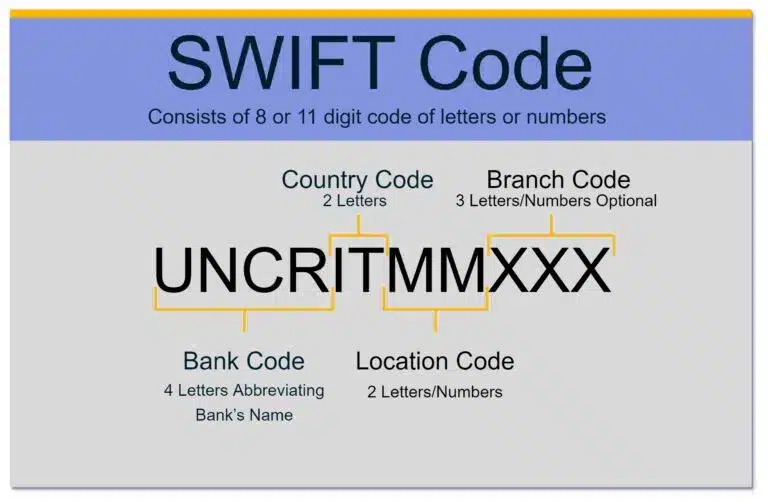
One example of a SWIFT code is for the bank UniCredit Banca in Milan, Italy, which is:
UNCRITMMXXX
- UNCR – the bank code for UniCredit Banca
- IT – the country code for Italy
- MM – the city code for Milan
- XXX – this is optional for the branch code
Does it Cost Money to use a SWIFT Code?
When making an international transfer using a SWIFT BIC code, expect banks to charge a 3%- 5% markup on the exchange rate. SWIFT also has low-cost message rates for sending transfers and each Request for Payment (RfP).
The exchange rate will vary based on the amount you send and the destination. For larger transfers, the exchange rate will cost more than the bank transfer fees, which you should also expect.
Main Functions of the SWIFT BIC Code
SWIFT codes help banks process international wire transfers. When you use SWIFT, you’re not actually sending money, but rather, it’s a “payment order” between banks. Still, it’s the method by which the majority of global fund transfers are made.
Share Important Information
One of the main functions of the SWIFT messaging system is enabling banks to share significant amounts of financial data. This includes critical information like:
- Account status
- Debit and credit amounts
- Details related to the transfer
Expedite Transfers
If both the sending and receiving banks have a relationship, SWIFT sends payment messages quickly, but the speed of settlement depends on bank relationships, intermediaries, compliance checks, and rails. The messaging system helps to expedite international payments and streamline the entire process.
How do I Find My SWIFT BIC Code?
Your SWIFT/BIC code can be located on a bank statement or through an online banking portal. If you’re not sure, you can also use a SWIFT code locator service online.
IBAN vs SWIFT BIC Code
Identification
The main difference between an IBAN and a SWIFT BIC code lies in what they’re used to identify. A SWIFT code identifies a bank, while an IBAN identifies a specific bank account.
Basically, a SWIFT number tells you where to pay, and an IBAN tells you who to pay.
Messaging
While IBAN works like a bank account and routing number, SWIFT is a financial messaging system that banks use to communicate with each other. While IBAN is like a general compass, SWIFT is like the mapping coordinates. Both are important to avoid post-transaction mistakes and fees.
Coding
A SWIFT BIC code breaks down into 3 more specific elements than an IBAN code. Namely, the bank code, country code, and branch identifier. IBAN and SWIFT codes are often described as an “either/or” choice, but in reality, they are often used in conjunction.
Bank Requirements
When sending money overseas with an IBAN, the recipient must be in a country that supports the system. In this case, they simply give you their IBAN number.
However, in many instances, a bank requires both an IBAN and a SWIFT code to identify a recipient’s bank and specific account number.
If the recipient’s country does not support IBANs, SWIFT codes are the only other option. In this case, you may incur additional fees, as funds will have to flow through an intermediary and/or a correspondent bank.
Use Cases
While IBAN numbers are used solely for transfers in a bank, SWIFT numbers are used by a variety of financial institutions, including:
- Clearinghouses
- Brokers/dealers
- Asset management companies
- Corporate business houses
- Service providers
…and many other types of businesses.
Why are IBAN and SWIFT Codes Important?
The mother of invention is necessity, and digital finance is no different. Prior to the global standardization of SWIFT and IBAN codes, international payments would end up in the wrong location, requiring extra fees and time to resolve the issue.
Before the adoption of IBAN, countries used different account number formats, leading to endless processing discrepancies.
The results of the IBAN and SWIFT programs have shown fewer errors in international transactions and faster transfer rates. Through the SWIFT program, banks can share large amounts of information. Details embedded in the code include debit and credit amounts, account status, and transfer-related data.
Despite these advantages, there are still issues that IBAN and SWIFT codes do not address, such as foreign exchange rates.
Using IBAN and SWIFT
The information you need to know varies depending on whether you are sending or receiving international funds.
Sending Funds
Prior to initiating a transfer, always double-check the IBAN and/or SWIFT codes. Using an incorrect number can cause the transaction to be rejected and returned, resulting in additional fees.
If you only have partial data, calculators are available online to help you determine an IBAN. Every bank provides its SWIFT BIC code on its online banking site, but the best place to check is always with your intended recipient.
Receiving Funds
As a recipient, you must provide your IBAN number to anyone sending you money internationally. This is secure as no one can use an IBAN number to access funds in a bank account.
SWIFT BICs are readily accessible to every banking customer. Most banks provide this data on their website or upon request.
Simplify Global Payments with Accurate Banking Details
Understanding the difference between IBAN and SWIFT codes is essential for successful international payments. As payment volumes grow, however, collecting, validating, and maintaining banking information across countries can become increasingly complex. Tipalti helps businesses automate payee onboarding, validate banking details, and support global payments across multiple methods and currencies—helping reduce payment errors and improve payment delivery worldwide.
Explore Tipalti Mass Payments to learn how businesses automate the collection and validation of banking details for global payments.
IBAN vs SWIFT FAQs
Which countries use IBAN Codes?
As of December 2025, 89 countries are using the IBAN system.
Is a SWIFT code the same as a routing number?
Routing numbers are only used by U.S. financial institutions, while the SWIFT system is used by international organizations. Routing numbers are only used for domestic transfers.
Is it safe to share an IBAN?
It is generally safe to share your IBAN when needed to receive a payment, but only share banking details with trusted parties and avoid unsecured channels.
Should I use BIC or IBAN?
While an IBAN provides information about your individual account, the BIC (SWIFT) code identifies the bank where your account is held. Countries that use the IBAN system will ask for both codes.
