


Corporate growth is often a combination of organic internal growth and external growth through M&A. When mergers or acquisitions occur, systems often differ across the newly acquired or merged companies. Part of the M&A integration process is converting the new business entities to the acquiring company’s multi-entity accounting software.
Managing a multi-entity company means handling complex multi-entity accounting processes and challenges. Multi-entity reconciliation and intercompany visibility are critical capabilities for finance teams managing transactions across subsidiaries, currencies, and jurisdictions. Learn how to improve multi-company accounting for growing businesses.
Key Takeaways
- Multi-entity accounting requires consolidating financial statements across subsidiaries, including currency translation and eliminating intercompany transactions for accurate reporting.
- Relying on spreadsheets slows down close cycles and increases risk; automated multi-entity accounting software improves speed, accuracy, and scalability.
- Real-time visibility across entities, combined with automated reconciliation and compliance controls, is essential for effectively managing global operations.
- As organizations grow through M&A and international expansion, standardized systems and centralized data become critical to avoid fragmentation, reporting delays, and costly errors.
What is Multi-Entity Accounting?
Multi-entity accounting is the consolidation and management of financial data across multiple legal entities under one parent organization.

Multi-Entity vs. Single-Entity Accounting
The difference between single-entity and multi-entity accounting is that single-entity accounting reports financial results for a single legal entity, while multi-entity accounting consolidates results across multiple entities and eliminates intercompany transactions.
Why Multi-Entity Accounting Matters in 2026
As companies scale through acquisitions and global expansion, they accumulate multiple legal entities, making multi-entity accounting critical for maintaining accurate financial reporting. Domestic and multinational corporations are increasingly using global supply chains.
In multi-entity or multi-subsidiary organizations, operational and accounting complexity increases significantly. Managing local compliance requirements, taxes, and currencies across jurisdictions is a key source of complexity.
How Multi-Entity Accounting Works
Multi-entity accounting combines the parent company’s HQ and divisions with subsidiary results, eliminates intercompany transactions, and consolidates the adjusted financial statements for the entire organization.
Multi-entity accounting consolidation steps include:
- Determine the parent-subsidiary reporting structure.
- Evaluate controlled vs. minority interest entities for appropriate accounting and financial reporting.
- Use financial statements from all entities requiring consolidation.
- Apply currency translation to foreign financial statements in a different currency and record the translation differences with journal entries.
- Eliminate inter-company transactions and record related journal entries.
- Combine adjusted financial statements for consolidated financial statement reporting.
Parent Company and Subsidiary Reporting Structure
A corporation uses an organizational chart to document its structure for managing finances (and operations), including those of a parent company and its subsidiaries. The organizational chart may reference the legal entity names and type of entity. International subsidiaries are incorporated as separate legal entities, operating under local laws, such as corporations or LLCs, to shield the parent company from their liabilities.
The corporation’s organizational chart, with reporting structure, shows the parent company (including headquarters) at the top, with underlying subsidiaries, divisions, or other major entities below the entity to which they report. For internal management purposes, enterprise companies may include group levels to which similar companies report.
Controlled Subsidiaries vs. Minority Interests
Determine entities with over 50% ownership of outstanding voting shares that evidence control and require full consolidation for financial reporting. Determine which entities are minority interests with less than 50% ownership but sufficient influence that require the equity method of accounting.
Minority interests reported under the equity method are consolidated in a separate category. This enables reporting the minority interest in the equity section of the balance sheet and as a line item in the multi-step income statement.
Currency Translation
When preparing consolidated financial statements, currency translation is required for international subsidiary financial statements before combining their financial results and balance sheets in the parent company’s functional currency. Translation adjustments are recorded in Other Comprehensive Income within Shareholders’ Equity on the balance sheet.
Intercompany Transactions and Eliminations
Intercompany transactions are transactions between entities, not arm’s-length transactions with external companies. To remove company-related revenues, profits, and effects on assets (such as inventory) and liabilities, these related-party transactions are eliminated in multi-entity consolidation.
One example of intercompany transactions is sales between related companies or business units, which are sometimes marked up (at justifiable market rates with a profit margin) through transfer pricing. Sales revenue, cost of sales, and inventory balances are affected in these intercompany transactions.
Consolidation and Financial Statement Roll-Ups
The final step in multi-entity accounting during consolidation is to combine (roll up) the adjusted financial statements to produce total-company consolidated financial statements in the reporting currency.
Key Components of Multi-Entity Accounting
Components of multi-entity accounting are:
- Chart of accounts standardization
- Entity hierarchies
- Consolidation workflows
- FX translation
- Intercompany reconciliation
- Reporting controls
To prepare for financial statement consolidation, standardize the chart of accounts across all entities, including newly acquired entities. Determine entity hierarchies and the degree of entity ownership control for consolidation.
Streamline and document consolidation workflows. While consolidation was traditionally performed manually using spreadsheets, modern ERP systems and accounting software, along with add-ons, now offer built-in consolidation features with reporting controls and automated reconciliation.
Apply FX translation to foreign-entity financial statements by translating them into the parent company’s reporting currency for consolidation. This currency translation process prepares them for roll-up into the combined entity. Record the translation adjustments in the accounting records via journal entries.
Perform an intercompany reconciliation after making intercompany eliminations. Ensure that reporting controls are strong enough to produce accurate reporting of financial results.
Table: Manual Spreadsheet vs. ERP/Accounting Software Consolidation
| Consolidation Method | Manual Spreadsheet | ERP/Accounting Software, or Add-on |
|---|---|---|
| Time-consuming | Yes | No |
| Error-prone | Yes | No |
| Automated, multi-entity consolidation | No | Yes, with multi-entity capabilities |
| Intercompany reconciliation | No, manual reconciliation required | Desired feature |
| Reporting controls | No | Yes |
Intercompany transactions, eliminations, and reconciliation are core operational challenges best handled through automated, multi-entity consolidation.
Streamlining Payables Across Multiple Entities
Learn how growing companies streamline intercompany workflows, improve visibility, and automate global payables across multiple entities.
Benefits of Multi-Entity Accounting
Key benefits of multi-entity accounting are financial visibility, faster consolidation, improved compliance and controls, and scalability as organizations grow.
Multi-entity accounting benefits include:
- Improved visibility: Using multi-entity software enables visibility at both the entity and consolidated/combined corporation levels.
- Better cash management: Multi-entity software streamlines the cash management process and provides the finance team with visibility across the company.
- Faster close cycles: Automation software with instant, real-time account reconciliation lets your business accelerate its financial close.
- Regulatory compliance: Efficient, thorough tax and global regulatory compliance can be achieved with AI-driven automation tools.
- Scalable growth: Multi-entity accounting software provides scalability to handle volume growth, new companies added through M&A, and global complexity.
- Reduced reporting risk: Financial controls in multi-entity accounting software help reduce reporting risk by limiting financial errors and fraud and automating consolidation and reconciliation processes.
Real-World Examples of Multi-Entity Accounting in Practice
Three examples of a multi-entity business using multi-entity accounting are:
- Alphabet
- Amazon
- Salesforce
1. Alphabet
Alphabet, Inc. is the multi-entity holding company and corporate parent of Google and its other subsidiaries, divisions, and business entities, as listed in a March 2026 article about companies owned by Alphabet. In an overview, this Thomas For Industry article mentions three primary segments with underlying companies (Google Services, Google Cloud, and Other Bets) and X, a Google R&D arm developing innovative technologies.
Alphabet uses a segment structure for managing companies in similar business lines or risk categories. Segment structure enables it to assign focused executives and teams to these segments, having responsibility for multi-entity management and financial performance. Businesses in the Other Bets segment are riskier and include companies developed by its R&D arm to achieve longer-term payoffs.
2. Amazon
Amazon is a multi-entity company with numerous businesses and partnerships, including its flagship eCommerce, AWS public cloud services, streaming and movie studios (Amazon & MGM), food retailing (including Whole Foods and Fresh), private label brands, manufactured products (including food, apparel, electronic devices), logistics and shipping, home services, and healthcare/pharmacy operations.
3. Salesforce
The CRM (customer relationship management) software company, Salesforce, is a multi-entity company that also owns non-CRM businesses and products it has developed internally or acquired. These businesses include the acquisition of companies with retained brands, including Tableau, Slack, and MuleSoft.
What Makes Them Multi-Entity?
Small businesses usually start out as a single entity. Most established businesses are multi-entity companies because they acquire other businesses and establish international legal entities in various countries. With these initiatives, companies achieve their growth objectives with cost synergies and market expansion or acquire new technologies. Businesses expand through M&A deals using either a horizontal integration or vertical integration strategy.
A multi-entity business is a corporation that serves as a parent company, with subsidiaries, business units, divisions, brands, and legal entities for foreign office operations. In a decentralized company, business entities operate autonomously and create financial reports. The parent has oversight, consolidated financial reporting, and global finance and accounting responsibilities.
How Reporting Likely Works
Multi-entity reporting groups companies by similar business lines, each with its own management team. Subsidiary companies likely operate under a decentralized structure, reporting to group-level management. The accounting consolidation may be rolled up by organizational structure for internal management.
Why Structure Matters
Structure matters because it enables entity-level accounting and visibility into financial results, from the entity level up to the entire corporation. The company structure also evidences the ownership percentage and control vs. minority interest for combined financial statement reporting.
Private and public companies prepare multi-entity financial statements for internal management, the Board of Directors, lenders, venture capital firms, shareholders, M&A due diligence if being acquired, and other stakeholders. If publicly traded, consolidated results for the entire corporation are reported in SEC filings, such as the 10-K and 10-Q reports.
Common Challenges in Multi-Entity Accounting
Accounting problems and challenges faced by multi-entity companies can be overcome through effective multi-company accounting systems, adequate training for the accounting team, smart financial management, and adherence to accounting best practices.
Accounting challenges for multi-entity companies include:
- Properly recording acquisitions in accordance with GAAP accounting standards
- Having a different chart of accounts in each entity and subsidiary’s software system results in complexity from system fragmentation after M&A
- Paying suppliers on time across multiple currencies, managing FX conversion and hedging, and maintaining accurate global cash forecasting
- Accurately preparing consolidated financial reports on a timely basis
- Visibility and communications at the business entity, corporate levels, and external supplier/global partner level
Other multi-entity accounting challenges are:
- Managing accounting for multiple LLCs or corporations
- Multinational reporting complexity
- Currency translation
- Ownership structures
- Intercompany mismatch risk
Intercompany mismatch risk is high when entities use siloed accounting systems. Intercompany transactions may not be properly accounted for by each entity, leading to missing entries and imbalances. If not corrected immediately, an imbalance or missing entry could affect the accuracy of financial statement reporting and lead to related income tax issues.
Intercompany account reconciliation is essential. Manual intercompany reconciliation takes time, delaying the release of financial statements.
Best Practices for Managing Multi-Entity Accounting
Solutions for a multi-entity company’s accounting challenges include migrating from each business entity’s existing accounting software to a multi-entity ERP and AP automation system with advanced FX features through integration. Multi-entity accounting software becomes much more efficient and accomplishes more with add-on accounting automation.
Many modern multi-entity accounting software, ERPs, and automation software products provide almost real-time visibility through dashboards, reports, and AI-assisted financial data analysis for business intelligence.
Best practices for managing multi-entity accounting systems include the following elements.
Standardized Chart of Accounts
In a multi-entity accounting system or ERP, the chart of accounts can be standardized for consistency across the company to the extent possible for the type of underlying business entity.
Clear Entity Hierarchy Mapping
ERP systems can be used to prepare consolidated financial statements. Multi-entity companies map hierarchies in their accounting systems to eliminate intercompany transactions from accounts in the general ledger and to prepare their consolidated income statement, balance sheet, and cash flow statements.
Automated Intercompany Eliminations
In modern multi-entity/multi-subsidiary systems, the intercompany eliminations process is automated rather than manually reconciled against the trial balance. With proper entity mapping, intercompany transaction imbalances shouldn’t occur. Intercompany reconciliation may also be automated.
Centralized Close Calendar
A centralized close calendar enables entities to close their books on the same timetable, meeting their reporting requirements with a capable multi-entity ERP or accounting platform. Without the problems associated with traditional, siloed systems, foreign subsidiaries include timely financial statements in the consolidated financial statements without a period lag.
Cross-entity Reporting Dashboards
Real-time, cross-entity reporting dashboards provide visibility into multiple business entities and consolidated results, including KPIs and other metrics to assess financial health and support decision-making.
Audit Trail Governance
Audit trails improve internal controls. Multi-entity accounting systems include automated audit trails.
What to Look for in Multi-Entity Accounting Software
When selecting multi-entity software, consider the following essential functionality elements in your evaluation to improve efficiency and visibility, reduce inaccuracies, and strengthen controls. Modern multi-entity accounting software is either cloud native or cloud-based, although some companies still use on-premises, legacy ERP systems.
The best multi-entity accounting software includes:
- Native consolidation
- Intercompany and multi-entity reconciliation
- Multi-currency support
- Entity-level drill-down
- Matrix reporting
- ERP integrations
- Audit controls
1. Native Consolidation
Native consolidation replaces manual spreadsheet consolidation. It optimizes financial operations efficiency and reduces errors. Real-time reporting is valuable when your ERP system supports it.
2. Intercompany and Multi-entity Reconciliation
Automated intercompany transaction and multi-entity reconciliation will reduce time delays and errors in the closing process. It eliminates inefficiencies and staff frustration caused by manual reconciliations across siloed systems.
3. Multi-currency Support
Multi-currency support means the system’s ability to handle accounting and reporting in multiple currencies for global operations, perform currency conversions for transactions, and translate foreign financial statements into the parent’s reporting currency during consolidation.
4. Entity-level Drill-Down
Entity-level drill-down enables real-time analysis of amounts from the top-level accounts to the underlying individual entity sources. This capability helps your business make informed decisions.
5. Matrix Reporting
Some businesses use matrix reporting, which is a dual-line employee reporting structure at both the functional and project levels. Modern systems can handle matrix reporting, which may require resource allocations between functions and project tracking.
6. ERP Integrations
Optional modules and third-party add-on multi-entity software for finance and accounting require ERP integration to create a unified platform without siloed systems. ERP integration is needed for data syncing between systems and performing instant automated reconciliations.
7. Audit Controls
To ensure strong internal controls and reduce fraud risks, audit controls, including automated audit trails, are essential.
How AP Automation Supports Multi-Entity Accounting
AP automation plays a critical role in simplifying multi-entity accounting by reducing manual processes, improving accuracy, and enabling real-time visibility across entities.
Key capabilities of AP automation for multi-entity organizations include:
- Entity, combined company, and supplier visibility
- Instant batch reconciliation
- Advanced FX (currency management)
- Global regulatory and tax compliance
Multi-Entity AP Automation Platform with ERP Integration
Tipalti’s AP automation platform is designed to support multi-entity organizations by streamlining global payables processes, including invoice processing, approvals, and payments, when integrated through an accounting API with multi-entity accounting software and ERPs.
We implemented Tipalti across our organization for its multi-entity capabilities and ease of global payments. Adding new entities is simple—we can get up and running right away.” —Bradley Clifford, Assistant Controller, Stack Overflow
Tipalti’s unified finance automation platform products include AP automation for global accounts payable and mass payments for payouts.
AI-driven automation further enhances these capabilities by improving data accuracy, accelerating approvals, and identifying exceptions before they impact financial reporting.
Automated invoice processing uses AI agents to detect discrepancies, flag anomalies, and streamline 3-way matching with purchase orders and receipts. It supports guided approvals, reduces fraud risk, and helps ensure global regulatory compliance when making payments.
Business Entity and Consolidated-Level Visibility
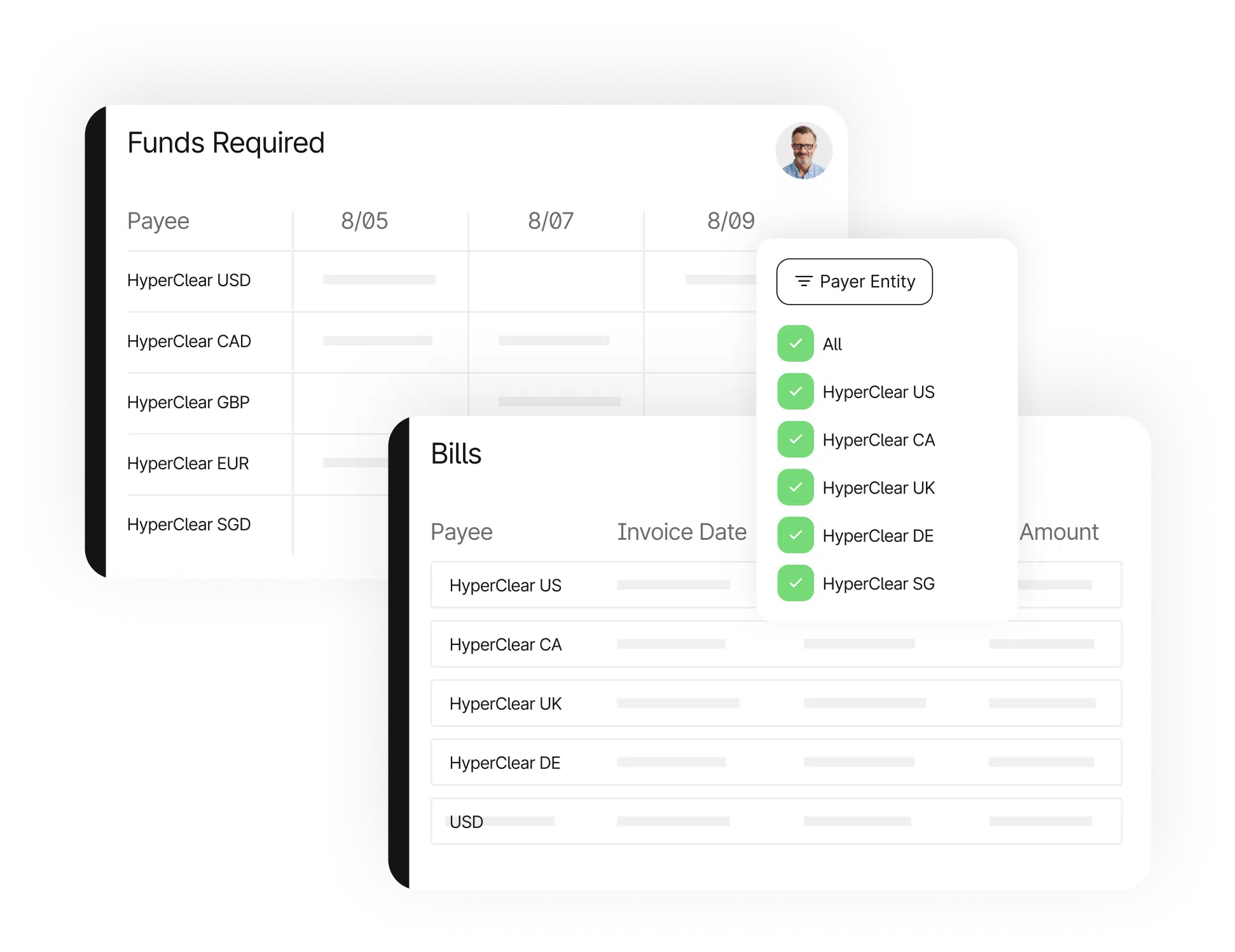
Tipalti’s multi-entity accounting software provides greater visibility at the business-entity and consolidated levels for multi-entity organizations, as well as supplier visibility. Tipalti AP and accounting automation software works for decentralized business entities that use their own payables processes and workflows for invoice processing.
Batch Reconciliation
Through automation, Tipalti instantly reconciles large-batch payments in multiple currencies and across different payment methods. This payment reconciliation capability, with synced ERP account and subsidiary-ledger financial records, speeds up your month-end close process.
Advanced Tipalti FX Products Integration
Tipalti also offers advanced FX products working in combination with its AP automation and mass payments software for foreign currency conversion into local currency, supporting 30 currencies and transaction hedging. These optional FX accounting add-on products, which are ideal for multi-entity companies and subsidiaries with foreign exchange, are Tipalti Multi-FX and Tipalti FX Hedging.
With Tipalti’s Multi-FX product, your company won’t need to set up a network of regional international banks to make payments through foreign bank accounts. Instead, Tipalti Multi-FX uses a virtual account for global payments.
Global Compliance
Tipalti’s payables software automates global regulatory compliance, including sanctions screening, KYC (Know Your Customer), and AML (anti-money laundering). It provides global payments compliance with domestic and international banking regulations by country.
Tipalti simplifies tax compliance by collecting the correct W-9 or W-8 series tax form during supplier or payee onboarding, performing TIN matching, and generating simple 1099 and 1042-S preparation reports.
Optionally, Tipalti users can automatically e-file 1099-MISC, 1099-NEC, and 1042-S information returns by subscribing to partnered ZenWork Tax1099 software and importing 12 calendar months of integrated Tipalti payments data.
Scaling Financial Operations Across Entities
Multi-entity accounting presents time-consuming challenges best addressed by software solutions that enable business-unit autonomy while giving the parent corporation of multiple companies visibility into business operations and results, cash flow needs, and financial statements. Visibility is provided at both the business entity level and the consolidated corporate level.
Multi-entity accounting solutions and automation deliver efficiencies and other benefits to the CFO, Controller, and finance team, freeing up more time to take on value-added projects and assist in strategic decision-making.
To improve multi-entity accounting efficiency and visibility, explore how Tipalti’s multi-entity automation helps streamline consolidation, reconciliation, and global payables.
Multi-Entity Accounting FAQs
What is multi-entity reporting?
Multi-entity reporting is preparing reports and financial statements at the business entity level and rolling them up into a combined total corporation (through consolidation) to view the underlying source of business operations, transactions, and financial results.
Why would a company have multiple entities?
Companies create multiple entities through international expansion, mergers and acquisitions, or to separate operations for legal, financial, or strategic management purposes.
What is multi-entity consolidation?
Multi-entity consolidation involves combining business-unit and corporate financial statements, translating foreign financial statements into the parent’s reporting currency, and eliminating intercompany transactions.
What is the difference between multi-entity and intercompany accounting?
In multi-entity accounting, transactions are recorded and financial statements prepared for all entities, with intercompany transactions and balances eliminated after consolidation, whereas in intercompany accounting, transactions and balances between related entities are recorded and reported separately.
Can small businesses use multi-entity accounting?
Small businesses use scalable multi-entity accounting software to handle accounting, reporting, and consolidation for all owned entities and future acquisitions.
What software supports intercompany eliminations?
Modern ERP systems can automatically calculate and eliminate intercompany transactions and balances, as well as perform intercompany reconciliation.
