

 Back
Back 

Who gets a 1099? Businesses must issue a Form 1099-NEC to any non-employee (independent contractor, freelancer, or eligible entity) who receives $600 or more in compensation for services during the tax year.
Form 1099-MISC is required for payments other than wages, such as rents, royalties, and legal settlements. Generally, C corporations and S corporations are exempt, with specific exceptions for attorneys and medical providers.
Key Takeaways
- If you pay a non-employee $600 or more for services during the calendar year via cash, check, or direct deposit, you must generally file Form 1099-NEC.
- Use Form 1099-NEC for service compensation. Use the reserve Form 1099-MISC for other payments like rent, royalties, and legal settlements.
- Most corporations (C-Corps and S-Corps) are exempt from receiving 1099s, although strict exceptions exist for attorneys and healthcare payments.
- Foreign contractors performing work outside the United States do not receive a 1099. They require a W-8 form to certify their status.
- Accurate filing depends on accurate payee data. Automating W-9 collection during onboarding helps finance teams capture the right information early and scale 1099 compliance with fewer downstream corrections.
January is when year-end 1099 requirements collide with close timelines. If payee data hasn’t been collected and validated upfront, teams often end up tracking down W-9s, fixing TIN issues, and manually sorting payments under tight deadlines.
For businesses paying hundreds of creators, affiliates, or gig workers, manual workflows can quickly become difficult to manage consistently as volume and complexity grow. It drains your AP team’s resources during the critical year-end close, leaving your process vulnerable to human error.
This article provides a blueprint for moving beyond spreadsheets. We will break down the NEC vs. MISC rules and show you how to automate tax data collection year-round to strengthen compliance, reduce errors, and support audit-ready reporting.
Who Needs a Form 1099-NEC?
Form 1099-NEC is one of the specific types of 1099 forms used by businesses to report payments of $600 or more for self-employed nonemployee compensation. Before 2020, this income was reported on Box 7 of the 1099-MISC, but the IRS introduced the NEC form to separate contractor pay from other miscellaneous income types.
The Four Rules for Reporting
To determine if a specific vendor requires this form, you must apply a four-point test to the payment. If the transaction meets all four criteria, you have a filing obligation.
- The payment must be made to a service provider who is not your employee and who receives a Form W-2.
- The payment must be for services in the course of your trade or small business. Personal payments do not count.
- Payment must be made to an individual, partnership, estate, or (in some specific cases) a corporation.
- Lastly, the total payments to the payee must equal or exceed $600 for the tax year.
The “Method of Payment” Exception
While those rules seem straightforward, there is a major exception that can mislead finance teams: how you pay the service provider matters. You do not need to file a Form 1099-NEC if you paid the contractor via payment card, debit card, or a third-party settlement organization (TPSO) like PayPal.
In these scenarios, the payment processor is responsible for reporting the income on Form 1099-K. If you file a 1099-NEC for these payments anyway, you risk over-reporting the contractor’s income to the IRS. This can trigger audit notices for your vendor and create major administrative headaches for your team to untangle.
Who Needs a Form 1099-MISC?
Rent, Royalties, and Direct Sales
One of the most common uses of this form is to report rent. If you pay office rent to a landlord totaling $600 or more during the year, that amount goes in Box 1. Royalties have an even stricter rule: if you paid over $10 in royalties for intellectual property usage, that belongs in Box 2.
Because royalty payments have a lower reporting threshold, they can be easier to overlook in a high-volume AP environment. Additionally, if you are involved in direct sales of consumer products for resale totaling $5,000 or more, you must check Box 7.
Settlements and Investment Income
The other critical category involves legal payments. Gross proceeds paid to an attorney (specifically, settlement funds rather than billable hours) must be reported here. It is also used to report insurance proceeds in specific medical contexts.
Finally, ensure you do not confuse this with investment income. Dividends and interest are reported on Form 1099-DIV and Form 1099-INT, respectively, each with its own specific reporting requirements.
Comparing 1099-NEC and 1099-MISC Forms
For a Controller, keeping these two forms straight ensures your data is sorted correctly long before tax season arrives. Filers must understand that while both forms report income, they serve different purposes in the eyes of the IRS.
The Core Difference
The core distinction lies in the nature of the payment. If you paid someone for work, such as their labor, expertise, or time, that almost always belongs on a 1099-NEC. If you paid them for the use of something, such as renting their building or using their intellectual property, that should be reported on the 1099-MISC.
Mixing these up can confuse your vendors when they file their own taxes and may lead to mismatch notices from the IRS.
Deadlines and Thresholds
Beyond the “what,” there is the “when.” The 1099-NEC has a strictly enforced filing deadline of January 31st for both the IRS and the recipient, leaving you very little time to close your books and file a 1099 online. The 1099-MISC offers a bit more breathing room for the IRS filing, though recipient copies are still due early. The table below breaks down these key differences for quick reference.
| Feature | Form 1099-NEC | Form 1099-MISC |
|---|---|---|
| Purpose | Reports nonemployee compensation (services). | Reports miscellaneous income (rent, royalties, legal settlements). |
| Primary Recipients | Freelancers, independent contractors, consultants. | Landlords, attorneys (for settlements), prize winners. |
| Filing Threshold | $600 or more. | $600 or more (Rent); $10 or more (Royalties). |
| Due Date to IRS | January 31. | March 31 (if e-filing). |
1099 Rules for LLCs, Corporations, and Attorneys
One of the most challenging parts of 1099 compliance is navigating exceptions. Business owners and finance leads struggle here because the rules are riddled with specific exemptions that can easily trigger a backup withholding notice (B-Notice) if your vendor master file isn’t meticulously coded.
Why You Usually Don’t Send Forms to Corporations
You typically do not need to send a 1099-NEC or 1099-MISC to a corporation. This applies to both C Corporations and S Corporations.
If a vendor is listed as “Inc.” or has checked the Corporate box on their tax form, you can generally mark them as exempt in your AP system.
The Tricky Case of Limited Liability Companies (LLCs)
LLCs are one of the most challenging entity type for AP compliance because their tax status cannot be determined solely by examining their name. An LLC is a legal designation, not a federal tax classification.
To determine whether you need to file, review the specific tax classification code they entered in Box 3 of their Form W-9. If they checked “C” (C Corporation) or “S” (S Corporation), they are generally exempt.
However, if they checked “P” (Partnership) or are a single-member LLC, you must issue a 1099. This is a common scenario for real estate agents and consultants who operate as LLCs but are taxed as sole proprietors.
The Exception for Legal Fees
Attorneys are the major exception that breaks the corporate rule. Under specific tax law regulations, you must issue a 1099 for legal services even if the law firm is incorporated. As the payer, if you send a law firm $600 or more during the year, you have a reporting obligation.
Build a Scalable Payouts Process That Holds Up at Year-End
1099 rules are only one piece of the bigger challenge: managing payee onboarding, compliance, fraud risk, and high-volume payouts as you scale. See how modern finance teams build a first-class payouts experience into everyday workflows—not just at year-end.
Who Doesn’t Need to Receive a Form 1099?
When your team is overwhelmed with filing forms, efficiency is essential. A pivotal factor in doing so is ensuring that you file the right ones. Removing exempt payees from your reporting batch saves time and reduces the risk of sending incorrect forms.
While the rules for inclusion are strict, the exemptions for specific types of payments and entities are equally clear.
Foreign Contractors
This is a critical difference for global businesses. If a non-U.S. person performs work entirely outside the United States, they do not receive a 1099. Instead, you must collect a Form W-8BEN (for individuals) or Form W-8BEN-E (for entities) to certify their foreign status.
Tax-Exempt Organizations
You generally do not need to report payments to tax-exempt organizations, such as 501(c)(3) non-profits. This exemption usually extends to payments made to a financial institution or distributions to IRAs (Individual Retirement Arrangements).
Sellers of Merchandise
The 1099-NEC is specifically for services. If you pay a supplier strictly for physical products, materials, freight, or storage, no information return is required. However, if a payment covers both goods and services, you typically report the entire amount.
Challenges of Managing 1099 Compliance at Scale
In a lean finance environment, 1099 compliance can often be managed with lightweight, manual workflows. But as your payee base expands to thousands of creators, affiliates, or contractors, often across multiple systems and countries, those same processes can create unnecessary exposure.
At scale, the risk isn’t just inefficiency. It’s incomplete tax data, inconsistent classification, limited auditability, and year-end reporting bottlenecks that pull finance teams away from higher-value work.
Data Integrity Risk
The biggest failure point is often tax data capture. When TIN collection relies on emailed forms and manual entry, it increases the likelihood of missing or incorrect information—creating avoidable rework and compliance risks later.
This data integrity risk is why finance teams rely on automated tax compliance for their mass payouts. If the taxable income you report doesn’t match IRS records, it complicates the payee’s tax return and triggers IRS B-Notices (CP2100A) for you.
Hybrid Workflow Trap
For modern Controllers, the challenge is sometimes structural. You likely have one rigorous system for your corporate AP invoices and a separate, looser workflow for mass payouts, such as referral fees to digital partners. These data silos create a dangerous blind spot where compliance rules are applied inconsistently.
The Cost of Failure
The stakes for getting this wrong can be significant. A systemic error in your logic could result in millions of dollars in fines for missed federal or state income tax reporting.
This turns a back-office oversight into a crisis that even your CPA will struggle to untangle, potentially raising red flags about Social Security and income tax withholding.
Streamlining Tax Compliance with Automation
One of the most effective ways to handle compliance at scale is to shift your focus from “year-end filing” to “year-round data management.” By embedding Tipalti’s automated tax compliance software into your daily operations, you stop fixing errors in January and start preventing them at the point of onboarding.
Central Data Collection
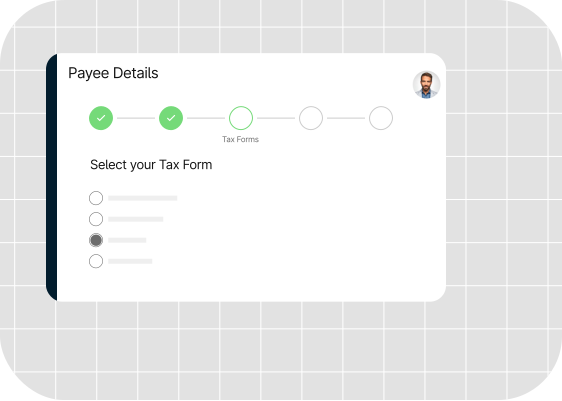
The process starts with a self-service supplier portal. Instead of your team manually entering data from emailed PDFs, your payees enter their own information into a secure white-labeled environment.
The system utilizes tax logic to automatically present the correct form. This approach involves asking the right questions to determine whether a payee requires a W-9, a W-8BEN, or a W-8BEN-E, helping to ensure that you collect the correct document every time without needing your AP team to intervene.
Real-Time Validation and Risk Control
Collecting the tax form is only the first step—validation is where compliance risk is reduced. Tipalti automatically checks each payee’s TIN against IRS records in real time, preventing incorrect information from entering your vendor master file and helping you avoid downstream issues like B-Notices.
This added layer of verification also strengthens fraud prevention by improving data accuracy, reducing manual handling, and ensuring your tax and payment workflows stay secure and audit-ready.
Automated Reporting for High Volume
Throughout the year, the platform helps finance teams track contractor payments against IRS thresholds and apply consistent 1099-NEC reporting logic, including excluding payment types—such as many credit card transactions—that typically aren’t reportable. As year-end approaches, teams can generate a “who gets a 1099” list with cleaner data, fewer exceptions, and significantly less manual reconciliation.
For companies growing fast, this scalability is essential. Kiva Alvarez, Senior Accountant at Symphonic Distribution, described the impact:
Tipalti has been a lifesaver in terms of scaling up international payments! It doesn’t matter if you send 100 or 5,000 payments in a month… the reporting for 1099 and 1042 tax reports has been very helpful.
Streamline 1099 E-Filing with Tipalti’s Zenwork Tax1099 Integration
Even when your payee data is clean, year-end filing can still become a bottleneck. Especially if your team is exporting spreadsheets, formatting CSVs, and manually uploading files across multiple systems. As volume grows, that extra handling increases the risk of errors, missed deadlines, and last-minute rework.
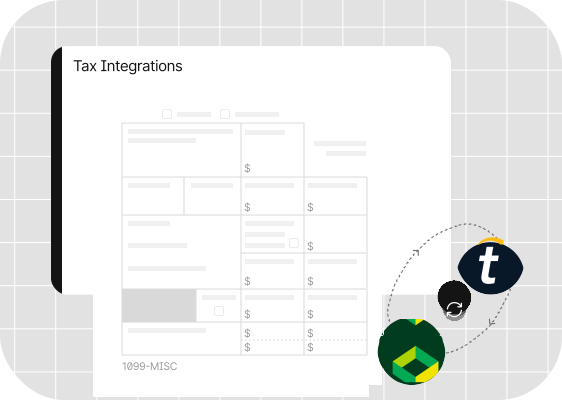
Tipalti recently launched a native integration with Zenwork Tax1099, making it easier for finance teams to e-file Forms 1099-NEC and 1099-MISC using validated payee and payment data already captured in Tipalti.
Instead of treating year-end filing as a standalone project, teams can navigate year-end reporting with greater consistency, control, and fewer manual steps, while keeping workflows aligned across mass payments and AP automation.
How Finance Teams Eliminate 1099 Risk
Answering “Who gets a 1099?” requires ongoing data management, not just a January review. For Controllers and finance leaders, a key objective is maintaining audit-ready documentation and defensible reporting logic throughout the year.
When finance teams are tracking thousands of vendors and hybrid workers across manual workflows, it can increase the risk of missing tax data, inconsistent classification, and year-end rework.
By collecting accurate data upfront, you can support more accurate year-end tax reporting for vendors while minimizing filing errors, notices, and downstream remediation.
Explore Tipalti Mass Payments today to eliminate the guesswork from your compliance workflow.
Who Gets a 1099–FAQs
What is the threshold for 1099-NEC in 2025?
The federal filing threshold for Form 1099-NEC remains at $600. If you pay a non-employee $600 or more for services during the tax year, you must file the form.
Do I issue a 1099 for products or merchandise?
No. The 1099-NEC is specifically for services. Payments made strictly for physical goods, materials, freight, or storage do not trigger a 1099 filing requirement. However, if a payment covers both goods and services, you generally report the entire amount.
What is the deadline for filing 1099s in 2025?
For the 2025 tax year, the deadline to file Form 1099-NEC with the IRS and furnish copies to recipients is January 31, 2026. This is a strict deadline with no automatic 30-day extension available.
Who gets a 1099 form if I pay via PayPal?
If you pay a contractor through a Third-Party Settlement Organization (TPSO) such as PayPal or by credit card, you do not need to issue a 1099-NEC. The payment processor is responsible for reporting that income on Form 1099-K.