

 Back
Back 

For most finance teams, the start of tax season brings a familiar pressure point: the realization that thousands of 1099 forms must be prepared and filed for a growing network of gig workers, creators, and independent contractors.
With 64 million Americans now freelancing, 38% of the workforce according to Upwork, this is no longer a small administrative task.
The IRS penalty for Intentional Disregard of filing requirements is over $630 per form, with no annual cap. For a high-volume business, manual errors can quickly become a million-dollar liability.
This guide is about building a scalable high-volume infrastructure. We will categorize the top 1099 automation platforms into three categories (Payment-Driven, Payment Processors, and Tax-Only Tools) to help you find the right automation solution for your business.
Key Takeaways
- As the volume of freelancers and contractors grows, 1099 filing shifts from an administrative task to a material compliance risk with significant financial exposure.
- Not all 1099 automation platforms are built the same—payment-driven platforms, payment processors, and tax-only tools serve very different operational needs.
- Manual workflows break down at scale due to delayed W-9 collection, TIN mismatches, spreadsheet aggregation errors, and fragmented payment data.
- The right 1099 automation platform connects onboarding, threshold tracking, payment data, and IRS e-filing into a unified compliance workflow.
- At high volume, automation is not just a time-saver—it becomes critical infrastructure for reducing filing risk, protecting margin, and supporting growth.
How Companies Automate 1099 Generation, Delivery, and IRS Filing
Automating tax compliance establishes a secure, digital pipeline that connects your payee data directly to the IRS. For high-growth businesses, this means adopting infrastructure that handles the entire lifecycle, from the moment a vendor onboards to the final electronic transmission of their tax return.
Leading finance organizations rely on robust 1099 automation platforms like Tipalti, Routable, Stripe Connect, Trolley, BILL, and Hyperwallet to significantly reduce manual errors.
These systems replace manual W-9 collection and end-of-year data scrubbing with a continuous compliance workflow that improves 1099 form accuracy before forms are generated.
What a 1099 Automation Platform Actually Does
True automation implements a system of payment-aware tax compliance that operates year-round. This means the software records activities and applies validation controls to help reduce compliance risk before payments are released.
Digital Onboarding as the First Line of Defense
The process begins with digital onboarding. Instead of your team chasing W-9s via email, a robust platform requires payees to complete a secure, white-labelled tax interview during registration.
This system automatically validates information, performing real-time TIN matching against IRS records to verify that the name and Taxpayer Identification Number match. This proactive step significantly reduces the risk of invalid data entering your system.
Continuous Monitoring and Threshold Tracking
Once onboarded, the platform acts as a watchful ledger. It tracks every payment in real time and automatically monitors against IRS reporting thresholds. The moment a contractor exceeds $600, the system flags them for reporting.
This eliminates the need for your team to manually aggregate payment data across spreadsheets or disparate banking portals to see who needs a form.
Seamless Filing and Distribution
Finally, when tax season arrives, the platform handles the heavy lifting of filing. It generates the digital forms, distributes them to recipients via secure email or portal access and handles the direct electronic transmission to the IRS and state agencies via the FIRE or IRIS systems.
By integrating these steps into a single workflow, you ensure that your 1099 rules compliance is a natural byproduct of your payment operations, not a frantic project at year-end.
Payment-Driven Platforms That Automate Contractor 1099 Reporting
For high-volume businesses, the most efficient architecture is a payment-driven platform. These systems handle money movement and tax reporting in a single step. Because the platform executes the payment, it knows exactly who was paid, how much, and when.
This creates a single source of truth for your tax data, eliminating the need to manually reconcile bank statements against spreadsheet logs at year-end.
1. Tipalti
Tipalti offers a comprehensive solution for finance teams managing complex, high-volume operations. It unifies the end-to-end cycle from supplier onboarding to tax form collection to global payment execution and reconciliation. The platform excels in the hybrid scenario where a business needs to pay both traditional accounts payable vendors and thousands of mass-payment recipients, such as creators or affiliates.
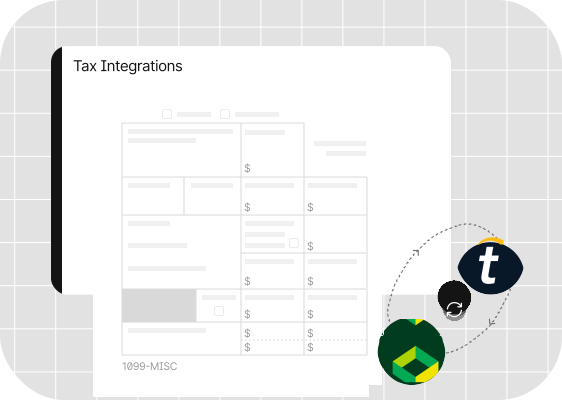
Crucially, Tipalti’s automated tax compliance engine handles the full spectrum of regulatory requirements, including W-9 and W-8 collection for global partners. The Zenwork Tax1099 integration solves the final mile of compliance, enabling you to e-file 1099-NEC, 1099-MISC, and 1042-S forms directly to the IRS and state agencies from the dashboard.
This integration removes the risks associated with exporting sensitive data to external filing tools.
2. Routable
Routable positions itself as a modern, API-first solution designed to simplify your day-to-day AP workflow. It is particularly strong for teams using QuickBooks Online, offering a deep sync that many competitors struggle to match. Its architecture supports mass payouts to over 220 countries and 140+ currencies via CSV upload or API, making it a flexible choice for scale-ups.
Routable’s focus is on reducing the busy work of AP, claiming to cut manual payment tasks by 80%. It automates the collection of W-9 and W-8 forms during vendor onboarding, ensuring that tax data is captured before payments are made.
However, finance leaders should note that while it excels at domestic AP and mass payouts, its tax filing capabilities are often more focused on form preparation rather than the complex, multi-entity tax governance found in enterprise-grade platforms.
3. Trolley
Formerly Payment Rails, Trolley markets itself as a payouts infrastructure built for the internet. It is heavily focused on the creator economy and pays over 5 million recipients globally. A key technical differentiator for Trolley is its dual focus on IRS tax compliance (1099/1042-S) and DAC7 compliance for the EU/UK, making it a strong contender for platforms with a heavy European user base.
Trolley offers flexible integration options, ranging from no-code quick settings to deep API embedding. While it is a powerful payout engine for gig workers, traditional finance teams may find it less suited to standard corporate AP workflows than a unified platform like Tipalti.
4. Hyperwallet
Hyperwallet powers PayPal’s mass payout capabilities. It is designed for marketplaces and platforms that need to fund payouts in multiple currencies (holding funds in up to 24 currencies) and disburse them to millions of sellers. Its strength lies in its full-stack payout capabilities, offering payees a choice of methods, including PayPal/Venmo, direct debit, and cash pickup.
For 1099 automation, Hyperwallet provides integrated payee verification and tax reporting. However, the ecosystem is tightly coupled with PayPal’s infrastructure. This offers immense global reach but can limit flexibility if you want to fund payments from non-PayPal sources or manage a unified vendor master file outside of the “wallet” paradigm. It is a great solution for B2C payouts, but often requires a separate system for B2B vendor management.
Payment Processors With Transaction-Based Tax Reporting
If your business operates as a marketplace or platform where you facilitate transactions between buyers and sellers, you might rely on a payment processor rather than a traditional accounts payable system.
Platforms like Stripe Connect, PayPal and Square operate differently from the solutions mentioned above. They act as the Payment Settlement Entity (PSE), which fundamentally shifts your tax reporting obligations.
1. Stripe Connect
Stripe Connect is the default infrastructure for many on-demand marketplaces and SaaS platforms. It handles the complex flow of funds between you, your customers and your service providers using a “Connected Account” architecture. From a tax perspective, Stripe takes on the heavy lifting of identity verification (Know Your Customer) and tax reporting.
Because the payments flow through Stripe’s credit card network, Stripe generates and files Form 1099-K for your payees once they hit the reporting threshold. This offloads a massive compliance burden from your finance team, as you are not required to file a 1099-NEC for payments already reported on a 1099-K.
However, its reporting is strictly transaction-based. It typically does not handle 1099-NEC filings for payments made outside the platform (e.g., checks or ACH), leaving a gap for your non-marketplace vendors.
2. Square
Square offers a dual approach depending on which product you use. Square Payments acts as a PSE, automatically filing Form 1099-K for sellers who meet the volume thresholds—with specific logic built in for states with lower limits, such as Massachusetts ($600) or Illinois ($1,000).
Separately, Square Payroll can manage your 1099-NEC filings for contractors. However, finance leaders should be aware of specific limitations. Square Payroll explicitly states that Form 1099-NEC is no longer part of the Combined Federal/State Filing (CF/SF) program.
This means you may still need to file manually with state revenue departments in jurisdictions like Oregon or Pennsylvania, creating a hidden compliance workload that fully automated platforms like Tipalti resolve.
3. PayPal
PayPal is one of the most common payment tools, but its tax reporting rules for 2025 are a bit different from what you might expect. While most people expect a tax form for anything over $600, PayPal is currently sticking to the older, higher federal threshold.
Generally, they will only issue a Form 1099-K if a payee earns more than $20,000 USD and has more than 200 transactions. However, do not get too comfortable with that $20,000 limit, because some states have stricter laws that require PayPal to file much sooner.
There are a few other specific scenarios that trigger a form regardless of those thresholds. If PayPal had to hold back taxes from an account, known as backup withholding, because the user did not provide a valid tax ID, they would issue a 1099-K regardless of how much money was sent. Additionally, if you pay contractors in crypto assets like PYUSD, PayPal tracks those payments separately from standard cash payments and issues a distinct 1099-K for them.
The Tie-Breaker Rule
Understanding the interaction between these processors and your own filing obligations is critical to avoiding double-reporting. IRS regulations state that if a payment is reportable on Form 1099-K, it is not reportable on Form 1099-NEC.
In other words, if you pay a freelancer $5,000 via Stripe and another $5,000 via check, you must be careful to only report the check payment on your 1099-NEC. A unified automation platform can often filter these transaction types automatically to ensure your filing is accurate.
Tax-Only Tools That Automate 1099 Filing but Rely on External Payment Data
If you already have a payment process you love but just need a way to submit forms to the IRS, a tax-only tool might be your bridge. These platforms specialize exclusively in the generation, distribution, and e-filing of information returns.
They do not touch your money. They only touch your data. This architecture requires a robust ETL (Extract, Transform, Load) process to move payment records from your ERP or bank system into the filing software.
1. Tax1099 (Zenwork)
Tax1099 is a powerhouse in the e-filing space, known for its deep feature set and reliability. It supports a wide range of forms beyond just the standard 1099-NEC and MISC, handling everything from payroll forms to ACA reporting.
For finance teams using Tipalti, Tax1099 offers a seamless integration that eliminates the need for manual file uploads. You get the best of both worlds—a robust payment engine and a specialized tax filing system that talk to each other directly.
2. Track1099
Track1099 is a favorite among smaller businesses and accounting firms for its user-friendly interface and transparent pricing. It excels at digital delivery, allowing you to email secure links to contractors so they can download their forms, which saves significant postage costs.
While it offers CSV imports from major accounting platforms like Xero and Bill.com, it lacks the deep, enterprise-grade API connectivity found in larger systems.
3. Yearli (Greatland)
Yearli is a comprehensive compliance platform that offers both federal and state filing services. It is particularly strong for businesses with employees and contractors across multiple states, as it has a robust engine for handling the nuances of different state filing requirements.
However, like other tax-only tools, its accuracy is entirely dependent on the quality of the data you import. If your Vendor Master File has bad addresses or missing TINs, Yearli will faithfully file that bad data, leading to penalties later.
The Data Transformation Risk
The hidden cost of these tools is the manual labor required to prepare the data. You must export payment histories, clean up the columns, verify that W-9 data matches the payment record and then upload it. This manual intervention is the single biggest source of filing errors.
A dropped row in a spreadsheet or a shifted column can result in misreporting income for hundreds of contractors. For high-volume businesses, this risk often outweighs the cost savings of a standalone tool. You can read more about the filing logistics in our guide to filing 1099 online.
Why Manual 1099 Workflows Break Down as Freelancer Volume Grows
There is a specific tipping point in every finance department where “we can handle this manually” turns into “we are drowning.” Managing tax compliance for fifty contractors is a nuisance, but manageable with a decent spreadsheet.
Managing five hundred or five thousand is a full-time job that exposes your organization to significant liability. The friction doesn’t grow linearly—it compounds.
W-9 Collection Delays
The most immediate breakdown happens during data collection. If you rely on email to collect W-9s, you inevitably end up chasing ghosts in December. Contractors change email addresses, move addresses, or simply stop responding once the project is done.
If you don’t have a valid tax form on file by the time you need to file, you are left with two bad options: a file with missing data that invites a penalty or a scramble to contact people who have no incentive to reply.
TIN Mismatches Discovered Late
Even if you collect the forms, manual workflows rarely include real-time validation. You might have a W-9, but if the contractor wrote their LLC name but used their personal Social Security Number, the IRS will flag it as a mismatch.
These B-Notices often arrive months later, requiring you to issue corrections and potentially begin backup withholding of 24% on future payments. Catching these errors manually is difficult and often unreliable at scale. You need a system that checks the IRS database as soon as the data is entered.
Spreadsheet Tracking and Financial Drag
Operationally, the reliance on spreadsheets is a high-wire act without a net. To file your 1099s, you must aggregate payment data from every source, such as wires sent via the bank portal, checks cut from the ERP, and perhaps payments made via third-party apps. Merging these disparate data sets is where errors happen.
A single shifted row or a formula error can result in misreporting income for hundreds of people. Beyond the risk, the cost is unsustainable. Industry research shows that the average cost to process a single invoice and payment manually hovers between $12 and $30, whereas best-in-class automation drives that cost down to under $5.
What a Scalable 1099 Automation Workflow Looks Like
You build a scalable workflow by reversing the traditional order of operations. Instead of paying now and chasing paperwork later, you establish a digital gatekeeper that ensures compliance before a single dollar moves. This shift turns tax compliance from a year-end cleanup project into a proactive, always-on function of your payment stack.
Step 1. Digital Onboarding
The process starts with self-service. You stop accepting W-9s via email attachments. Instead, you direct every new payee to a white-labeled portal where they enter their own legal name, address, and tax information.
This shifts the data entry burden from your AP team to the vendor, ensuring that the data originates from the source. By making this step mandatory before funds are released, you dramatically reduce the likelihood of missing W-9s.
Step 2. Real-Time Verification
Once the data is entered, the system acts immediately. A scalable workflow performs a TIN match against the IRS database in real-time. If the name and Tax ID don’t match, the system rejects the form and notifies the payee to fix it immediately. This happens months before tax season, preventing the invalid data from ever sitting in your ERP.
Step 3. Continuous Monitoring
You shouldn’t be running SQL queries in December to see who hit the $600 threshold. Your automation platform acts as a continuous ledger, tracking every payment against the reporting limits across all your entities. It automatically flags who needs a form and who doesn’t, separating your corporate vendors from your independent contractors without you having to sort them manually.
Step 4. Automated Execution
When January arrives, the filing process becomes a non-event. Because the data was validated at the door and tracked throughout the year, generating the forms is just a matter of review. The system generates the digital PDF, emails a secure download link to the payee and handles the electronic transmission to the IRS and state agencies.
To understand the specific box-by-box requirements that the software handles for you, you can review our 1099 instructions guide.
Automate Your Entire Tax Lifecycle
Stop managing spreadsheets and start managing strategy. See how Tipalti collects, validates, and files 1099s automatically.
How Tipalti Supports Payment-Driven 1099 Automation
The hybrid model of paying both corporate vendors and thousands of gig workers is the new standard for modern businesses. Tipalti is designed to unify these two workflows into a single tax compliance solution.
By consolidating your AP automation and mass payments into a single system, you eliminate data silos that create compliance gaps.
Global Reach with Local Compliance
For businesses scaling internationally, Tipalti handles the complexity of collecting W-9s for domestic partners and W-8s for international partners within a single portal. The system applies the correct tax logic based on the payee’s country, ensuring you’re not just compliant with the IRS but also prepared for global reporting.
It automatically generates 1099-NEC and 1099-MISC forms for US payees and 1042-S forms for foreign payees, all from the same payment data.
Data Integrity You Can Trust
Because Tipalti is the engine moving the money, payment, and tax records remain closely aligned within the same system. You don’t need to reconcile a bank statement against a spreadsheet because the payment event is the tax event. This helps improve general ledger accuracy and reduces reconciliation risk.
This level of integration transforms operations. As Bradley Clifford, Assistant Controller at Stack Overflow, noted: “The amount of time that’s been saved from moving to an automation process is very significant. We’ve removed 90% of the manual elements from the process, and we’re making it super easy for everyone at each stage to understand what’s going on.”
You can read more about their journey in the Stack Overflow customer story.
Choosing the Right 1099 Automation Approach
Price is obviously important when selecting the right platform, but just as important is matching the software architecture to your specific operational reality. The decision usually comes down to the three factors of volume, payment rails, and geography.
Volume and Growth
If you manage fewer than 50 contractors, a tax-only tool like Tax1099 is likely sufficient. You can handle the manual CSV exports without overwhelming your team. However, once you cross into the hundreds or thousands of payees, that manual data transformation becomes a liability.
At this scale, a payment-driven platform is essential to eliminate the reconciliation work and ensure your data remains accurate without constant human intervention.
Payment Rails
Look closely at how you move money. If you primarily pay via credit card, a processor like Stripe Connect handles the 1099-K for you, simplifying your workload. But if you pay via ACH, wire or check (which is common for B2B relationships), the reporting obligation falls squarely on you.
In this scenario, a payment-driven platform can significantly reduce the need for manual reporting.
Global Ambitions
Finally, consider your hiring roadmap. If you plan to hire international talent, a US-centric tool that only handles W-9s will become a bottleneck. You need a system capable of managing the complex W-8/1042-S requirements to support your expansion without triggering compliance risks abroad.
Turning Tax Compliance Into an Advantage
1099 compliance is ultimately a data governance challenge, not just a paperwork problem. If your vendor master file is clean and your TINs are validated, year-end filing is a simple export. If your data is messy, it becomes a high-risk accounting project.
The shift to a modern finance function means moving from reactive year-end cleanups to proactive, automated data governance. To implement a system that captures and validates tax data before a payment is ever made, explore Tipalti Mass Payments today.
1099 Automation Platform FAQs
Do I need separate tax software if I automate payments?
Not necessarily. If you choose a payment-driven platform like Tipalti, the tax compliance engine is built in. It handles everything from W-9 collection to e-filing without needing a third-party tool. However, if you use a simpler payout tool that lacks tax features, you will need to license a separate tax-only solution like Tax1099 to handle the filing.
Can I automate 1099s if I pay freelancers via ACH and checks?
Yes, but you need a Payment-Driven platform. Payment Processors like Stripe generally only automate 1099-K filings for credit card payments. If you are cutting checks or sending ACH transfers directly from your bank, you need a system like Tipalti to track these non-card payments and generate the required 1099-NEC forms.
What’s the difference between 1099-NEC, MISC, and K?
The 1099-NEC is for nonemployee compensation, covering services performed by contractors. The 1099-MISC is for other payments like rent, royalties or legal settlements. The 1099-K is filed by payment processors for credit card transactions. Understanding which form applies to which payment is critical for avoiding duplicate reporting.
When should a business switch from manual 1099 preparation?
You should switch the moment you cross the IRS e-filing threshold of 10 returns, or when your contractor volume exceeds what one person can manage in a few days. If you are managing more than 50 payees, the risk of data entry errors and the cost of manual labor typically outweigh the cost of software, making automation a strong ROI consideration for high-volume teams.
