

When I started at Tipalti, we decided to completely modernize our finance stack for our next phase of growth. One of my favorite aspects of my career has been putting cutting-edge systems and technology in place to help our people and processes. To me, that’s just fun.
Because Tipalti is inherently driven by innovation, our strategy was all about accelerating that momentum. Number one, we upgraded to an enterprise-grade ERP. Number two, we expanded our in-house accounting team. Once those two decisions were made, it was about hiring the right people and getting our ERP implemented. After that, we wanted to fill out our tech stack and move to the next layer of technology. We already had Tipalti, so accounts payable was a no-brainer. But sometimes, with companies at this stage, accounts payable might be the last thing they try to tackle.
I sat down with my AP management team to talk about the key questions that arise after an ERP implementation and why AP automation should be prioritized as that next layer of technology adoption.
Key Takeaways
- While foundational, ERPs lack the native, specialized features required to manage complex AP processes efficiently.
- Relying entirely on an ERP creates operational bottlenecks, forcing AP teams into manual workarounds that become unsustainable as transaction volumes grow.
- True efficiency is achieved when your ERP is seamlessly integrated with an AP automation solution, enabling a secure, end-to-end data flow.
ERP Limitations in Accounts Payable
What are the limitations of ERPs when it comes to managing the AP workflow?
ERPs are designed for broad functionality across departments, such as finance, procurement, and inventory, and they’re usually a one-size-fits-all solution. Customization in ERPs can be complex and expensive, often requiring IT support or external consultants to tailor the AP process, including approval workflows, tax regulations, automation, OCR, and invoice storage.
ERPs often lack specialized AP features such as vendor portals, multi-currency support, advanced invoice scanning (OCR), and purchase order matching capabilities. Plus, customizing and integrating these features with your ERP can be complex and costly.
While it’s true that ERPs can handle basic invoice processing, they often struggle with the complexities of two- or three-way matching (purchase orders, receipts, and invoices), and manual intervention is frequently needed to resolve these discrepancies, which is unsustainable in the long term for your AP team.
Overcoming ERP Gaps with Automation
How does AP automation solve ERP limitations?
AP automation tools with advanced AI capabilities provide highly customizable workflows, allowing businesses to tailor invoice routing, approvals, and exception handling based on their needs. They often come with vendor self-serve portals that streamline the onboarding process. Vendors can directly input their own banking, tax, and compliance information, which is then automatically validated (through TIN matching, banking verification, etc.) and entered into the system. This reduces manual errors and accelerates onboarding.
Additionally, AP automation solutions provide real-time dashboards and analytics, offering detailed insights into invoice statuses, payment schedules, invoice information, accounting details such as GL account coding, and cash flow forecasting.
One thing that really stands out is that ERP interfaces are often clunky and outdated, making them difficult for AP teams to use efficiently, which can lead to processing errors or delays. AP automation solutions directly solve this issue.
The Power of Ecosystem Integration
What is the benefit of having an AP automation solution that directly integrates with an existing ERP?
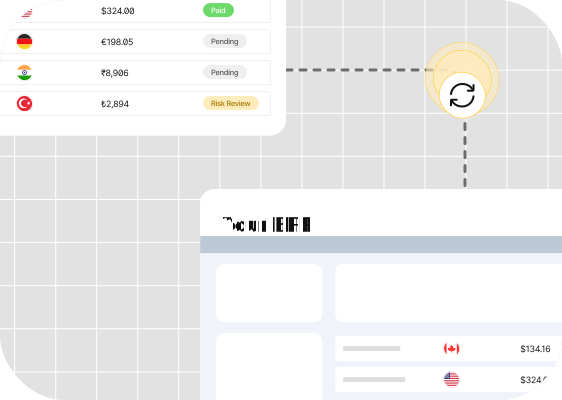
Data flows automatically between the two systems without the need for manual intervention—invoices, purchase orders, and payment information sync to your ERP. This enables full end-to-end automation of the AP process, from invoice capture, validation, and approval to payment processing and reporting—all within a single system.
A streamlined integration between your ERP and AP automation tool ensures full transparency and auditability across the AP process. All actions, such as approvals, payments, and changes to invoice data, are automatically logged in both systems. Some of the benefits include:
- Faster processing times that allow companies to reduce their invoice backlog, accelerate payments, and take advantage of early payment discounts.
- Improved communication and faster payment cycles that lead to stronger vendor relationships (vendors appreciate the transparency and efficiency).
- Reduction in fraud risk and payment errors that safeguard the company’s finances (automation enforces compliance with internal controls).
Choosing the Right AP Partner
What are the key indicators that an AP solution is the right choice for your ERP?
The solution should support API-based integrations that allow real-time data syncing, like invoices, purchase orders, and payments, without requiring custom development. It should automate the entire AP workflow from invoice capture, data extraction, and validation to approval routing, three-way matching, and payment processing. Here are some critical features to keep in mind:
- Scalability: The AP solution should easily scale with your business as your transaction volume, vendor base, and geographic reach grow.
- Reporting and analytics: The AP solution should provide real-time visibility into your processes.
- Regulatory compliance: The AP solution should offer security features to protect against fraud and unauthorized payments.
- Self-service portal for vendors: The AP solution should improve communication while reducing the manual workload for your team.
Overall, you should look for a solution that already has customized workflows that can adapt to your unique business requirements.

A Message for Finance Leaders
What is the best approach for finance professionals who think they can get by on an ERP alone or think they don’t need an AP solution right now?
While ERPs are powerful tools for managing financial operations, they often fall short in addressing the specific challenges of AP. By recognizing these limitations and considering the advantages of a dedicated AP solution, finance professionals can position their organizations for greater efficiency and compliance. Investing in AP automation after an ERP implementation is not just about keeping up—it’s about leading and having an advantage in a rapidly competitive market.
