

 Back
Back 

Paying suppliers, vendors, or partners across borders is a complex and challenging process, requiring navigation of various banking rules, fees, and compliance requirements.
The more payments you make, the harder it is for manual workflows to keep up with local regulations while ensuring payouts are secure, accurate, and punctual.
This guide explains how a cross-border payouts API automates global payments and compliance to streamline manual workload. You’ll also learn key features to look for, top solution options, and tips on building the foundations for a scalable system.
Key Takeaways
- Cross-border payout APIs automate and scale global payments, reducing manual effort, improving compliance, and accelerating financial close.
- Payout APIs can handle multi-currency payments, local rails, and international regulatory requirements.
- The best cross-border payout APIs integrate seamlessly with your existing systems, allowing developers to test and build custom payment workflows to boost efficiency.
- Successful API implementation requires clear planning and collaboration between developers and finance teams before rollout.
What Is a Cross-Border Payouts API? (And How It Works)
A cross-border payouts API (Application Programming Interface) is a financial infrastructure that enables your business to send money securely to suppliers, users, or partners in other countries—automatically and at scale from within your platform.
Payout APIs are digital interfaces that enable software systems to communicate and exchange data in real time.
They act as an intermediary between your website or app and financial institutions, giving you a customizable solution to make global payments in multiple currencies—without needing to integrate with different local banks.
By handling the payment process from payment trigger to execution in the background, API payout tools reduce transfer times, FX costs, and cross-border payment compliance overhead—freeing your team to focus on growth rather than payment operations.
Payout APIs offer an effective alternative to managing cross-border payments through bank portals, spreadsheets, and compliance checklists that struggle to scale as payee volume grows.
With the global cross-border payments market projected to reach $320.73 billion by 2030, the technology has become crucial for operational efficiency and strategic success. Open Banking API call volume is predicted to grow to 722 billion by 2029, from 137 billion in 2025, according to a Juniper Research report.
In other words, cross-border payout APIs are fast becoming the industry standard for international payments—table stakes for businesses wanting to stay competitive.
Note: Payout APIs differ from payment gateway APIs, which handle inbound payment collection (e.g., e-commerce product purchases). A payouts API sends money out, with infrastructure to support reliable transactions across currencies, countries, and compliance requirements.
How Cross-Border Payouts APIs Solve Legacy Payment Challenges
A cross-border payouts API eliminates inefficiency by automating and standardizing your payment process.
Sending money across borders has traditionally been expensive, slow, and operationally intensive. The more countries or territories you expand into, the more friction you experience.
Each new market introduces additional bank portals, compliance requirements, and manual reconciliation demands that increase pressure on staff and systems.
The result is payout delays or failures, regulatory risk, and an unreliable payee experience that causes churn and reputational damage.
Here’s how implementing the right solution solves common challenges and supports growth:
| How a Payout API Solves It | How a Payout API Solves It |
|---|---|
| Manual processes that don’t scale | Sanctions and fraud risk |
| Slow settlement times | Enables same-day or real-time payouts via local payment rails. |
| High FX fees and hidden costs | Provides transparent, competitive FX rates with fewer markups for consistent financial planning. |
| Time-consuming reconciliation | Cross-Border Payout Challenge |
| Payee tax compliance burden | Collects and manages tax documentation from payees at onboarding. |
| Sanctions and fraud risk | Automates Know Your Customer (KYC), Anti-Money Laundering (AML), and sanctions screening before payment. |
| Poor payee experience | Automates payouts in local currency and rails, improving speed and accuracy. |
Even before the recent wave of AI-driven finance tools, PwC found that automation could reduce time spent on financial tasks by 30–40%—a baseline that modern solutions continue to build on.
This frees up time for strategic tasks such as nurturing partnerships and financial planning that grow your business.
Types of Cross-Border Payout APIs
Various types of cross-border payout APIs support global payment functionality in different ways. Below are some common solutions.
- Payout APIs: Designed to integrate with your platform or product to automate mass payments without building infrastructure from scratch. They offer a seamless white-label payout experience within an existing system. Tipalti’s Payout API is an example of this type of API.
- End-to-end payouts platforms: Full-service software that manages the entire payout process in one place, including FX, compliance, payee onboarding, and reconciliation. These are the most complete solutions for replacing manual cross-border transactions. Tipalti Mass Payments is an example of this type of API.
- FX and currency conversion APIs: Specialist APIs to convert and move money across currencies, helping reduce FX costs and increase FX control. These are often used as components within a broader payments stack rather than as standalone solutions.
- Local payment network APIs: Built for deep coverage in specific regions or corridors rather than global reach. For businesses with concentrated payee bases in markets like Latin America, Africa, or Southeast Asia, these APIs enable faster and cheaper local settlements.
- Recurring billing APIs: Designed to help streamline subscription-based payment flows and simplify scheduled disbursements. They’re best suited to businesses with predictable payouts, rather than variable or high-volume payouts.
- Risk management APIs: Focused on fraud detection, sanctions screening, and compliance verification to reduce the risk of bad actors and regulatory penalties. These are typically integrated alongside another payment solution rather than used independently.
- Banking-as-a-service (BaaS) APIs: Infrastructure-level service providers that offer the building blocks to create payment products. They offer strong flexibility, but can require significant engineering investment, making them better suited to large enterprises.
The right type of cross-border payment API depends on your payout volume, the countries or regions you operate in, and your internal resources.
For most businesses scaling internationally, an end-to-end global payment platform offers the widest coverage and efficiency with the least overhead. However, other types have their place, particularly when complementing an existing solution.
Which Businesses Need a Cross-Border Payouts API?
If your business pays (or plans to pay) suppliers or partners abroad regularly and at scale, you’ll likely benefit from a cross-border payout automation API.
Here are some common use cases and how using an API can improve performance.
Marketplaces Paying Global Sellers and Users
Whether you’re running an online marketplace, digital asset platform, or crowdfunding service, your payees expect prompt payments in their local currency. Slow or inconsistent payouts erode trust, increase inquiries, and cause churn.
A payouts API streamlines onboarding, so payees are up and running and receiving payment faster. As payments scale, the API supports increased volume—without processes breaking down every time you add a new country.
Gig Economy Platforms Paying Global Workers
Like marketplaces, gig economy workers expect prompt payment. However, payout frequency can be higher, with added expectation for same-day or on-demand payments.
At scale, this means processing thousands of individual payouts across multiple countries, currencies, and payment methods on a rolling basis.
Achieving this manually requires significant headcount. A payout API, however, handles volume consistently, scaling to deliver the speed and local coverage gig workers demand—without ramping up hiring.
With more choice than ever over the platforms, a payout API can be the difference between a gig worker choosing you over a competitor.
Affiliate and Influencer Networks Paying Global Creators
Creator and affiliate programs often operate across dozens of countries, with payees ranging from individual influencers to large media networks.
Payout amounts, frequencies, and tax obligations vary significantly by region, increasing the regulatory burden on finance teams.
A cross-border payouts API handles these complexities automatically. End-to-end solutions like Tipalti can collect and validate W-9/W-8 series tax forms, or VAT and local tax IDs during onboarding, then generate submission-ready 1099 and 1042-S reports to eFile during tax season.
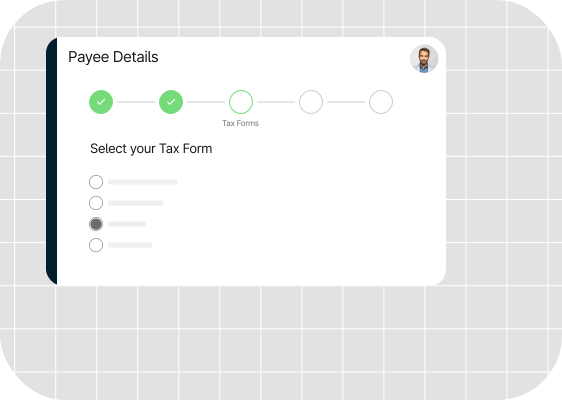
Additionally, each payment is subject to fraud prevention checks to ensure legality.
It frees finance teams from chasing down tax forms or manually running screening checks each month.
SaaS Platforms Disbursing Partner Commissions Internationally
Expanding channel and referral programs surfaces new commission obligations across borders.
For example, platforms that pay suppliers in the EU must comply with VAT, GDPR, and financial transparency regulations.
For SaaS businesses with global partner networks, manually managing payouts raises compliance and reconciliation headaches that cause delays and damage supplier relationships.
A payouts API automates the calculation-to-disbursement workflow and keeps partners paid accurately and on time, regardless of where they’re based.
Staffing or Recruitment Firms Paying Contractors in Multiple Countries
Staffing firms managing international contractor workforces face a compounding set of challenges:
- Different payment methods by country.
- Varying tax documentation requirements.
- Payees who rely on timely payouts as income.
Cross-border payout automation API platforms provide the infrastructure to consistently meet those expectations—without building a bespoke solution for every new market.
Insurance Companies or Financial Services Disbursing Claims Globally
For insurers and financial services businesses, payout speed isn’t solely an operational metric—it directly impacts customer trust. A delayed or failed payment damages confidence at the moment a customer needs it most.
Cross-border payouts APIs and integration tools enable faster, more reliable disbursements across borders, with the compliance controls that regulated industries need built in from the start.
E-commerce Businesses Paying Overseas Suppliers
Global e-commerce operations depend on supplier relationships that can span countries and currencies. For example, you might rely on manufacturers in China and marketers in India.
Late or error-prone payouts put your relationships and supply chains at risk, hindering stability and growth.
A payouts API streamlines the supplier payment process, reduces FX costs, and gives finance teams visibility into payment status without logging into various banking portals.
Scale across borders seamlessly with a powerful API
Access a robust payments infrastructure to automate payments to 200+ countries and territories in 120 currencies with 50+ payment methods—without complicated setups.
What to Look for in a Cross-Border Payouts API
Choosing the right cross-border payouts API is a long-term infrastructure decision. The right solution will enable you to scale into new markets efficiently. However, the wrong fit can result in costly migrations, compliance gaps, and a poor payee experience that require an expensive overhaul.
Use this checklist to evaluate any software before you commit.
| Cross-Border Payout API Feature | What to Look For in a Cross-Border Payout API |
|---|---|
| Currency coverage and FX rates | Broad currency support across key countries/territories, with transparent FX pricing and no hidden markups. |
| Diverse payment methods | Support for local bank transfers, such as global ACH, SEPA, SWIFT, wire, and digital wallets, as well as bulk payment functionality. |
| Compliance and regulatory coverage | ISO 20022 and data protection support. Automated KYC/AML, OFAC screening, and KPMG-approved tax validation. |
| Speed and settlement times | Clear transparency on settlement times. Look beyond broad “fast payments” claims. |
| Scalability | The ability to handle increasing payout volume and new geographies without a platform change or reintegration. |
| Flexibility | Custom payment workflows and approval chains, and the ability to test API, iFrame, and hosted portals. |
| Payee onboarding and self-service portal | A hub for payees to manage banking details, tax forms, and payment preferences in their native language. |
| Reconciliation and reporting | Automatic payment matching, real-time status updates, and transaction-level reporting to improve transparency and financial planning. |
| Integrations | Native integrations and APIs for ERPs, accounting systems, and your financial stack. |
| Uptime, reliability, and SLA guarantees | Documented service level agreements (SLAs) and a strong track record of uptime and payment success rates. |
| Developer experience | In-depth documentation, a sandbox environment, IPN, and reliable webhooks for real-time payment status updates. |
| Multi-entity and multi-subsidiary support | Native support for multiple legal entities or subsidiaries built into the platform. |
| Pricing and fees | Transparent pricing with no hidden fees across FX margins, transaction fees, and platform costs. |
This table serves as a starting point when assessing and speaking to payout API providers. While not every API will tick every box, the right one should meet your current and future requirements.
Prioritize features that match your biggest challenges and ensure the solution has the functionality to support your growth.
4 Best Cross-Border Payout APIs to Scale Global Payments
The top cross-border APIs help you automate global payments, customize workflows, and track transactions.
End-to-end fintech platforms go deeper still, embedding payee onboarding, tax compliance, and real-time reconciliation into their APIs.
Here are 4 widely used solutions and what they offer.
1) Tipalti: Best for Cross-Border Scalability and Compliance Automation
Tipalti is a global mass payment solution that automates the entire payout lifecycle—from payee onboarding and tax form collection to payout execution and ERP reconciliation.
Tipalti’s easy-to-integrate REST API includes a Developer Hub with sample code, a sandbox for testing, and real-time payment visibility features that let you programmatically track payment status.

Businesses can tailor payout workflows from payee creation to disbursement to match their business needs. Tipalti’s production environment gives developers the ability to configure and test hosted payee portal or embedded iFrame, execute sample payment runs, and establish integrations to ensure a successful launch.
Once set up, finance teams can automate payouts to 200+ countries and territories in 120 currencies, using multiple payment methods with security and compliance built in at every layer.
Access is protected via SSO, MFA, and IP restrictions, payee data is encrypted with role-based permissions, and a KPMG-approved tax engine validates tax IDs across 62 countries.
It’s built for companies that want to automate compliance, fraud prevention, and financial workflows as global payouts scale.
2) Stripe: Best for Digital Platforms With Developer Resources
Stripe Connect’s APIs allow SaaS platforms and marketplaces to embed payments and payouts into their products.
Businesses can securely onboard payees, tailor payout timing, and pay users in over 150 countries.
The software’s flexibility makes it a popular option for developer-led organizations, but custom workflows can require added engineering resources—something to keep in mind when exploring Stripe alternatives.
3) Payoneer: Best for Single-Entity Cross-Border Payouts
Payoneer’s cross-border API is popular with freelancer platforms and marketplaces paying global partners and suppliers.
Businesses can automatically manage payments, transfers, and invoices in over 190 countries within their own infrastructure.
The software also automates currency conversion and provides access to financial data to increase transparency.
Payoneer’s simplicity is beneficial for single-entity payouts, but it lacks the in-depth payment experience growing organizations may need, as a Tipalti vs. Payoneer comparison shows.
4) PayPal: Best for Payouts to Unbanked Payees
PayPal’s Payout API (powered by Hyperwallet) provides the infrastructure to automate PayPal payouts in over 200 countries and regions, as well as Venmo transfers across 90 markets.
Its global reach and the ability to make payments with only an email, phone number, or PayPal ID make it a popular option for paying recipients without traditional banking access.
Advanced payout API features add onboarding and tax form collection, but the focus leans more toward streamlining payments within the PayPal ecosystem than broader payout flexibility—a key differentiator when evaluating Hyperwallet alternatives.
Getting Started with a Cross-Border Payouts API
While top payout API platforms make it easy to build the infrastructure, technology integration is only one part of a successful setup.
Effective implementation requires collaboration between developers, finance leaders, and operations teams to ensure your API benefits each part of the payout lifecycle.
Follow these best practices to create payout infrastructure that works at scale from day one.
1) Evaluate Your Payment Coverage Needs
Before evaluating platforms, consider your payees. Coverage varies significantly between API providers. Factor in your current markets and where you plan to operate in the next 2–3 years.
Ask yourself:
- Which countries and currencies do you pay into today?
- Are any of your key markets in regions underserved by global rails (e.g., Southeast Asia, Latin America, or Sub-Saharan Africa)?
- How is your payee base likely to grow geographically over the next 2–3 years?
Understanding your current and future markets upfront will help you choose a platform and develop an API that supports your business growth. It eliminates the need to switch providers and overhaul systems as you scale.
2) Define Your Payment Approval Workflows Upfront
Before implementing your payout API, map how payments move through your organization: who initiates and approves them, and what happens when the system flags something for review.
Create clear documentation to outline:
- What thresholds apply (e.g., payments above a certain value requiring senior sign-off).
- Which individuals or teams have the authority to approve payments in specific currencies or regions.
- The escalation path for flagged or failed payments (e.g., payments flagged for sanctions screening escalate to a senior finance manager before release).
Agreeing and configuring approval workflows before testing means fewer bottlenecks, clearer accountability, and a faster cross-border payment cycle.
3) Monitor FX Exposure
If you make payouts in different currencies, tracking FX exposure is crucial for managing costs—particularly in volatile markets driven by price fluctuations, interest rate differentials, and global instability.
Before committing to a provider, understand:
- When the exchange rate is applied—at the time of instruction, or at settlement?
- Whether you can lock in rates for predictable, scheduled payment runs.
- How the provider handles volatile currency pairs (e.g., payouts in Nigerian Naira or Argentine Peso).
Getting a handle on FX exposure early means you can manage costs proactively to keep financial planning reliable.
4) Audit Payee Data Before Migration
If you’re moving from an existing system, the quality of your payee data will directly affect how smoothly your new API runs.
Before migrating, review your existing payee records for:
- Incomplete or outdated banking details, particularly for payees in countries with complex account formats (e.g., IBAN, BSB, or CLABE).
- Missing or expired tax documentation (e.g., W-8, W-9, or VAT registration numbers).
- Duplicate payee records that could result in double payments.
Cleaning your payee data before migration will reduce the volume of failed payouts and compliance issues you’ll encounter in the early weeks of going live.
5) Test in a Sandbox Environment Before Going Live
The best global payments APIs feature a developer hub with a sandbox environment for testing new automations. Use it to simulate your full payment workflows, particularly edge cases that are easy to overlook, such as:
- Failed payments and retry logic.
- FX conversions across multiple currency pairs.
- Payee validation errors and rejection handling.
- Webhook behavior for payment status updates.
Thorough sandbox testing allows you to spot issues early and reduce surprises in production.
Before rolling out globally, run a pilot test in one or two markets to iron out issues before expanding. This limits risk and gives your team time to get comfortable with new workflows.
To support development, ensure your API captures and logs error responses and notifies teams if any part of the workflow fails.
Real-time alerts enable operations teams to make quick fixes to maintain a smooth experience for finance teams and payees.
Automate Global Payments with a Cross-Border Payouts API
As cross-border trade becomes standard across industries, finance teams are expected to deliver fast, accurate and compliant payments—not just to grow, but to stay competitive.
Expanding into new regions doesn’t have to stretch staff resources or hinder payee experiences. With the right cross-border payout API, teams of any size can build the financial infrastructure to confidently work with global suppliers.
See how Tipalti’s cross-border payout API helps developers customize and automate global payments without hassle.
Cross-Border Payouts API FAQs
What compliance and FX risks complicate global payouts?
Global payouts introduce new compliance checks, tax requirements, KYC/AML, and privacy obligations that may differ from North American regulations. Adhering to these is crucial to avoid regulatory penalties or blocked payments.
Additionally, exchange rate volatility, hidden conversion markups, and mistimed rate application can impact your profit margins at scale. A cross-border payouts API like Tipalti mitigates risk by automating compliance and providing transparent, predictable FX handling.
How do cross-border payment APIs facilitate international transactions?
A cross-border payments API connects your business systems to a global network of payment rails, including ACH, SEPA, SWIFT, wire transfers, debit cards, and PayPal via a single integration.
When a payment is triggered, a payout API like Tipalti handles validation, currency conversion, routing, and delivery automatically—using the most cost-effective option based on speed, location, and fees.
Should you build your own cross-border payment infrastructure or buy from a provider?
For most businesses, buying is the stronger choice. Building in-house means setting up new banking relationships, licenses, and compliance infrastructure in every market. The large investment of time and capital is best suited to global institutions.
A dedicated cross-border payouts API gives you immediate access to that infrastructure, with ongoing maintenance, compliance updates, and new market coverage handled by the provider.
How do cross-border payouts APIs ensure security and compliance?
Cross-border payouts APIs use data encryption in transit and at rest, tokenization of sensitive payee details, and role-based access controls to keep payments secure and compliant.
Mass payment platforms also automate sanctions screening, AML checks, and payee identity verification before payments, and maintain certifications for security frameworks such as SOC 2 Type II and PCI DSS.
