

When you manage cross-border payments through manual systems, it’s difficult to scale without processes becoming burdensome, error-prone, and a risk to payee satisfaction.
The best global payment platforms automate mass payments and compliance, so teams can scale efficiently and deliver a seamless experience in every new market.
This guide compares 7 top cross-border payment platforms for growing businesses. You’ll learn what each solution does, who it’s best for, and how to choose the right software for your business.
Key Takeaways
- Cross-border payment platforms enable seamless payments to international payees, handling FX, regulatory requirements, and end-to-end financial workflows.
- The top global payment solutions replace manual processes with end-to-end automation, streamlining onboarding, tax compliance, and payments to accelerate close and support growth.
- Businesses should prioritize software that supports global currencies, diverse payment methods, multi-FX, international KYC, AML, and tax reporting requirements.
- Compare platforms by evaluating how key capabilities like automation, compliance, and risk protection address your operational and strategic challenges.
The Hidden Cost of Legacy Systems (And How Cross-Border Payment Platforms Solve Them)
Managing cross-border payments manually through collated spreadsheets, banking portal uploads, and manual approvals works at low volume. However, once payee numbers scale, a legacy system of different intermediaries and disconnected tools starts to hold your business back:
- Payment exceptions and failed transactions consume more and more of your team’s time.
- Foreign exchange (FX) costs become hard to track and even harder to forecast.
- Handling compliance and tax administration across multiple jurisdictions becomes a tedious process of chasing missing details.
- Reconciliation in spreadsheets is increasingly laborious and error-prone.
- Payees inundate your team with payment update requests due to a lack of visibility.
- Every new market means building new manual processes from scratch.
The inefficiency of legacy systems shows up in settlement delays that damage payee trust, FX margins that erode margins, and compliance gaps that expose you to potential regulatory penalties.
Cloud-based cross-border payment solutions simplify global payouts by centralizing and automating your payment lifecycle.
Instead of chasing tax forms, manually screening payees, and reconciling transactions after the fact, finance teams get compliance automation, transparent foreign exchange (FX) pricing, and full transparency across every disbursement.
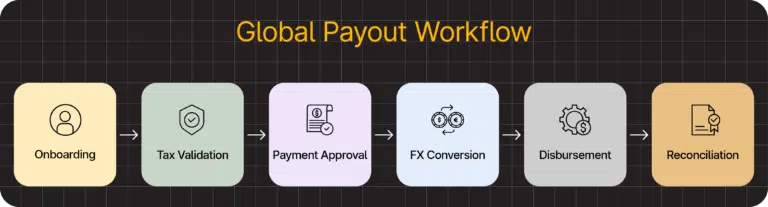
Platforms automatically complete transactions using the most efficient payment method to save time and money.
The result is lower monthly processing costs, risk, and admin effort—supporting smoother growth.
Here’s how legacy systems compare with modern fintech platforms on the key components of global payment processing:
| Cross-Border Payment Capability | Legacy Payment Methods (Banks & Manual Processes) | Modern Cross-Border Payment Platforms |
|---|---|---|
| Payment speed | Multi-day bank wires with limited tracking. | Fast settlement with real-time visibility. |
| Currency conversion | Marked-up FX rates, hidden transaction fees, limited multi-currency support. | Competitive FX rates, transparent pricing, multi-currency accounts. |
| Regulatory compliance | High manual burden, fragmented per country/territory. | Automated KYC/tax verification, built-in regulatory frameworks. |
| Tax administration | Manual form collection, high error risk. | Automated W-9/W-8 collection, 1099/1042-S filing. |
| Sanctions screening | Ad hoc or reactive. | Continuous AML, OFAC, and global watchlist screening. |
| Payment reconciliation | Spreadsheet-based and time-intensive. | Real-time reporting and native ERP syncing. |
If your business is expanding international trade, managing growing payee volumes, or facing pressure on compliance and audit readiness, implementing a dedicated platform isn’t just an efficiency gain. It’s a strategic advantage.
The right platform grows with your business, reducing errors and payment delays that legacy systems create before they become a risk to customer churn or reputation. Let’s look at how the leading platforms stack up.
Stop losing users to a poor cross-border payout experience
Your cross-border payment experience directly impacts payee trust, retention, and global growth. Download our free guide to learn how leading platforms turn payouts into a competitive advantage.
7 Top Cross-Border Payment Platforms for Scaling International Transactions
The right cross-border payment platform depends on your business needs.
Whether you want to reduce manual errors, improve global compliance, or scale without increasing headcount, these 7 platforms excel in supporting growing digital businesses and marketplaces.
| Platform | Overview | Pricing |
|---|---|---|
| 1) Tipalti | • Global mass payment coverage and automation. • Built-in tax compliance. • OFAC and sanctions screening. • APIs and native ERP integrations. • Best for automating and scaling cross-border payouts. | From $99 per month. |
| 2) Wise | • Multi-currency accounts. • Domestic payment systems. • Automated compliance. • Swift and API integrations. • Best for low-cost international money transfers. | Per transaction. |
| 3) Airwallex | • Multi-currency accounts. • Cross-border batch transfers. • Online payment gateway. • Built-in fraud protection. • Best for small digital businesses scaling internationally. | Free basic account. Paid plans from $12 per user per month, plus a platform fee. |
| 4) Payoneer | • Multi-currency payments. • Payment gateway. • Local receiving accounts. • Simple integrations. • Best for small businesses with a single entity. | Free account with fees per transaction. |
| 5) Stripe | • Global payment and collection. • Pre-built payment interfaces. • Robust payment APIs. • Custom fraud protection. • Best for custom payment development. | Fee-based by transaction and platform use. |
| 6) Trolley | • Global payout automation. • Multi-currency support. • Built-in tax compliance. • ERP integrations and APIs. • Best for global payouts to contractors. | From $49 per month. Additional fees for tax, ID verification, and integrations. |
| 7) Adyen | • Multi-channel payment processing. • Local acquiring licenses. • Performance tracking. • Payment APIs. • Best for enterprise-grade high-volume payment processing. | Per transaction processing plus payment method fees. |
Let’s explore how each platform helps you streamline and scale international payments.
1) Tipalti: Best All-Around Platform for Automating Global Payables at Scale
Tipalti is an end-to-end cross-border payment automation solution that lets you manage mass payments across the entire payment operations cycle.
Growing businesses use Tipalti Mass Payments to onboard and nurture partners, institute financial controls, execute global payments, and reconcile payables across multiple entities.

By switching from manual to automated processes, Tipalti users can save an average of $31K per month.
Tipalti’s award-winning capabilities include:
- Global payments. Trigger payments to 200+ countries and territories in 120 currencies and multiple payment methods, including international wire transfer, global ACH, prepaid debit card, and PayPal. Automatically validate data against over 26,000 banking rules to reduce payment errors.
- Advanced FX solutions. Make multi-subsidiary and multi-currency payments from a single account, with multi-FX and FX hedging to save on costly overheads and extra banking fees.
- Self-service portal. Easily onboard vendors in a custom-branded hub, with structured tax form collection, diverse payment options, automated verification, OFAC and global sanctions screening, and instant remittance notifications.
- Self-billing. Automatically generate invoices on behalf of payees to improve accuracy and free your team from chasing missing or incorrect details.
- Automated tax compliance. Collect and validate IRS forms (e.g., W-8 and W-9) and tax IDs with a KPMG-approved tax process. Then, generate and file year-end 1099/1042-S tax via Tipalti’s e-filing service for efficient, accurate reporting.
- Proactive fraud protection. Block or suspend payee payments, identify bad actors before they become a threat, and get real-time alerts with always-on fraud detection running in the background.
- ERP and marketing integrations. Centralize your finance stack by connecting to popular software, including ERPs like NetSuite, QuickBooks, Xero, and SAP, as well as performance marketing systems, SSOs, Slack, and more, without the need for coding or extensive development.
- Robust payout APIs. Connect seamlessly to a global payments network and develop custom payment workflows via REST APIs, supported by world-class documentation and a developer hub.
If your business manages complex, multi-entity payables across different countries or territories, Tipalti is a strong fit.
The software consolidates your payment process to reduce errors and speed up monthly close, while ensuring payee experience and compliance stay consistent as you scale. Its pricing model supports this, allowing you to seamlessly upgrade to more advanced capabilities when you need them.
Tipalti in action: Ad Tech platform PubMatic implemented Tipalti to automate global payments, streamline supplier and currency management, and improve compliance. The company reduced payment processing time to 3 minutes, improving overall efficiency and increasing customer satisfaction.
We’re saving massive amounts of time and have increased financial controls. With the Tipalti and NetSuite integration, we’ve streamlined as much as possible.
Jason Wechsler, VP Revenue Accounting and Finance Automation, PubMatic
2) Wise: Best for Transparent, Low-Cost International Transfers
Wise is a multi-currency account platform built to help businesses send and receive money worldwide, without hidden FX costs.
Wise uses a mid-market rate for cross-border transfers, removing the markups many banks add on top. Its transparency makes it well-suited to businesses that want predictable FX costs when paying suppliers, contractors, or invoices in different currencies.
Businesses can hold and transact in 40+ currencies, with dedicated account details in multiple countries. Local payment rails help payees receive money faster. Wise claims that 95% of payments arrive within 24 hours.
Key capabilities include:
- Mid-market FX rates with clearly stated conversion fees.
- Local account details in over 23 countries to speed up transfers.
- Batch payments for up to 1,000 recipients.
- Real-time compliance checks to keep transactions safe.
- Multi-user accounts with custom permissions and approval workflows.
- Accounting integrations with Xero, QuickBooks, and FreeAgent.
Wise works well for SMBs and scaling companies that need simple, cost-effective international transfers, without complex compliance requirements.
If you process payments in high volume (1,000+) or need robust tax compliance, sanctions screening, and deep ERP integration to meet regulatory requirements, consider a more comprehensive solution—such as Tipalti.
3) Airwallex: Best for Digital Businesses Scaling Internationally
Airwallex is a payments and financial platform designed for global businesses that need to streamline cross-border transfers.
Like Wise, Airwallex lets businesses send and receive payments in multiple currencies without expensive conversions, keeping FX costs low for batch payments. However, Airwallex’s functionality makes it a more feature-rich spend management solution.
Airwallex offers:
- Local bank accounts in multiple global currencies.
- High-speed transfers at interbank rates, regardless of transaction size.
- Global payment acceptance via cards and local payment methods.
- Multi-currency corporate cards to manage employee spending.
- AI-driven fraud detection with human review for dispute resolution.
- Real-time spending analytics to track payments and improve performance.
- No-code and API integration with accounting software and e-commerce platforms.
For SaaS companies or e-commerce operators that need diverse local currency support for cross-border payments, Airwallex removes the friction and expense of legacy banking and provides cost-effective technology to scale.
It’s less suitable for businesses with complex AP automation needs or high-volume multi-entity payments.
4) Payoneer: Best for Small Businesses with a Single Entity
Payoneer’s global payments platform allows businesses to send and receive payments from partners, customers, and suppliers in over 200 countries and regions.
The software has a strong focus on marketplace payments and the global gig economy, offering features such as multicurrency accounts, business funding, and workforce management to support growth.
As a cross-border payments platform, Payoneer includes:
- Local receiving accounts in multiple currencies.
- Payment processing from numerous sources, including bank transfers, credit cards, and e-wallets.
- Single, batch, and recurring global payments with automated scheduling.
- AML and KYC automation to support compliant hiring.
- End-to-end tax compliance, including W9, W-8BEN-E, W-8ECI, 1099, and 1042 forms.
- Payments API and partnership integrations connect Payoneer with e-commerce platforms, SaaS tools, and ERPs.
If you work with a single entity and have basic FX needs, Payoneer’s payment infrastructure offers everything you need to manage freelancers and marketplace vendors.
Businesses that need multi-entity support, FX hedging, and a custom-branded customer experience may prefer alternative options.
5) Stripe: Best for Developers Customizing Payments for Digital Platforms
Stripe is a developer-first global payments platform that helps online businesses accept, manage, and send payments worldwide.
The software’s primary strength is its flexible API. It’s a popular solution for SaaS and e-commerce companies with strong engineering teams that want to embed payments into their digital products.
APIs aside, Stripe’s pay-in and payout system supports:
- Various local payment methods, including ACH and credit cards.
- Global point-of-sale payment acceptance across cards, wallets, and local payment methods.
- Automated global tax collection, collection, and filing.
- Stripe Radar fraud protection to detect and block bad actors.
- Real-time reporting dashboards to track transactions and simplify reconciliation.
- Subscription and recurring billing tools, with automated revenue management workflows.
Stripe is beneficial for businesses that need a customizable checkout solution. However, it may not be the best choice for managing global disbursements. While Stripe allows you to send money to over 60 countries, you’ll need cryptocurrency-based transfers to extend global reach. Solutions like Tipalti offer more comprehensive global capabilities as standard.
Additionally, be mindful of pricing. Stripe’s standard fee structure runs at 2.9% + $0.30 per transaction, with additional charges such as a 1.5% international card surcharge and a minimum 1% currency conversion fee. These costs can compound at high volume.
6) Trolley: Best for Global Payouts to Contractors
Trolley’s global payout automation solution is built for businesses that pay contractors, creators, freelancers, and suppliers across multiple markets.
Where Stripe has the infrastructure to simplify collecting cross-border payments, Trolley’s features streamline payments by consolidating and automating the payout lifecycle.
Trolley’s payment services include:
- Payout automation across more than 210 countries and territories.
- Multiple payment methods, including local bank transfers, EFTs, PayPal, and digital payment wallets.
- White-label supplier onboarding with automated KYC, ID verification, and tax form collection.
- AML and global watchlist screening for new payees and payments.
- IRS and international regulatory compliance, including withholding and e-filing.
- Real-time payment tracking and status updates.
- Integration with popular ERP, CRM, and project management systems.
Trolley is a robust solution for platforms and marketplaces managing high-volume outbound cross-border payments and IRS tax compliance. However, its lack of FX hedging may be a drawback for businesses looking to reduce FX volatility in markets such as the UK and Europe.
Digital platforms seeking a cost-effective starting point will appreciate its modular pricing model, but expect to pay extra for features like tax compliance, integrations, and document validation. Other leading platforms include these features within set plans.
Note: Some Trolley users have reported operational disruptions following a recent banking partner change, including tighter timelines for payee re-verification and adjusted onboarding requirements. Always evaluate how cross-border payment platforms handle change management and communication before committing.
7) Adyen: Best for Enterprise-Grade High-Volume Payment Processing
Adyen’s unified commerce software is a payment gateway, processor, and acquirer that allows businesses to operate globally without multiple local service providers.
Its omnichannel ecosystem supports online and in-person payments, with over 250 methods, including credit cards, digital wallets, and local rails.
Additionally, Adyen’s direct acquiring model connects directly with card networks (e.g., Visa and Mastercard) to offer merchants more control, faster settlements, and in-depth financial insights.
This distinguishes it from aggregator platforms like Stripe, which process user payments through their own acquiring licence.
Other key functions include:
- Multi-currency handling.
- Real-time 24/7 payout automation to sellers, vendors, and partners.
- Revenue Protect risk management tools to combat fraud and optimize authorisation.
- Financial performance analytics, including channel performance and cash flow insights.
Adyen is a good choice for large enterprises with high-volume card processing needs. If your business focuses on outbound payments to contractors, suppliers, or partners, a dedicated mass payment automation solution like Tipalti or Trolley may be a better fit.
What to Look For in a Cross-Border Payment Platform
To narrow your list of options and better compare cross-border payment platforms, it helps to separate essential features from complementary extras.
The following capabilities have the biggest impact on global payment processing speed, cost, compliance, and team efficiency.
| Feature | What to Look For | Why It Matters |
|---|---|---|
| Payment speed and settlement times | Fast payment routing, real-time tracking, and clear SLAs. | Fast settlement improves cash flow liquidity and strengthens payee trust. |
| Global FX rates and currency conversion | FX hedging, lock-in rates, transparent fees, and multi-currency accounts. | FX markups compound quickly at high volume. |
| Compliance automation | Built-in KYC/AML and tax form collection/validation. | Compliance gaps create direct regulatory and audit risk. |
| Supported countries and currencies | Confirmed coverage for your specific markets. | Your platform should meet your expansion goals. |
| Fraud protection | Real-time AML monitoring and sanctions screening. | Fraud and compliance failures risk regulatory fines and reputational damage. |
| Payee onboarding | Self-service portal, multi-language support, and automated verification. | Manual onboarding is hard to scale, leading to delays and compliance risks. |
| Fees and pricing transparency | Clear plans, itemised fees, no hidden markups, and volume pricing. | Opaque pricing makes it impossible to forecast the true cost of ownership. |
| ERP integrations and APIs | Native integrations, real-time interoperability, auto-reconciliation, and APIs for custom workflows. | Strong integration reduces manual effort, accelerates payments, and improves visibility. |
Use these features as a starting point when comparing your options. Focus on capabilities that solve your current challenges, whether that’s lowering transaction costs, improving payee experience, or enabling scalability.
How to Choose the Right Cross-Border Payment Platform
Selecting the right cross-border payments platform depends on your business model and the scale and complexity of your payment operations.
Before evaluating and demoing software, it’s important to understand how it will solve your current challenges and support your growth plans.
Working through the following questions will refine your options and help you make a confident decision:
- Which payment corridors and currencies do we need? Map the markets you offer now and plan to expand into before evaluating. A payment provider with broad headline coverage may still have gaps in specific markets. Prioritize those that confirm support for your corridors.
- How complex are our compliance requirements? If you have payees across various countries, built-in KYC and AML, tax form collection, sanctions screening, and GDPR are non-negotiable. Evaluate whether platforms offer these as standard or if you need to budget for add-ons.
- How does the platform handle operational changes that could disrupt payments? Evaluate how providers manage banking relationships, compliance updates, and customer communication. Platforms that are transparent about changes to banking partnerships or regulatory requirements give you the lead time needed to avoid disruptions to critical workflows.
- What does our payment volume and frequency look like? Log your monthly payments to how many payees, and across how many countries. Use this to stress-test pricing models. A percentage-based fee that looks competitive at low volume can become your biggest cost driver as you scale.
- How much manual work are we doing today? If your team manages payments in spreadsheets or manually via bank uploads, prioritise platforms that support batch processing and workflow automation. If reconciliation is your main pain point, weigh ERP integration more heavily.
- What does our payee mix look like? Platforms vary in how well they handle mixed payee types. If you’re paying employees, contractors, and suppliers simultaneously, confirm the platform can manage different compliance and payment requirements across all three.
- How much time and resources can we dedicate to implementation? Some platforms offer more power but need significant setup and development expertise. Others are faster to deploy but less configurable. Filter out platforms that don’t match your team’s bandwidth.
Shortlist 2 or 3 global payment solutions that meet your needs, then research customer reviews and use cases to see how they help businesses like yours.
Request a demo to better understand capabilities. Seeing how a tool works first-hand is the fastest way to find out whether it’s the right fit for you now, and as you scale.
Spend Less Time on Global Payments, More Time on Growth
The right cross-border payment platform protects your brand reputation with on-time, reliable payments and helps you expand into new markets without adding compliance burden or FX guesswork.
If you’re feeling the strain of scaling payments, the shift from a legacy system to true payment automation is less a question of if and more of when.
Tipalti’s Mass Payments solution centralises cross-border payments, FX handling, and regulatory compliance in a single workflow, making it more comprehensive than standalone payout systems—and more internationally capable than single-entity platforms.
Book a free personalized demo to learn how it can improve your payment workflows and payee experience in one place.
Cross-Border Payment Platform FAQs
What are examples of cross-border payments?
Common cross-border transactions include paying international suppliers or contractors, marketplace platforms disbursing earnings to global sellers, companies paying remote employees or freelancers abroad, and businesses collecting payments from international customers.
What platforms streamline B2B cross-border transfers?
Tipalti, Airwallex, and Trolley are among the strongest options for B2B cross-border transfers.
The right fit depends on your specific use case—whether that’s high-volume payables automation, FX handling, multi-currency account management, or outbound payouts to large contractor and supplier networks.
What’s the best software for secure cross-border transactions?
The most secure platforms support global initiatives like AML monitoring, sanctions screening, KYC verification, and fraud detection as standard. Tipalti builds enterprise-grade security into your payment workflow to automate protection and reduce manual checks.
How do platforms handle currency conversion for cross-border payments?
Most platforms convert funds at a mid-market or marked-up rate, with additional fees. Others, including many traditional financial institutions, build margins into the exchange rate itself, making the true cost harder to calculate.
Multi-currency payment solutions like Tipalti help businesses execute payments, fund payee accounts in their preferred currency, and automate currency conversion. Tipalti also lets you lock in FX rates to reduce exposure to volatility.
Which cross-border payment platform offers the best global FX rates?
FX rates vary significantly between platforms. Platforms that offer mid-market or near-mid-market rates with transparent fees and FX hedging typically work out cheaper than those that build their margin into the exchange rate. Always compare rates based on your specific currency.
How do cross-border payment platforms handle regulatory compliance?
Leading platforms build tax form collection and business ID verification into onboarding workflows. If you operate across several countries and territories, choose software that automates compliance to reduce administrative burden and regulatory risk.
