

Form W-9 and Form 1099 serve different steps in the same tax reporting workflow. Payees complete Form W-9 to provide their taxpayer information; businesses use that information to prepare applicable 1099 forms at year-end.
For 2026, the reporting threshold for most Form 1099-NEC and 1099-MISC categories increases from $600 to $2,000. Finance teams should think of W-9 collection and 1099 reporting as one connected process:
W-9 collection → TIN validation → payee data → 1099 preparation → e-file
This guide explains the key differences between W-9 and 1099 forms, when each is required, and how they work together in the tax reporting process.
W-9 vs. 1099: Fundamental differences for finance managers
The main difference between the W-9 form and the 1099 tax form is that the supplier or independent contractor completes a W-9 to provide their tax and payment information to the payer.
In contrast, payers provide 1099 forms to document the supplier’s or contractor’s gross earnings and any backup withholding with taxing authorities, which payees also use to file income taxes.
Quick Comparison Table: W-9 vs. 1099
| Differences | IRS W-9 Form | IRS 1099 Form |
|---|---|---|
| Prepared by | Payee | Payer (the business that requested the W-9) |
| Submitted to | A trade or business that makes your payments | IRS, the payee, and applicable states |
| Used for | Businesses to prepare 1099 information returns | Income verification; recipients preparing income tax returns |
| Filed with the IRS? | No (kept on file) | Yes |
| Threshold | None (request at onboarding) | $2,000 for 2026 payments |
| Deadline | Before the first payment | Feb 1, 2027 (1099-NEC) |
In addition to being submitted to income tax agencies, copies of each 1099 form are also submitted to the payment recipients.
Businesses use W-9 forms submitted by some U.S. suppliers and independent contractors to complete IRS Forms 1099-MISC and 1099-NEC in compliance with IRS instructions on 1099 rules. W-9 forms are also required for other transactions besides reporting self-employed contractor income on 1099-NEC.
According to the IRS (About Form W-9), a W-9 form is required from a payee for:
- Income paid to you
- Real estate transactions
- Mortgage interest you paid
- Acquisition or abandonment of secured property
- Cancellation of debt
- Contributions you made to an IRA.
The payer receiving the W-9 form from the payee uses the payee’s information to complete a 1099 information return or other IRS tax form if required. The IRS uses Form 1099-NEC and Form 1099-MISC information by comparing them to a payee’s federal income tax returns for a tax year.
The above list of W-9 purposes may not be exhaustive, but it includes examples of transactions requiring payees to submit a W-9 to payers.
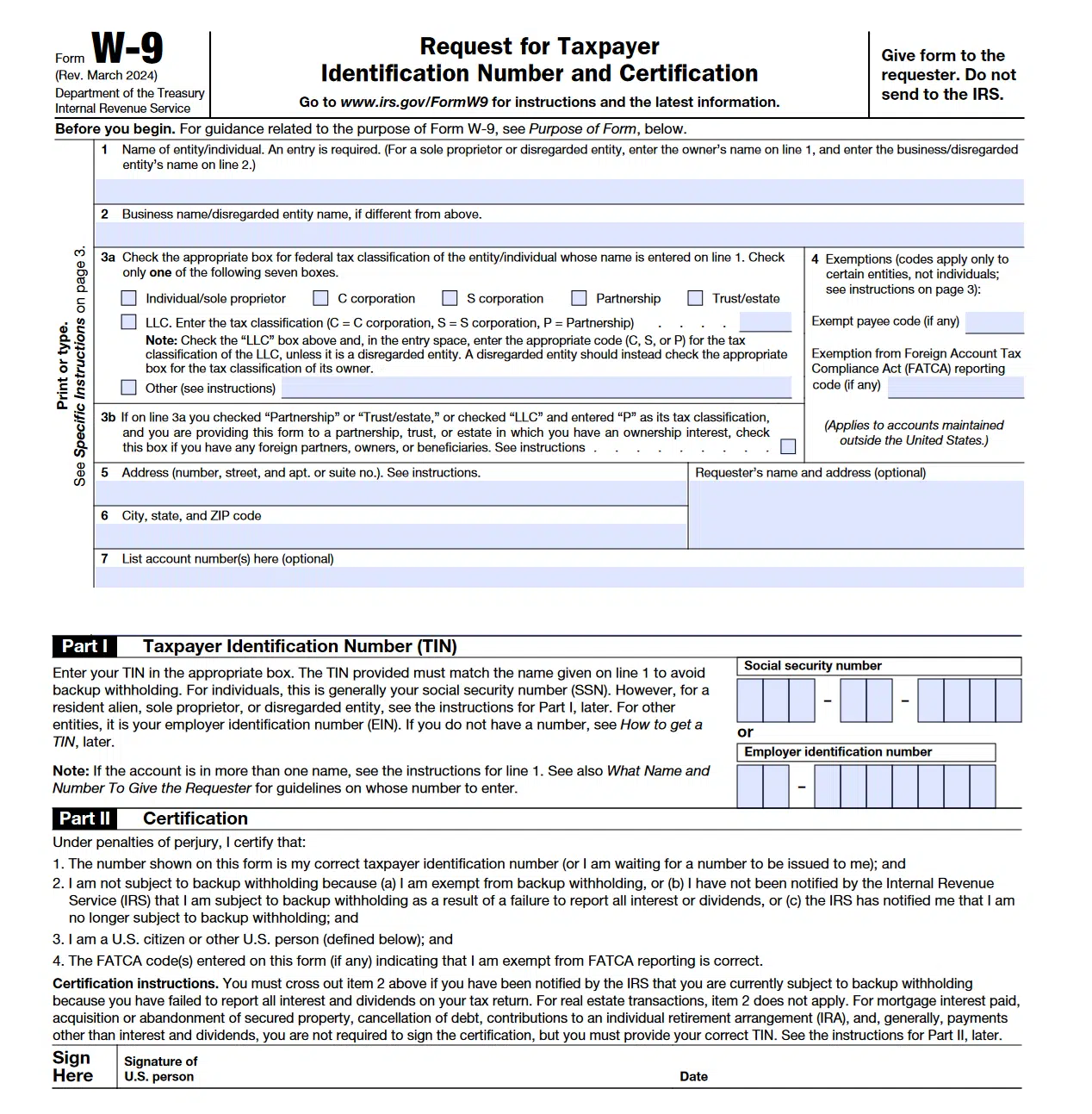
IRS Form W-9
The image of an IRS Form W-9 follows:
IRS Form 1099-NEC
The image of an IRS Form 1099-NEC for Nonemployee Compensation reporting by payer follows:

IRS Form 1099-MISC
The image of an IRS Form 1099-MISC for Miscellaneous Information reporting by payer follows:

Who gets W-9 and 1099 forms?
The requester gets a W-9 form to retain in their files. The IRS, state income tax authorities, and the payee (recipient) are the parties who receive a 1099 from the preparer.
Certain suppliers—such as independent contractors and small business owners who are U.S. citizens or resident aliens—must complete Form W-9. In general, payees submit a W-9 to the business paying them (the payer) so the payer has the correct taxpayer identification number (TIN) for tax reporting.
A TIN may be a Social Security Number (SSN), Employer Identification Number (EIN), or (in some cases) an ITIN for resident aliens. The IRS issues EINs to approved business entities, non-profits, and trusts. Special W-9 rules for TINs and certifications apply to disregarded entities, resident aliens, and pending TIN applications tied to backup withholding.
Using the W-9, businesses prepare Form 1099-NEC and Form 1099-MISC to report calendar-year payments by category. Form 1099-NEC is generally required for nonemployee compensation of $2,000 or more, and may also be required for certain payments to attorneys for services and other cases outlined in IRS instructions.
The 1099-MISC threshold for reporting royalties remains $10; the threshold for reporting gross proceeds paid to an attorney from lawsuit settlements or a court-ordered judgment remains $600. Rents and other income reported on Form 1099-MISC also move to $2,000 for 2026.
Businesses must file Form 1099-NEC or 1099-MISC if backup withholding was taken (Box 4). Forms are filed with the IRS (often in batches), and copies are sent to payees and relevant state tax agencies when applicable.
Simplify W-9 Collection and 1099 Reporting
Automate tax form collection, TIN validation, withholding calculations, and tax preparation reporting as part of your payee onboarding workflow.
What constitutes an independent contractor?
An independent contractor is a self-employed worker offering business or professional services. The independent contractor is paid for results, not for how and what work is performed. Independent contractors may be service providers, such as accountants or dentists, or may perform project work as freelancers.
Contractor vs. employee
W-2 employees are hired through payroll and typically work under the employer’s direction, meaning the business controls what work is done, how it’s done, and expects employees to follow internal policies. If a self-employed worker doesn’t meet the IRS criteria for an independent contractor, the IRS may reclassify them as an employee.
At a high level, the IRS focuses on control. As the IRS explains: “The general rule is that an individual is an independent contractor if the payer has the right to control or direct only the result of the work…” In other words, independent contractors are generally considered self-employed when the payer controls the outcome of the work, not the details of how the work is performed.
Independent contractors are responsible for their own taxes, including self-employment tax, which generally covers the equivalent of both the employer and employee portions of FICA (Social Security and Medicare).
When to request or issue a W-9 and 1099
Request Form W-9 from every U.S. contractor and supplier at onboarding, before the first payment, for whatever you expect to pay them. The $2,000 threshold (up from $600 for most categories) determines whether a 1099 is required at year-end, not whether you collect a W-9.
What information does a W-9 provide?
The contractor completes Form W-9 with the required information, including their legal name, taxpayer identification number (TIN), and contact information. The payer retains the W-9 but doesn’t file it with the IRS. Having this information on file also enables the payer to apply backup withholding when required and prepare applicable 1099 information returns.
The IRS provides Instructions for the Requester of Form W-9 and generally requires payers to request Form W-9 from applicable U.S. persons. For federal tax purposes, a U.S. person includes, but is not limited to:
- An individual who is a U.S. citizen or U.S. resident alien;
- A partnership, corporation, company, or association created or organized in the United States or under the laws of the United States;
- Any estate (other than a foreign estate); or
- A domestic trust (as defined in Regulations section 301.7701-7).
Note that a foreign person, including a non-resident alien, may be required to complete a Form W-8 or other required information tax form issued by the IRS.
Automating tax form collection during onboarding
Tipalti’s Mass Payments and AP Automation solutions help collect required W-9 or W-8 information from payees during onboarding, before the first payment.
Pro tip: Managing international contractors?
Foreign payees have different tax documentation requirements. Get guidance on W-8 forms and global contractor tax compliance in our International Contractor Tax Guide.
The IRS instructions for W-9s don’t specify calendar-year payment amounts that require a W-9 submission and assume companies will obtain W-9s from payees upon onboarding.
IRS tax deadlines for Forms W-9, 1099-NEC, and 1099-MISC
The IRS sets different information return deadlines for tax forms W-9, 1099-NEC, and 1099-MISC. When a tax deadline falls on Saturday, Sunday, or a legal holiday in the District of Columbia or where the return is to be filed, the due date is the next business day.
Form W-9 tax deadlines
The IRS doesn’t provide a deadline for submitting Form W-9. However, the payee should submit the W-9 before receiving the first payment. If a payee doesn’t provide a TIN, the payer must start 24% backup withholding on reportable payments. A payee who certifies “TIN applied for” has 60 days to provide it.
Form 1099-NEC tax deadlines
Form 1099-NEC is generally due to the IRS on January 31, after the end of the calendar year, for both paper and electronic filers. The due date for furnishing electronic or paper copies of Form 1099-NEC to recipients is normally January 31st. However, January 31, 2027, is a Sunday; therefore, the due date for reporting 2026 calendar-year payments on Form 1099-NEC (and distributing copies to recipients instead of January 31st) is Monday, February 1, 2027.
The PATH Act eliminated the automatic option to file a 30-day extension for filing Form 1099-NEC. But if businesses submit IRS Form 8809, they can request a non-automatic extension to file Form 1099-NEC if they meet one of the 5 strict criteria on Line 7 of Form 8809.
The IRS still offers Form 15397 to request a maximum 30-day extension (subject to IRS approval) to furnish various types of 1099 statements to recipients, when Form 15397 is submitted by fax starting on January 1st and received by the IRS by the date recipient copies are due.
Form 1099-MISC tax deadlines
The 1099-MISC deadline for electronic filers is March 31, 2027. For paper filers, Form 1099-MISC is generally due on February 28th (unless that date falls on a weekend or holiday), after the end of the calendar year. The 2027 due date for paper filers of Form 1099-MISC will be March 1, 2027, because February 28th, 2027, is a Sunday.
The due date for furnishing copies of Form 1099-MISC to recipient payees is February 1, 2027 (instead of Sunday, January 31st), or if amounts are reported in boxes 8 or 10, it is February 16, 2027, because February 15th falls on a legal holiday. Recipients use copies of the 1099 form to prepare their income tax returns during tax season.
Penalties for Forms W-9 or 1099
Form W-9 IRS penalties
If required payees don’t submit Form W-9, they are not furnishing their tax ID number (TIN) to the requester. If a payee fails to furnish a correct TIN, the payee is subject to a $50 penalty per failure unless it’s due to reasonable cause and not willful neglect. The payer must then begin 24% backup withholding on reportable payments and remit it to the IRS.
The IRS imposes criminal penalties for willfully falsifying certifications or affirmations. Criminal penalties include fines and prison terms for offenders.
Conversely, if a W-9 with a payee’s TIN is submitted to the requester, the IRS imposes penalties for requesters disclosing or misusing payee TINs as a violation of federal law. Penalties for requesters are civil and criminal.
Form 1099-MISC and Form 1099-NEC IRS penalties
IRS penalties for information returns (detailed with maximum amounts in Section O – Penalties, included in the General Instructions for Certain Information Returns) are the same for Form 1099-NEC and 1099-MISC.
IRS penalties assessed differ between large businesses with gross receipts of more than $5 million and non-federal government entities, and small businesses with gross receipts up to $5 million.
The $5 million gross receipts threshold is computed as average annual gross receipts for the 3 most recent tax years (or for the period you were in existence, if shorter) ending before the calendar year in which the information returns were due. For 1099 information returns due in calendar 2027, we show IRS information return penalties in the table below from Rev. Proc. 2025-32.
Large businesses and non-federal government agencies
| Timing of correction | Penalty per return or statement | Maximum penalty (returns due in 2027) |
|---|---|---|
| Not more than 30 days late | $60 | $698,500 |
| 31 days late to August 1 | $130 | $2,095,500 |
| After August 1 or not at all | $340 | $4,191,500 |
| Intentional disregard | $690 | No limitation |
Small businesses (up to $5 million gross receipts)
| Timing of correction | Penalty per return or statement | Maximum penalty (returns due in 2027) |
|---|---|---|
| Not more than 30 days late | $60 | $244,500 |
| 31 days late to August 1 | $130 | $698,500 |
| After August 1 or not at all | $340 | $1,397,000 |
| Intentional disregard | $690 | No limitation |
Use Form W-9 to complete Forms 1099-NEC and 1099-MISC
Form W-9 is prepared by a required U.S. person, as defined by the IRS. We have included the IRS definition of a U.S. person. The U.S. person may be a sole proprietor with a legal form of sole proprietorship, corporation (including LLC), partnership, estate, or domestic trust.
Payers should request Form W-9 from every U.S. contractor and freelancer at onboarding. The W-9 is kept on file, not filed with the IRS. The $2,000 threshold for 2026 payments applies to the 1099, not the W-9.
The payer receives W-9 forms (or W-8 or equivalent forms from foreign persons and non-resident aliens) from payees and retains them. W-9 forms may be either paper or electronic.
How W-9 information is used for 1099 reporting
From the W-9 forms, the payer prepares information tax returns, Form 1099-NEC (nonemployee compensation) and Form 1099-MISC (miscellaneous information). These 1099 tax forms include the business name, payee name, contact information, and required tax information.
The payer deducts 24% of the total amount from a payee’s payment for backup federal income tax withholding when backup withholding applies, for example, when the payee doesn’t provide a TIN or the IRS notifies you that the TIN is incorrect. A payer files a 1099-NEC or 1099-MISC for any payee with backup withholding, regardless of the payment amount.
The payer submits a copy of the 1099 forms and Copy 2 of the state form to the payee for filing their state tax return, if applicable. The payer also sends a copy of the 1099s (with a transmittal form only if paper filing is used) for information tax filing to the IRS and to states for income tax filing.
Effective January 1, 2024, the IRS has changed the threshold, now requiring electronic filing of information returns, such as 1099 forms, for 10 or more forms instead of 250 (calculated as the aggregate of all information returns filed).
Automate the W-9-to-1099 workflow
Finance automation software for global mass payouts and accounts payable invoice processing enables efficiency, scalability, and de-risking of financial operations through integrated payment and tax compliance workflows.
Tipalti helps finance teams automate tax form collection during payee onboarding, validate TINs through IRS TIN matching, calculate required withholding, and generate 1099 tax preparation reports. Tipalti can also e-file forms directly with the IRS. Explore Tipalti Automated Tax Compliance.
W-9 vs. 1099 FAQs
Is a 1099 and a W-9 the same thing?
No, 1099 forms and W-9 forms are not the same. A trade or business prepares 1099-NEC and 1099-MISC forms using the information provided by its payees on Form W-9.
Which tax form shows end-of-year earnings for independent contractors?
Form 1099-NEC shows the total amount of independent contractor earnings through the end of a calendar year when the payer paid them $2,000 or more in 2026, and the payer must file the information return with the IRS.
Does a 1099 require a W-2?
No. Form 1099 doesn’t require a W-2. Although 1099 and W-2 are IRS forms, 1099 requires a W-9 or comparable form (such as a W-8 for foreigners) instead of a W-2. 1099-NEC reports non-employee compensation. A W-2 form is used to report employee compensation.
