Global Tax Compliance Guide for US-Based Companies

Paying international contractors for services can help US companies scale faster, but it also adds tax and compliance obligations that become harder to manage as contractor volume and payout destinations grow.
For finance teams, that means determining whether a worker is properly classified, collecting the right tax forms before payment, identifying where the work is performed, assessing whether withholding applies, and maintaining records that support accurate year-end reporting.
This guide outlines a practical framework for managing those requirements. It walks through the core steps that shape compliant global contractor payments: classification, work location, documentation, withholding, reporting, and recordkeeping. It also shows where automation can reduce manual work and compliance risk.
Why Manual Tax Compliance No Longer Works
In some organizations, business expansion moves faster than compliance. That means teams often begin cross-border projects and payments without the right documents and controls in place. Even minor compliance gaps can cause significant problems later as global regulations grow more complex.
International tax regulations are outpacing manual compliance processes
72% of finance professionals say keeping up with international tax regulations is a growing challenge.
Data based on Tipalti’s Global Finance Outlook
Compliance Failures Create Business Risk
Tax compliance mistakes rarely stay confined to the finance department. Missing a form, misclassifying a contractor, failing to withhold if required, or missing a filing deadline can lead to back taxes, penalties, government scrutiny, and more.
In those situations, Legal may face classification disputes, tax liabilities may accrue, HR may need to rework cross-border hiring policies, and operations teams may have to deal with delayed payments or manual fixes.
A consistent, well-documented compliance process reduces these issues before they surface, keeping every department focused on growth instead of cleanup.
Governments Are Cracking Down On Cross-Border Payments
Governments across the world are tightening oversight of cross-border contractor work and becoming more stringent on disguised employment.
If you pay contractors overseas, foreign tax authorities—like HMRC in the UK and the CRA in Canada—those payments may require reporting and result in other tax implications.
To stay ahead, finance teams need workflows that comply with both IRS rules and local regulations, creating a defensible and scalable foundation for paying international contractors.
Beyond Tax Compliance
Tax rules are only part of the picture. Our guide to financial compliance regulations covers the AML, sanctions, and data privacy requirements that apply to cross-border payments.

The Five Essential Steps for International Tax Compliance
Managing tax compliance for global contractors and payees isn’t a one-off task. It’s a repeatable workflow that keeps every payment accurate. Each stage builds on the last, meaning a single misstep (like incorrect classification) can cascade through form collection, withholding, and reporting.
By standardizing the five core steps below, you can consistently manage compliance across countries while reducing manual work and risk.
1. Classify Correctly: Contractor vs. Employee
Everything in global compliance starts with proper worker classification.
For US-based companies paying international contractors, classification must align with both IRS standards and the contractor’s country’s labor laws. Different jurisdictions apply different criteria to determine whether someone is an independent contractor versus an employee, but in many cases, the underlying question is the same: how much control does the company have over the work?
How the IRS Determines Worker Classification
The IRS uses three key areas of control to determine whether a worker should be treated as an employee or an independent contractor. These same principles can also guide US companies when evaluating international engagements.
Behavioral Control
Ask yourself: How much control do we have over how this person does their work?
Example: You assign tools, set daily hours, or require detailed progress check-ins.
Why it matters: The more you direct how and when the work happens, the more the IRS may view the worker as an employee.
Financial Control
Ask yourself: How much control do we have over how this person is paid or the resources they use?
Example: You reimburse expenses, supply company equipment, or limit how they take on other clients.
Why it matters: If the contractor relies financially on your business or doesn’t control their own costs, the relationship leans toward employment.
Type of Relationship
Ask yourself: Does this engagement function like an employer-employee relationship?
Example: The contractor has a long-term contract, attends internal meetings, or receives benefits similar to staff.
Why it matters: The longer and more integrated the relationship, the more likely authorities are to treat them as an employee.
The Risks of Misclassifying an Employee as a Contractor
Misclassifying workers can have serious legal, financial, and reputational consequences. US companies often look to IRS guidelines, but international contractors are also protected by their own countries’ employment and tax laws.
When someone’s work closely resembles that of an employee, authorities may require you to treat them accordingly, covering payroll taxes, benefits, and local registrations.
Misclassification Risk by Working Arrangement
| Low Risk | Moderate Risk | High Risk | |
| Relationship Type | Truly independent contractor | Contractor, but engagement has red flags | Functionally acting as an employee |
| Work Schedule | Sets own hours | Regular check-ins / some structure | Fixed hours controlled by the company |
| Work Exclusivity | Multiple clients | One primary client | Works only for your company |
| Tools & Systems | Uses own tools | Partial access to company systems | Uses company-issued equipment & tools |
| Team Integration | Communicates for project delivery | Semi-integrated (occasional meetings) | Fully embedded (Slack, standups, etc.) |
| Payment Style | Invoices per project/output | Ongoing monthly retainers | Regular salary-like payments |
2. Know Your Tax Withholding & Treaty Obligations
In general, US-source income paid to a foreign contractor is subject to a 30% withholding, unless the income qualifies for a reduction or exemption under a tax treaty. Whether the payment counts as “US-source” depends largely on where the work is performed.
- Work performed outside the US: This is generally considered foreign-source and is not typically subject to US withholding.
- Work performed in the US: Withholding may apply unless a treaty reduces or eliminates it.
- Work performed in both the US and abroad: Withholding doesn’t automatically apply to the full payment. How much is subject to US tax depends on where each portion of the work actually took place and the provisions of an applicable treaty. Get qualified tax guidance before applying a rate.
Because each treaty sets its own standards, finance teams need a documented process for determining whether treaty benefits apply.
The US maintains income tax treaties with more than 60 countries. The following are some common examples. Payments to contractors in these locations may qualify for reduced or eliminated withholding when the treaty conditions are met:
Canada
United Kingdom
Germany
Spain
Denmark
Sweden
Norway
Finland
Iceland
Philippines
Mexico
A treaty existing is not the same as a treaty applying. Whether benefits actually apply to a given payment depends on the facts of the engagement, not the country alone. Several factors carry most of the weight:
- Where the services are performed. This largely determines whether the income is US-source.
- Whether the work creates a permanent establishment in the US.
- How much time the contractor spends working in the US.
- The contractor’s residency status and the specific treaty article.
Confirm applicability with a qualified tax advisor before reducing or eliminating withholding.
3. Collect the Right Tax Forms Before Payment
Collecting the appropriate tax documentation before first payment is both best practice and, in most cases, a practical requirement. These forms determine how much tax, if any, must be withheld and how the payment should be reported at year-end. Having them on file before the first payment helps avoid compliance gaps, delayed payouts, unnecessary withholding tax requirements, or messy year-end reconciliations.
For US payees, missing or expired documentation can trigger backup withholding and create reporting issues. For foreign payees, a valid W-8 form is necessary to support the withholding treatment you apply and to meet your year-end filing obligations.
At a high level, US persons submit Form W-9, and non-US persons submit the appropriate form in the W-8 series. The correct form depends on the payee’s status, entity type, and the nature of the payment.
Common Scenarios
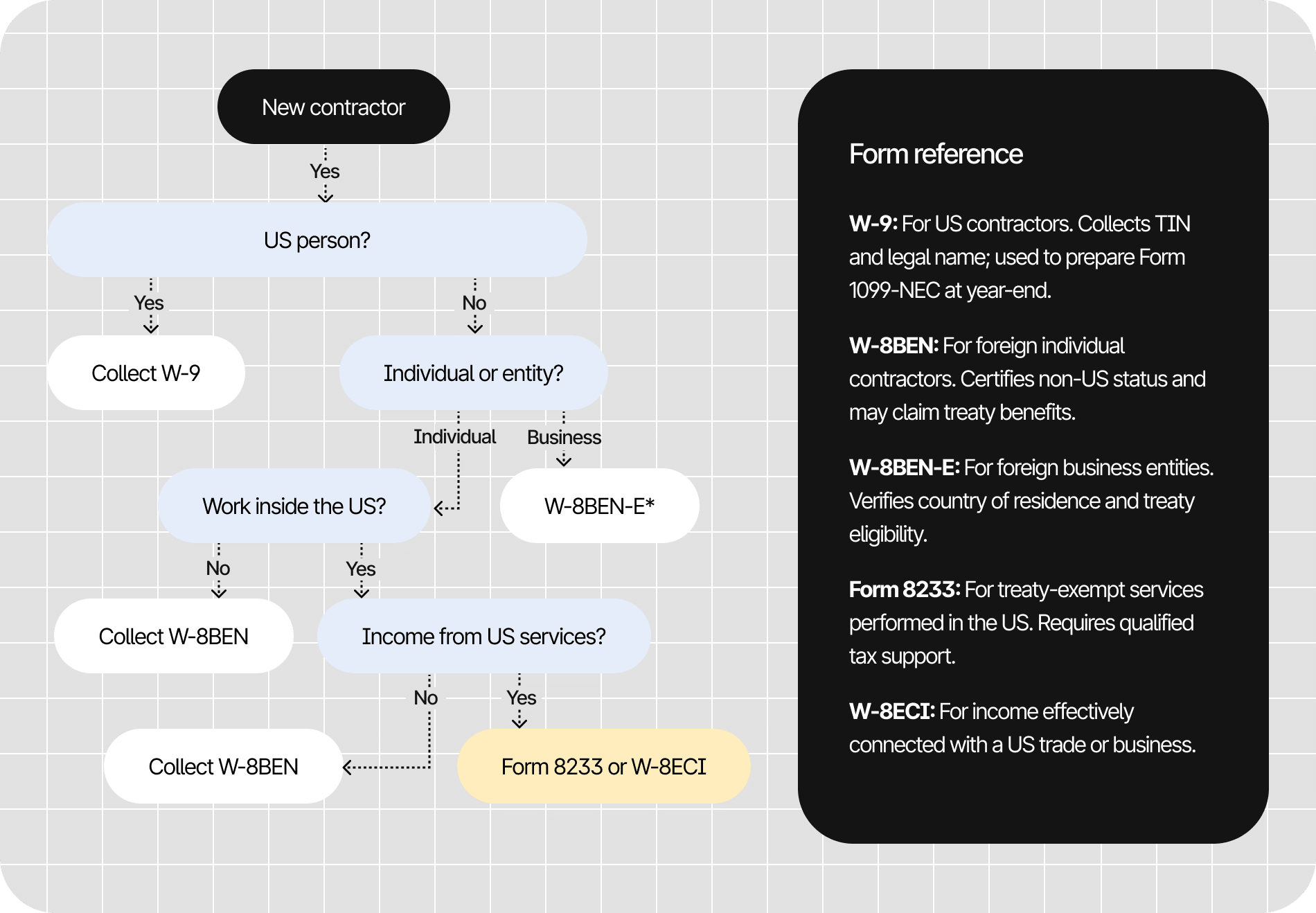
This is a simplified decision aid covering the most common scenarios. Complex engagements may require additional forms or tax review before payment.
*Note: A business could provide more than just the W-8BEN-E, depending on the circumstances which could include W-8 ECI, W-8 IMY.
Tip: Collecting the right form before payment keeps compliance on track. Automating the process ensures every contractor’s record is verified and taxed correctly from day one.
4. File the Right Annual Forms With the IRS
Once payments have been made, your compliance responsibility doesn’t end. Each year, companies must report contractor payments to the IRS, and the proper form depends on whether the payee is a US or non-US person, and whether any tax was withheld.
These filings tie directly to the documentation you collected at onboarding, such as W-9 or W-8 forms. Accurate reporting confirms that the correct tax treatment was applied and keeps your company in good standing with both the IRS and your contractors.
For foreign payees, annual reporting typically centers on Forms 1042-S and 1042 when US-source income and withholding rules apply. Because reporting obligations depend on payee status, income type, and whether withholding occurred, confirm the correct filing set for each scenario before year-end.
IRS Filing Deadlines by Contractor Type
| Contractor Type | Form to File | Due Date | Recipient(s) |
| US Contractor | 1099-NEC | January 31 | IRS + Contractor |
| Foreign Contractor (when Form 1042-S reporting applies) | 1042-S + 1042 | March 15 | IRS + Contractor |
| Withholding Taken | 945 | January 31 | IRS |
Be sure to file your forms on time to avoid escalating fees. The longer a return remains unfiled, the worse the IRS penalty can become.
5. Maintain Audit-Proof Documentation
Accurate, well-organized records are the backbone of global tax compliance. When audits, legal questions, or payment disputes arise, complete documentation is what keeps your company protected. Every form, invoice, and proof of payment should be easy to locate and logically linked back to the contractor who submitted it.
At its core, strong documentation supports consistency, traceability, and defensibility—three traits that matter most during a tax audit.
How Long Should You Keep Contractor Tax Records?
Retention minimums vary by jurisdiction and the specifics of each engagement. There is no single rule that applies across all cross-border payment scenarios, and defaulting to the shortest defensible period isn’t always the right call.
As a starting point, align your retention policy with guidance from your tax or legal team. Several factors consistently justify keeping records longer:
- You pay or have paid foreign contractors in any country
- You withheld taxes on any payment
- There is any question about whether a worker was correctly classified
- You are managing forms or payments manually
- You operate across multiple jurisdictions with different audit windows
Digital copies are generally acceptable as long as they are accurate, secure, and accessible.
Best Practices for Storing Contractor Records
Maintaining audit-ready documentation gets easier when every record lives in a single, organized system. These tips can help you stay in control:
- Centralize storage in a secure digital platform: Keep all the forms, agreements, and invoices linked to each contractor profile.
- Use consistent folder structures: Create identical templates for each contractor so anyone on the team can find what they need quickly.
- Apply clear file-naming conventions: Include the contractor name, form type, and year for every document.
- Tag files with relevant dates: Use metadata or folder tags to flag tax-form expirations, contract renewals, or audit deadlines.
- Automate form collection and expiration tracking: The right systems can automatically flag missing or outdated W-8 forms, keeping compliance continuous.
- Schedule periodic reviews: Set quarterly or semi-annual checks to archive old records, remove duplicates, and update classifications.
- Limit access to sensitive data: Restrict tax forms and personal information to authorized finance or compliance roles only.
- Ensure version control and audit trails: Use cloud systems that log who edited a document and when, creating a defensible record of changes.
Strong documentation turns compliance from a reactive task into a strategic advantage. When every record is organized and verifiable, finance teams move faster, respond to audits with confidence, and scale across borders without hesitation.
Scaling Contractor Compliance as You Grow
The five steps above form a solid foundation for global contractor compliance, but they only stay efficient up to a point. As contractor volume, global payout destinations, and reporting requirements expand, manual processes that once kept pace with volume begin to fall short. This is especially true when you’re managing mass payments across multiple currencies and jurisdictions.
Every new country adds unique classifications, tax treaties, and documentation rules. Each new contractor increases the volume of forms, data, and deadlines your team must track. Without automation or centralized control, compliance risk scales right alongside growth.
Signs You’ve Outgrown Manual Processes
Most finance teams reach a point where contractor compliance becomes unmanageable in spreadsheets. If any of these signs sound familiar, it’s a signal that a manual approach may be holding you back:
- You’re working with contractors across four or more countries: Complexity multiplies as each location introduces different rules and filing requirements.
- You’re manually tracking form expirations in spreadsheets: W-8 forms generally remain valid through the end of the third succeeding calendar year unless a change in circumstances makes the form incorrect sooner.
- You chase contractors at year-end for missing tax forms: Without automated collection, teams lose valuable reporting time validating late forms.
- You file more than 10 IRS forms a year: If you file 10 or more information returns in the aggregate, you are generally required to file electronically.
- You store sensitive tax forms in shared drives like Google Drive or Dropbox: This creates unnecessary exposure for personally identifiable information.
- You’ve missed—or almost missed—a filing deadline: Filing delays can trigger mounting penalties and erode auditor trust.
- You rely on team memory for classification or treaty logic: Institutional knowledge isn’t a compliance system and becomes risky as teams change.
- Your contractor count is doubling year over year: Scaling payments without upgrading compliance processes magnifies errors and slows onboarding.
If several of these issues resonate with your team, it’s time to move beyond spreadsheets and email workflows. Streamlined, automated compliance gives your finance team the visibility and control needed to scale confidently across borders.
Compliance risk is climbing
43% of finance teams report more compliance issues than in any prior year. This is another sign that manual controls can’t keep up with global contractor growth.
Data based on Tipalti’s Global Finance Outlook
What Future-Ready Compliance Really Looks Like
As your contractor network grows, compliance can’t rely on manual steps or scattered files. Finance teams need connected systems that consistently and accurately manage every stage of the process.
Technology is now a major compliance advantage
51% of finance teams rethinking their AP processes have invested in technology and automation to gain more control and reduce compliance risk.
Data based on Tipalti’s Global Finance Outlook
Embedded Tax Form Collection During Onboarding
Compliance begins the moment you add a new contractor. Collecting W-9 and W-8 forms before the first payment ensures tax details are validated early, preventing payment holds and last-minute chases during tax season.
At scale, embedding this step directly in onboarding saves time, shortens the payment cycle, and guarantees every contractor starts with the right forms on file.
Expiration Tracking and Automated Reminders
W-8BEN forms expire every 3 years, and keeping track of those dates manually becomes nearly impossible as contractor volume increases. Automated tracking tools issue renewal reminders before forms lapse, keeping your tax data up to date without tedious follow-ups.
This kind of visibility reduces internal workload, minimizes risk, and keeps your compliance cycle continuous.
Real-Time Withholding Logic
Automation brings precision to every cross-border payment. Modern systems calculate withholding rates in real time, factoring in contractor location, work source, and applicable tax treaties.
Accurate withholding at the point of payment keeps filings consistent and prevents disputes later on, giving finance teams confidence in every transaction.
IRS eFiling and Form Distribution
Electronic filing and automated global payouts streamline two of the most time-consuming parts of the reporting season, ensuring contractors are paid accurately while forms reach the IRS on time.
Built-in status tracking also provides submission confirmation, simplifying recordkeeping and audit readiness.
Centralized Digital Recordkeeping
Modern compliance thrives on organization. Storing all contractor agreements, tax forms, and invoices in a single secure workspace enables finance teams to locate or export documents instantly.
Access Controls and Audit Trails
Sensitive financial and tax data deserve the same safeguards as your payments. Role-based access controls limit who can view or edit forms, while audit trails automatically document every change.
These controls preserve the integrity of your compliance records and strengthen your defense in the event of an internal review or external audit.
How Tipalti Simplifies Global Contractor Tax Compliance
We interviewed 2,300 global finance leaders. Half of them say their businesses lack a clear roadmap for managing global compliance as they scale.
Scaling global contractor payments doesn’t have to mean scaling risk. Tipalti unites every stage of your compliance and payment workflow—from onboarding and tax form collection to withholding, reporting, and mass global payouts—in one secure platform built for finance teams.
With Tipalti, finance teams can:
- Automate tax collection and documentation
- Apply the right withholding in real time
- File and distribute IRS forms electronically
- Keep records audit-ready in every country
- Reduce manual touchpoints across payments and compliance
Tipalti simplifies contractor payments in 200+ countries and territories—securely and with built-in controls designed to support compliant global payouts across 120 currencies.
Ready to simplify your global contractor tax compliance?
Global Tax Compliance FAQs
What is backup withholding and when does it apply?
Backup withholding is a flat 24% tax the IRS requires you to withhold from a contractor’s payment when they fail to provide a valid Taxpayer Identification Number (TIN), or when the IRS notifies you that the TIN they provided doesn’t match their records. It applies to payments reported on Form 1099-NEC, including payments to independent contractors.
The best way to avoid it is to collect and validate a W-9 during onboarding—before the first payment is made.
What’s the difference between a W-9 and a 1099?
W-9s and 1099s serve opposite roles in the same process. A W-9 is a form your contractor submits to you before work begins. It collects their legal name, address, and TIN. A 1099 is a form you file with the IRS at year-end to report how much you paid that contractor during the calendar year. The W-9 is the input. The 1099 is the output.
Do US companies have to withhold taxes when paying international contractors?
Whether a US company must withhold taxes when paying an international contractor depends mainly on whether the payment is US-source income and whether valid tax documentation is on file. For services, source generally depends on where the work is performed.
If the contractor performs all services outside the US, the payment is generally foreign-source and typically not subject to U.S. withholding. If services are performed in the US, withholding and Form 1042-S/Form 1042 reporting may apply, subject to treaty and documentation rules.
What’s the difference between a W-8BEN and a W-8BEN-E?
Both forms certify that the payee is a non-US person for US tax purposes, but they apply to different entity types:
- Form W-8BEN is used by individual contractors
- Form W-8BEN-E is used by foreign business entities, such as companies or partnerships
Each form documents the payee’s country of residence and allows them to claim treaty benefits when applicable. Submitting the correct version ensures the right withholding rate is applied.
What happens if I pay an international contractor without collecting a W-8 form?
If a W-8 form isn’t on file, the IRS generally requires you to apply presumption rules that treat the payment as US-source income subject to 30% withholding. It’s important to note that missing documentation doesn’t change where the services were actually performed. The true source of the income is still determined by where the work took place. What it does change is your defensible position. Without a valid W-8, you lose the documentation needed to support a different withholding treatment, even if one would otherwise apply.
Without the form, you also can’t properly complete year-end reporting on Forms 1042 and 1042-S.
Failing to collect and retain a valid W-8 exposes your company to back-withholding liability, late filings, and audit penalties. Always obtain the correct form before releasing payment and monitor expiration dates.
Do tax compliance rules apply if the contractor is paid in their local currency?
Yes, the currency of payment doesn’t determine tax obligations—the payer’s location, the payee’s location, and the location where the work is performed do. Even if the contractor is paid in a different currency, US tax rules still apply if the payer is a US entity and the income is considered US-source.
Payment currency impacts operational logistics, not tax classification.
Can automation fully replace a tax advisor for global contractor compliance?
No platform can fully replace a qualified tax advisor, but automation can handle most of the operational compliance tasks, such as collecting W-8 and W-9 forms, tracking expirations, applying withholding logic, and generating year-end filings.
Automation reduces manual risk and ensures consistency, while a tax advisor provides strategic interpretation. The strongest compliance frameworks leverage both.
Can I collect tax forms after I’ve already paid a contractor?
You can, but it won’t retroactively fix withholding or reporting obligations. The IRS expects forms to be collected before payment, so the correct withholding calculations are applied from the start.
Collecting a form after payment can help with recordkeeping, but you may still be liable for unpaid withholding obligations or additional reporting amendments if the correct tax treatment wasn’t applied at the time of payment.
What happens if a contractor refuses to submit a tax form?
If a contractor refuses to provide the required tax form, the payer may need to apply default withholding rules depending on the payee’s status, the type of payment, and whether the income is US-source. For foreign payees receiving US-source income, the default withholding rate is often 30% unless a reduced rate or exemption applies and valid documentation is on file. Because documentation rules and presumption rules can materially affect the result, companies should collect the correct form before payment whenever possible. Having an automated onboarding process that requires tax forms before payment is issued can help eliminate this issue.
Disclaimer: This content is for general informational and educational purposes only and does not constitute legal, financial, or business advice. The information provided is subject to change and Tipalti makes no warranties or guarantees about the completeness, reliability, or timeliness of the content. You are solely responsible for any actions you take based on the information in this content. We strongly recommend consulting with qualified professionals for advice tailored to your specific situation before making any business decisions.