

Paying a small team of contractors is manageable. Paying thousands through multiple payment workflows, tax jurisdictions, and locations is a different challenge entirely.
Gig platforms face this pressure more than most. As your payee network grows, so does the complexity of 1099 compliance. Small process gaps can lead to filing errors, IRS notices, backup withholding issues, and unnecessary manual work.
The seven most common 1099 compliance mistakes gig platforms make all start before filing season, and each one gets harder to fix as payee volume grows:
- Filing the wrong form (1099-NEC or 1099-K)
- Reporting the same payment twice
- Reporting the wrong amount (gross versus net)
- Missing W-8 documentation for international payees
- Validating tax documentation after the payee is already active
- Treating backup withholding as optional
- Overlooking state filing requirements
2026 1099 Reporting Thresholds for Gig Platforms
The One Big Beautiful Bill Act, signed in July 2025, increased the reporting threshold for Forms 1099-NEC and 1099-MISC beginning with payments made in 2026 while restoring the previous federal threshold for most Form 1099-K reporting.
For high-volume platforms, that means reporting logic should be tied to the payment year rather than hard-coded into filing workflows.
| Form | Tax year 2024 | Tax year 2025 | Tax year 2026 and later |
|---|---|---|---|
| 1099-NEC / 1099-MISC | $600 | $600 | $2,000 (inflation-indexed starting 2027) |
| 1099-K (third-party settlement) | >$20,000 and >200 transactions (reinstated retroactively) | >$20,000 and >200 transactions | >$20,000 and >200 transactions |
There are two caveats to this:
- Payment-card transactions are reportable on Form 1099-K regardless of dollar amount
- Some states impose lower reporting thresholds than federal law
Reporting thresholds determine when a platform must issue an information return. They don’t determine whether the payee owes tax on the income.
If your platform operates across multiple states or payment models, verify that your reporting rules reflect both current federal requirements and applicable state obligations.
Mistake 1: Filing the Wrong Form (1099-NEC or 1099-K)
In the 1099-NEC vs. 1099-K decision, the correct information return depends on how payments flow through your platform, not the type of work a contractor performs.
If your platform pays contractors or freelancers directly for services, you generally have a Form 1099-NEC reporting obligation. If your platform facilitates payments between buyers and sellers as a third-party settlement organization (TPSO), you may have Form 1099-K reporting obligations instead.
Misclassifying payments can create reporting problems across your entire payee network. Filing the wrong form can lead to duplicate reporting, missed reporting obligations, and additional reconciliation work.
1099-NEC vs. 1099-K: Which Form Applies?
| How Money Moves | Likely Form | Who Reports It |
|---|---|---|
| Platform pays contractors directly for services | 1099-NEC | Platform as the payer |
| Platform facilitates third-party payments as a TPSO | 1099-K | Platform as the TPSO, when requirements apply |
| Payments processed through payment cards | 1099-K | Payment settlement entity |
Best Practice
Define reporting rules before payments are processed. Your workflow should identify:
- Which form applies to each payment type
- Who has the reporting obligation
- How payments are classified across different payment methods
Building this logic into your payment workflows reduces duplicate reporting, prevents missed filings, and simplifies year-end reconciliation.
Mistake 2: Reporting the Same Payment Twice
This issue often arises when organizations use multiple payment models without clearly defining which payments belong on which information return. For example, some payments may be reported on Form 1099-NEC, while others may be reportable on Form 1099-K, depending on how the transaction was processed and who has the reporting obligation.
Without clear reporting rules, the same payment can be included in more than one reporting workflow. Correcting those errors after forms have been issued requires additional reconciliation, amended returns, and responses to payee questions.
Best Practice
Assign each payment to one reporting workflow at the transaction level. Card and third-party network payments belong on Form 1099-K, not 1099-NEC, so check that none of them appear in both datasets before year-end.
Applying those rules at the transaction level helps reduce duplicate reporting and makes year-end reconciliation more straightforward.
Mistake 3: Reporting the Wrong Amount (Gross Versus Net)
For Form 1099-K, the reportable amount is the gross amount of payment transactions, without regard to adjustments for credits, discounts, fees, refunded amounts, shipping, or other amounts.
Reporting net amounts instead creates discrepancies between what the IRS expects and what your platform reports.
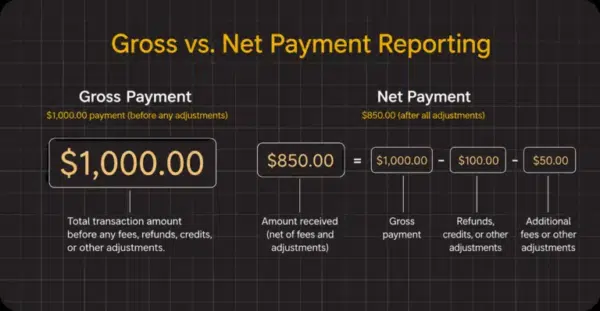
The challenge grows as payment complexity increases.
Platforms that process multiple currencies, handle refunds, or deduct marketplace fees often manage several versions of the same payment over its lifecycle. The IRS sets each transaction’s dollar amount on the date of the transaction, so later refunds, fee deductions, or currency movements don’t reduce what gets reported. Without clear transaction records, finding the correct reportable amount becomes increasingly difficult.
Best Practice
Capture reportable payment amounts at the transaction level.
Gross payment values should remain separate from platform fees, currency conversions, refunds, and chargebacks throughout the reporting process.
Maintaining that separation simplifies reconciliation and makes reported amounts easier to support if questions arise during an audit.
Mistake 4: Missing W-8 Documentation for International Payees
A foreign payee should submit a Form W-8BEN (individuals) or W-8BEN-E (entities) instead of a W-9. This form establishes foreign status, which determines which reporting track the payment falls into.
Where the work was performed decides the rest. Payments for services performed entirely outside the United States are foreign-source income: no 1099, no withholding, as long as a valid W-8 is on file. Payments for services performed inside the United States by a foreign person are U.S.-source income, reported on Form 1042-S rather than Form 1099, and are generally subject to 30 percent withholding unless a tax treaty reduces the rate. For more on how this works in practice, see our guide to 1099s for foreign contractors.
Best Practice
Collect W-8 documentation at onboarding, with the same rigor as W-9 collection. Route U.S. and foreign payees into separate reporting pipelines (1099 versus 1042-S), and flag payments that cross the U.S.-source line, such as a foreign contractor performing part of their work while physically in the United States.
A.Team, which scaled global payouts to builders in 40 countries using Tipalti, found that this kind of automated onboarding was what let a lean finance team focus on growth instead of administrative and compliance work.
Mistake 5: Validating Tax Documentation After the Payee Is Already Active
A tax form collected at year-end is already a compliance gap. A tax form collected at onboarding but never checked against IRS records is the same gap. Missing or invalid taxpayer information can trigger backup withholding and delay reporting. A name and taxpayer identification number (TIN) that don’t match IRS records can lead to CP2100 or CP2100A notices, starting a B-notice process that can trigger backup withholding from a different direction.
A two percent mismatch rate is 1,000 records requiring investigation and correction across 50,000 contractors, on top of any forms still missing entirely.
Best Practice
Collect and validate tax documentation in the same onboarding step. Real-time TIN matching at the point of collection catches mismatches while the contractor is still engaged, rather than months later during filing season.
Mistake 6: Treating Backup Withholding as Optional
When certain IRS conditions apply, businesses generally must withhold 24 percent from reportable payments and remit those funds to the IRS. Common triggers include a missing or incorrect TIN or an IRS notice requiring backup withholding.
Skipping this step doesn’t make the obligation go away. It moves the liability onto your platform. If a payment requires backup withholding, you must file Form 1099-NEC for that payee regardless of whether the payment meets the standard reporting threshold, and you must report and deposit the withheld amount on Form 945. A platform that fails to withhold when required can be pursued by the IRS for the amount that should have been collected.
Because withholding requirements can change after a contractor is onboarded, relying on manual processes increases the risk of missed withholdings or inconsistent payment handling.
Best Practice
Build backup withholding into your payment workflow.
Your process should identify payees subject to backup withholding, apply the required withholding rate before payments are issued, maintain records of withheld amounts, and support year-end reporting.
Automating these steps helps finance teams apply withholding requirements consistently while reducing manual work and the risk of compliance errors.
Mistake 7: Overlooking State Filing Requirements
Filing with the IRS doesn’t necessarily satisfy your state filing obligations.
While many states participate in the Combined Federal/State Filing (CF/SF) Program, reporting requirements vary by state and information return. Some states require direct filing, maintain different reporting thresholds, or impose additional registration and filing requirements.
For organizations paying contractors in multiple states, those differences add complexity quickly. Assuming federal filing covers every reporting obligation can lead to missed deadlines, duplicate work, or unnecessary compliance risk.
Best Practice
Build state reporting into your filing process to reduce the risk of missed filings and last-minute compliance work.
Your reporting workflow should identify where each payee is located, determine the applicable filing requirements, and account for state-specific deadlines and thresholds.
For example, although many states participate in the CF/SF Program, some participating states still require you to file Form 1099-NEC with them directly. Depending on where your contractors are located, you may still need to file directly with individual states.
Building a Scalable 1099 Compliance Process
The mistakes in this guide have a common theme: they all begin long before returns are filed.
Collecting tax forms during onboarding, validating TINs before the first payment, correctly classifying payments, monitoring state reporting requirements, and documenting international payee status all help reduce manual work during filing season. Our global tax compliance guide covers the full documentation framework for platforms paying both U.S. and international payees.
As your payee network grows, those processes become increasingly difficult to manage manually. An automation platform helps finance teams standardize compliance workflows, improve reporting accuracy, and reduce the operational burden of preparing information returns.
See How Tipalti Handles 1099 Compliance at Scale for Gig Platforms
Tipalti’s tax compliance solution is built differently from a generic payment processor. Its built-in tax engine is KPMG-approved and designed to help platforms meet IRS requirements as prescribed by KPMG. It also extends to local and VAT tax ID collection across 60+ countries* for platforms paying non-U.S. payees.
For platforms paying contractors and payees at scale, that means tax form collection, TIN validation, backup withholding, and year-end 1099 and 1042-S reporting with e-filing integrations run in one workflow, so a threshold change doesn’t mean rebuilding your process by hand.
Simplify 1099 Reporting with Tipalti
See how Tipalti automates tax form collection and validation, TIN matching, backup withholding, and year-end tax reporting workflows for large payee networks.
1099 Compliance Mistakes FAQs
What’s the penalty for filing 1099s late?
The IRS assesses separate penalties for filing a return late (Section 6721) and for furnishing a late copy to the recipient (Section 6722). For returns due in 2026, the standard penalty tops out at $340 per form for returns filed or corrected after August 1, or not filed at all. A single form that’s late on both fronts carries $680 in combined exposure. At a few hundred forms, that adds up quickly; at tens of thousands, it’s a material line item.
See a deeper look at the IRS 1099 rules for 2026 tax filing.
When is Form 1042-S due?
Form 1042-S, used for reportable payments to foreign payees, is due to both the IRS and the recipient by March 15, six weeks after the January 31 deadline for Form 1099-NEC. Platforms that manage both domestic and international payees need two deadlines on the calendar, not one.
What happens if we don’t collect a W-8 for a foreign payee?
Without valid W-8 documentation, a platform may be unable to establish the payee’s foreign status or apply applicable treaty benefits, which can create additional withholding and reporting obligations. The correct treatment depends on the payment type, source of income, and payee circumstances.
Does a higher reporting threshold mean gig workers owe less tax?
No. The $2,000 threshold changes when your platform has to file a form, not what a payee owes the IRS. Freelancers and independent contractors are still required to report every dollar of taxable income on their own tax return, including self-employment tax, whether or not a 1099 was issued. A platform that doesn’t file a form isn’t reducing anyone’s tax liabilities, only its own paperwork.
Does the $2,000 threshold change apply to Form 1099-K as well as 1099-NEC?
No. The $2,000 threshold applies to Forms 1099-NEC and 1099-MISC starting with payments made in 2026. Form 1099-K operates on a separate threshold: more than $20,000 and more than 200 transactions, which the One Big Beautiful Bill Act restored rather than changed going forward. Platforms tracking both forms need to apply each threshold independently.
Can we correct 1099s that were already filed incorrectly?
Yes. The IRS allows corrected information returns, and filing a correction as soon as an error is found generally reduces penalty exposure compared to leaving it unfiled or waiting until the next filing season. The correction doesn’t erase the original filing failure, but timing still matters under the tiered penalty structure.
How We Verified This
The thresholds, penalty tiers, backup withholding rate, and filing rules here were checked against the IRS General Instructions for Certain Information Returns, the Instructions for Forms 1099-MISC and 1099-NEC, the IRS guidance on Form 1099-K, and the text of the One Big Beautiful Bill Act, current as of October 2026. Tax rules change often, so confirm the review date before relying on these figures.
This article is for informational purposes and does not constitute tax or legal advice. Reporting thresholds, penalty amounts, and filing rules change, and requirements vary by situation. Confirm your obligations with a qualified tax advisor.
*Supported countries are: Argentina, Australia, Austria, Azerbaijan, Brazil, Bulgaria, Canada, Chile, China, Colombia, Costa Rica, Croatia, Cyprus, Czech Republic, Denmark, Dominican Republic, Estonia, Finland, France, Germany, Greece, Honduras, Hong Kong, Hungary, India, Indonesia, Ireland, Israel, Italy, Japan, Kuwait, Latvia, Lithuania, Luxembourg, Malaysia, Malta, Mexico, Netherlands, New Zealand, Paraguay, Peru, Philippines, Poland, Portugal, Romania, Russia, Saudi Arabia, Singapore, Slovakia, Slovenia, South Africa, South Korea, Spain, Sweden, Switzerland, Thailand, UAE, Ukraine, United Kingdom, Uruguay, Vietnam.
