

 Back
Back 

How quickly you onboard sellers and get them up to speed directly impacts your bottom line. However, the process of getting a new marketplace user from sign-up to first transaction involves multiple complex steps: identity verification, tax compliance, payment setup, and legal agreements.
When any part of that breaks down, the cost isn’t just increased support requests or payment delays. It’s lost revenue, compliance exposure, and seller churn.
In this guide, you’ll learn what an effective seller onboarding process looks like, how to automate it at scale, and how to measure whether it’s working.
Key Takeaways
- The efficiency of your marketplace onboarding process directly impacts seller activation, retention, and revenue.
- Managing onboarding manually creates payee approval bottlenecks, tax compliance gaps, and seller drop-off, which compounds as your marketplace grows.
- An effective seller onboarding process follows a clear workflow of collecting and validating tax documents before approvals to avoid costly compliance issues.
- Automation software like Tipalti uses self-serve portals, real-time tax validation, and rules-based approvals to help you scale onboarding without adding headcount.
Common Marketplace Onboarding Mistakes to Avoid
Onboarding is one of the most complex processes marketplace operators run. You’re managing payees with diverse preferences and compliance requirements, onboarding at scale, and coordinating across tax, payments, and legal tasks.
The complexity is where most onboarding processes break down, not through lack of skill or effort, but through design and workflow failures that compound as your marketplace grows.
Here are some of the most common onboarding mistakes and how they cost you:
- Relying on manual data entry: Incorrect bank details, mismatched tax IDs, or incomplete forms compound as seller volume increases. The result is approval and payment delays, as well as time-consuming compliance remediation. Switching to automated ID validation and structured tax forms can reduce errors before they create downstream problems.
- Collecting tax documents after making payments: Chasing sellers for W-9s/W-8s after payment creates reporting delays that are difficult and time-consuming to fix. Tax form collection and validation should always be a prerequisite for payment in your onboarding process.
- Inconsistent seller communication: Sellers who don’t hear from you submit duplicate applications, contact your support team, or abandon onboarding entirely. Every stage of onboarding should trigger clear, timely updates so sellers know what to expect. This aspect is particularly important for international sellers navigating an unfamiliar compliance process in a second language.
- Poor mobile registration experience: If your process isn’t optimized for mobile, you create immediate friction for every seller who tries to sign up on their phone. You’ll feel the impact on your completion rates. Sellers should be able to upload documents, complete forms, and enter bank details easily on any device. Any step that doesn’t work seamlessly is a potential drop-off point.
The cost of these mistakes is both operational and commercial. If any part of your onboarding process is inefficient, you’ll feel the impact of fewer active sellers, regulatory exposure, and less marketplace liquidity.
Put simply, sellers who have a poor onboarding experience will churn.
The solution is a structured, automated process that intentionally addresses each of these failures, rather than relying on developers or finance teams to catch them manually. The rest of this guide explores what this looks like.
Your Sellers Shape The Onboarding Process
Common onboarding issues come from treating all sellers the same. Depending on your online marketplace, your sellers might have different business statuses, each operating with specific verification requirements, tax obligations, and tolerance for friction.
The key to an onboarding process that’s compliant and consistent is understanding their needs from the start.
Here are four common seller types and how they differ.
Vendors and Suppliers
These are typically businesses, which means onboarding involves entity-level Know Your Customer (KYC)/Know Your Business (KYB) verification, alongside the appropriate tax documentation.
Payment terms and banking setup are more structured. Activation may require sign-off from a finance or procurement manager before a vendor can transact. Good onboarding design is crucial to ensure the process runs smoothly.
Independent sellers
Independent sellers can be individuals or small businesses, domestic or international. They often join marketplaces in high volumes, with some marketplaces onboarding hundreds of new payees every week (e.g., e-commerce or crowdfunding platforms).
At this scale, manual onboarding processes struggle to hold. Functionality such as self-serve registration portals and automated tax form validation is crucial to your process. They’re what keep workflows moving without creating a backlog for your finance and operations teams.
Freelancers
Freelancers are self-employed individuals, which presents a different set of challenges. Documentation requirements can be lighter for a vendor or supplier, but freelancers often use multiple platforms. They’ll likely compare your customer experience to others’.
A process that’s slow, confusing, or doesn’t work on mobile will cost you. Speed and simplicity are critical to improving time-to-activation.
Contractors
Contractors are often engaged more formally than freelancers and may require signed service agreements or extra documentation before activation.
US-based contractors also trigger 1099-NEC filing to meet IRS reporting obligations. This fact means your onboarding process needs to capture the right information from the start to stay compliant at year-end.
The more payee types or volume your marketplace supports, the harder it becomes to manage onboarding through a single manual process. Trying to handle tax forms, verification process, and approvals through email and spreadsheets creates data silos, increases compliance risk, and slows activation.
The result: seller dissatisfaction and a loss of trust can damage your reputation.
Automating key steps reduces errors and judgment calls for new signups, enabling sellers to start transacting faster.
The Core Components of Compliant Marketplace Seller Onboarding
Regardless of your payee type or marketplace size, your onboarding process should cover the same verification and approval fundamentals.
Implementing the components below ensures your onboarding process runs smoothly, keeping payments, compliance, and reporting accurate.
| Onboarding Component | Why It Matters |
|---|---|
| Identity verification (KYC/KYB) | Confirms who you’re paying, prevents fraud, and meets regulatory requirements. |
| Tax form collection | Enables IRS compliance and year-end reporting. |
| Banking and payment details | Ensures payments reach the right place. |
| Legal agreements and contracts | Creates consent records and reduces liability. |
| Communication and notifications | Reduces support requests and improves completion rates. |
These components often run parallel, and the order in which payees complete them matters. For instance, tax form collection and validation should always happen before you confirm banking details and activate payments.
The next section covers how to get the marketplace vendor onboarding sequence right.
What An Effective Marketplace Onboarding Process Looks Like
A well-designed onboarding flow moves sellers from sign-up to first payment as efficiently as possible, without cutting corners on compliance or experience. Use the following step-by-step process as an onboarding checklist.
1) Direct Sellers to a Registration Hub
Depending on your marketplace, you might offer an open self-initiated onboarding process or an invite-only setup. In either scenario, it helps to manage onboarding via a self-serve registration process for several reasons:
- Sellers have a clear, structured starting point.
- Payees can complete onboarding in their own time.
- It removes your finance team from the data collection process.
When seller volume increases, this step alone significantly reduces administrative overload. It also has a direct impact on time-to-first sale and payout.
As part of your onboarding process, brief sellers on their onboarding requirements. Clear instructions help you get ahead of obstructions or questions sellers may have.
Include the following information in your invitation email or hub before vendors start the process:
- Documents suppliers need to complete onboarding.
- How to fill out contact information, payment details, and tax forms.
- Deadlines for completion.
- What happens when suppliers submit information (e.g., how you approve and confirm documentation).
- How to contact your customer support team.
Use templates to standardize this process and ensure each seller receives consistent information.
With a marketplace payments solution like Tipalti, you can create and customize templates to streamline onboarding and ensure efficient communication.
You can also access email features to automatically send bill approvals and payment updates from the same email address. This feature creates familiarity from initial contact through to payment, strengthening your relationships.
2) Collect Profile and Business Information
Under the INFORM Consumers Act, US marketplaces must collect and verify identity, financial, and contact data from third-party sellers.
Your portal should prompt sellers to submit the core information you need to verify and pay them.
Core details include:
- Full legal name
- Physical address
- Email address and phone number
- Date of birth
- Government-issued ID
For business entities, you may also need:
- Registered business name
- Employer Identification Number (EIN) or tax ID
Collecting this information will also help you comply with international seller ID rules, such as the EU’s DAC7 regulations and the UK’s Reporting Rules for Digital Platforms.
Enabling sellers to provide these details in a structured setup keeps your onboarding process clean and consistent, reducing back-and-forth communication and manual errors.
3) Collect Tax and Compliance Documentation
This is the most consequential step from a compliance standpoint and should happen before you initiate payment.
Your required documentation varies by seller type:
- US-based individuals, sole proprietors, and businesses: W-9 (name, address, TIN or SSN).
- Foreign individuals: W-8BEN (country of residence, foreign TIN, treaty claims if applicable).
- Foreign business entities: W-8BEN-E (entity type, country of incorporation, FATCA classification).
Correct documentation is crucial to ensure accurate 1099-NEC and 1042-S year-end reports.
Using verification software to validate tax IDs quickly can speed up the approval process while keeping your system secure.
The best approach is a combination of automated checks and manual review for discrepancies.
For example, Tipalti can automatically flag incorrect details and notify approvers. This functionality stops bad actors from slipping through the cracks while ensuring genuine errors are quickly resolved.

Ensure you encrypt and securely store sensitive data. This helps you build trust with sellers. More importantly, it keeps you compliant with data privacy laws, such as GDPR.
4) Set Up Payment Method
Once you’ve verified and validated tax documentation, sellers can submit their payment details.
The payment methods you support at this stage directly impact your ability to attract and retain the right sellers. If a seller can’t receive funds in their preferred way, they’ll find another platform that serves them. It means diverse payment options are as much a growth decision as an operational one.
A robust onboarding process should offer a range of options relevant to your seller markets. For example, ACH, SEPA, SWIFT, wire transfer, PayPal, prepaid debit, digital wallets, and paper check.
A global payout solution like Tipalti can help you add cross-border payments across hundreds of countries and currencies, and dozens of payment methods/providers. Software makes it easy to pay sellers internationally, without building separate payment infrastructure for each market or managing global banking uploads.

Tip: Prompt sellers to double-check their account details at submission. Data errors at this stage are a common cause of delayed first payments and elevated support tickets.
5) Confirm Agreement Acceptance
Before you activate a seller, ensure they formally accept your marketplace terms and rules. Agreements typically include:
- Terms of service: The rules and obligations governing how sellers operate on your marketplace.
- Payment policies: Payment schedules, pricing structures, currency terms, and disbursement conditions.
- Anti-fraud and acceptable use policies: Prohibited activities, consequences for violations, and fraud prevention obligations.
- Data privacy and consent agreements: How you collect, store, and use seller data, including GDPR compliance for international sellers.
- Tax compliance acknowledgment: Confirmation that the seller has provided accurate tax information and understands their reporting obligations.
Along with a checkbox for sellers to confirm their agreement, consider a timestamped record of acceptance—it provides your business with a clear audit trail in the event of a dispute.
6) Verify and Approve Sellers
Once you have the necessary documentation and signed agreements, run final verification checks to ensure seller information is accurate.
To comply with KYB/KYC and Anti-Money Laundering (AML), this process can include:
- Confirming seller ID against submitted forms.
- Screening sellers against OFAC and global sanctions lists.
- Validating tax data against IRS records where applicable.
Automated workflows can do this at the point of submission, saving time-intensive manual cross-referencing.
When you approve a seller, notify them immediately. The shorter the gap between submission and activation, the lower your drop-off risk.
Clear and prompt communication is equally important for rejections or cases that require additional information. Sellers left without a status update will cause frustration and significantly increase support requests.
7) Provide Onboarding Resources and Support Materials
When a vendor is successfully signed up, they need the right resources and support to get up and running. Provide new sellers with a welcome kit that includes:
- Platform guidelines
- How-to guides
- Tutorials
- FAQs
The right early-stage support sets sellers up for marketplace success while reducing the volume of general troubleshooting inquiries.
If you have international sellers, create localized resources that cover key topics such as currency, payment, and tax withholding.
The easier it is for global users to understand how your platform works, the faster they become valuable users. They’re also more likely to show stronger retention than payees left to figure it out on their own.
8) Confirm First Payment
Send a confirmation email or notification in the seller’s portal (or both) when you make a first disbursement.
This notification can be as simple as an automated message that confirms payment and provides instructions for contacting your team with any questions. The key is to make it clear and concise.
Until this point, your onboarding workflow is a lot of process and documentation. The first payment is the moment it delivers on its promise. It’s an important closing step that builds trust and sets the tone for your ongoing seller relationships.
Make Seller Experience a Competitive Advantage
Automate marketplace onboarding and turn complex payout processes into smooth workflows that enhance the payee experience, strengthen tax compliance, and grow with your business.
Automating Seller Onboarding for NA Marketplaces
A well-designed marketplace onboarding process introduces structure and clarity for you and your sellers. As we touched on earlier, implementing processes like tax form collection and ID verification at scale requires automation.
For growing North American marketplaces, the operational ceiling on manual onboarding comes quickly.
Tax forms get missed, approval queues back up, sellers wait days for confirmation, and your operations team spends more time chasing documentation than on strategies to expand the business.
Automation removes that ceiling. It turns a process that breaks under volume into one that gets more efficient as your seller base grows.
Here’s how automated seller onboarding streamlines your workflows:
| Self-Onboarding | Sellers register and submit details independently |
| Embedded Tax Compliance | Tax forms are validated automatically in real-time |
| Automatic Fraud Screening | OFAC and sanctions checks run at submission |
| Instant Approval Routing | Sellers are approved with or without manual review, according to your custom rules |
| Real-Time Notifications | Sellers get alerts automatically at every stage, from approval to payment |
Let’s look at that process in more detail.
Self-Onboarding
A self-service portal guides sellers through the onboarding process, helping them provide accurate information at every step, without manual data entry on your side.
For example, Tipalti’s payee management solution lets you collect business, tax, and payment details in more than 27 languages, ensuring all required fields are complete for faster activation.

You can also guide sellers through payment setup with a choice of preferred payment methods and currencies.
Once onboarded, sellers can use the portal as a central hub to track payouts, receive updates, and communicate with your team.
Giving sellers the flexibility to manage their preferences increases transparency and confidence in your onboarding process.
Embedded Tax Compliance
An automated system prompts sellers to complete the correct tax forms based on their payee type and location, then uses real-time AI validation to ensure details meet IRS requirements, improve reporting, and protect against penalties.
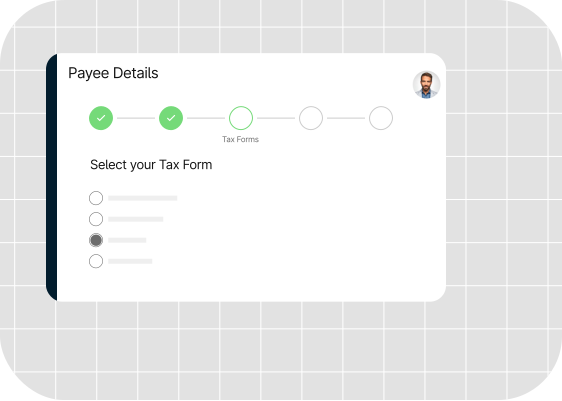
For North American marketplaces and sellers, a KPMG-approved tax engine like Tipalti supports:
- W-9
- W-8BEN/W-8BEN-E
- W-8EXP
- W-8IMY
- W-8ECI
- Form 8233
It also helps you expand globally, validating local and VAT IDs across multiple countries and applying 3,000+ rules to prevent errors.
Compliance doesn’t stop at onboarding. At year-end, the best marketplace payment software can generate 1099/1042-S tax preparation reports and calculate any necessary withholdings.
With accurate information automatically synced in your ERP or accounting software, finance teams have immediate access to tax data for accurate filings, without the need for paperwork or spreadsheets.
Automatic Fraud Screening
Real-time automated screening systems run at the point of onboarding (and on an ongoing basis) to protect you without adding steps to your approvals process.
For instance, if a new seller’s banking details match those of an existing payee, or an account shows signs of suspicious activity, Tipalti’s fraud prevention feature automatically flags it and builds an audit-ready case for review.

It shifts fraud protection from reactive investigation to proactive prevention, reducing the risk of operational, reputational, and legal exposure.
Instant Approval Routing
Automated workflow routing applies rule-based logic to determine which sellers to approve automatically and which to send for manual review.
Marketplace payment APIs let you configure workflows for your use case. With Tipalti, for example, you can set your own routing rules and approval hierarchies to adapt to complex seller requirements easily.

Approvals are sent to the correct approver immediately, with task reminders to ensure processes stay on track. Better still, machine learning algorithms learn from historical actions to improve workflows.
With this process running in the background, your team can focus on strategic tasks rather than reviewing each submission.
Real-time Notifications
Automated updates keep sellers informed throughout onboarding, without your team having to create and send emails manually.
Tipalti automatically sends branded notifications for approvals, payments, or whenever extra information is required.

Engaging sellers at every stage eliminates confusion and builds trust. It also means your support team isn’t fielding update requests that automation can handle.
Tipalti in Action: How Flytographer Onboards and Pays 500+ Photographers Worldwide
Flytographer, a marketplace connecting travelers with local photographers across 300+ cities, was manually managing payouts to a global network of 500+ photographers.
The process was slow, error-prone, and made it difficult to scale. Additionally, manual onboarding and tax compliance consumed significant resources.
Implementing Tipalti Mass Payments means photographers can onboard and manage payment details through a self-serve portal, receiving funds via their preferred payment method.
By automating onboarding, Flytographer has reduced payment workload by 95% and cut compliance risk while ensuring timely payments to improve partner satisfaction.
With Tipalti, partner interaction no longer requires any bandwidth from our team. Photographers can change bank accounts or switch payment methods between PayPal, ACH, or wire transfers—it’s all self-service.
Nicole Smith, CEO and Founder, Flytographer
How to Track the Success of Your Marketplace Onboarding Process
Tracking the right onboarding metrics tells you where sellers are dropping off, where teams are wasting time, and where compliance gaps are appearing.
These four KPIs give operations and finance teams a solid baseline for evaluating and improving onboarding performance.
| Metric | What to Look For |
|---|---|
| Seller activation rate | A low rate points to process friction (e.g., confusing registration, excessive onboarding steps, or poor mobile experience). Segment by location, channel, or device to identify where drop-off is highest. |
| Time-to-first-payment | A long time-to-first-payment usually signals manual bottlenecks. Reducing this metric directly impacts seller satisfaction and how quickly new sellers start transacting. |
| Onboarding completion rate | Track completion at a milestone level, not just end-to-end. A drop-off at the tax documentation stage, for example, suggests the form collection needs simplifying or clearer guidance. |
| Support ticket volume | High ticket volume indicates process issues or communication gaps. Categorize tickets by stage and issue type to spot where to implement automated notifications or process improvements. |
Monitoring these metrics helps you make targeted improvements, rather than overhauling your entire process.
Supplement your insights with direct seller feedback to optimize your onboarding strategies. Regular onboarding surveys and performance check-ins can highlight friction that isn’t always clear from data alone.
Streamline Marketplace Onboarding With Automation
An intentional marketplace seller onboarding process driven by automation isn’t just an operational win—it’s a growth driver. Faster payee approvals, stronger compliance checks, and a high-quality user experience all translate into a marketplace that scales smoothly and retains sellers more effectively.
Tipalti Mass Payments gives you the infrastructure to streamline regulatory compliance, improve reporting, and measure what matters. Book a demo to see how it transforms your seller onboarding workflows.
Marketplace Onboarding FAQs
How can marketplaces automate vendor onboarding at scale?
The most effective way is to use automation software. The best marketplace payment solutions systemize common onboarding tasks, such as form collection, reviews, and seller communication, to accelerate sign-ups and reduce finance workload.
How can marketplaces speed up the seller onboarding process?
Reduce manual tasks in your workflows. A mass payment solution with a self-serve portal, automated tax validation, and instant approvals accelerates time-to-first-payment. It also ensures an efficient onboarding process to prevent back-and-forth compliance checks that significantly slow activation.
What are the best practices for marketplace onboarding?
Use self-serve onboarding, automate tax compliance and fraud checks, offer diverse payment methods to support global sellers, and communicate clearly at every stage. Finally, track key onboarding metrics to spot friction before it impacts growth.