

 Back
Back Next-Level Controls for Financial Compliance
Built-in compliance programs for AP automation and safeguards that protect customer data—from onboarding to payout—with the visibility and control you need to reduce risk and keep payments accurate.






































Financial Compliance Features

Role-Based Access and Simplified Audits
Our comprehensive internal control framework includes 20+ role-based permissions that enforce segregation of duties by configuring who can initiate disbursements, fund accounts, create approval flows, run reports, and more. Automatically route invoice and payment approvals based on transaction criteria. Prepare for audits and regulations like General Data Protection Regulation (GDPR) with our built-in audit trails, reporting, and document storage.
Validate Suppliers Before Approval
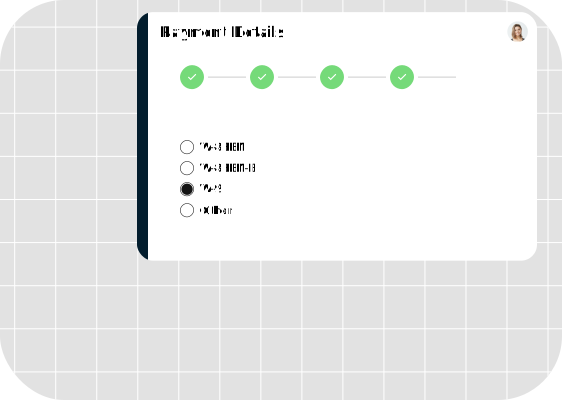
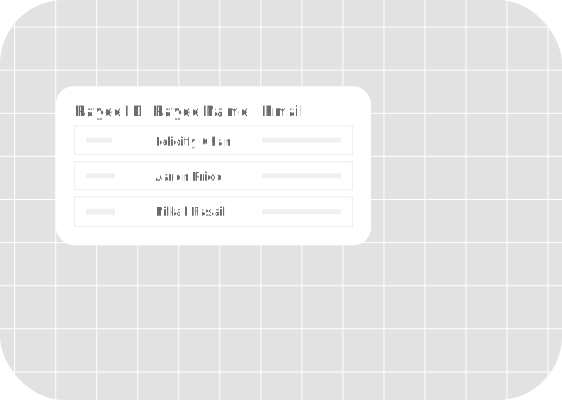
Validate and secure sensitive payment data and financial information by collecting and storing it in our self-service supplier portal. Automatically validate contact information, payment data, and tax information against 26,000+ global rules before approving suppliers. Our KPMG-approved tax engine validates IRS tax forms and ID collection, including TIN matching.
Protect Against Loss With Ongoing Screening
Automatically scan all supplier records against a range of “Do Not Pay” lists during onboarding and before each payment to verify legitimacy and legality. We also screen against OFAC, anti-terrorism, and anti-narcotics lists to flag suspicious suppliers.
Prevent Fraud With Electronic Payments
Use electronic payment methods such as US and global ACH and wire transfers to minimize fraudulent payouts, ensure compliance with financial regulations, and avoid reputational damage. You can also use Positive Pay to combat paper-check fraud. Fee-splitting lets you incentivize suppliers to adopt safer, more efficient payment methods. Instant reconciliation means you can detect fraudulent payments quickly and take corrective action.

Double Down on Risk Management
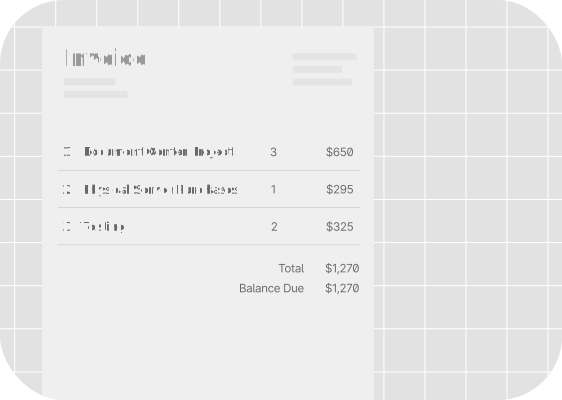
The Tipalti Detect™ risk module is an internal network that proactively identifies and prevents potential fraud by proactively looking for patterns. Payers can block or suspend suppliers from receiving payments, identify blocked or suspended suppliers trying to create multiple accounts, and get notified of suspicious suppliers.
Integrations
Pre-built connections to extend automated workflows
Easily extend and simplify your workflows with pre-built integrations and powerful APIs for your ERPs, accounting systems, performance marketing platforms, HRIS, SSO, Slack, credit cards, and more.





Customer Stories
Don’t just take our word for it,
see what our customers are saying

 Accounts Payable
  United States, Canada
  E-Commerce & retail
 100 – 1000
 Non-profit
 Card
Card 
 Mass Payments
  AdTech
 Business services
 Software and technology
 Affiliates and influencer networks
Platform Features
Work smarter, not harder
With AI and machine learning capabilities, an intuitive UX, and quick and easy global payments, you can drive unprecedented efficiency.


Awards
#1 award-winning finance automation solution

The Fintech Awards
Best SaaS for FinTech 2025

2025 Deloitte Technology
Fast 500
Awarded to Tipalti for the 8th consecutive year

2025 CNBC World’s Top Fintech Company
Awarded to Tipalti for the 3rd consecutive year

Leader in the IDC 2024 MarketScape
Worldwide Accounts Payable Automation Software for Midmarket

Ready to save time and money?
Book a demo to get started today and take control of your finance operations with Tipalti.


Financial Compliance FAQs
What is Compliance in Accounts Payable?
Compliance in accounts payable encompasses financial and IT security controls that adhere to regulations, company policies, and standards for paying supplier invoices with fewer errors and a lower risk of fraud.
Accounts payable workflow automation strengthens internal controls. It ensures consistent and complete invoice processing with supplier validation, invoice verification with exceptions flagging, approvals, secure payments, and role-based access that facilitates the segregation of duties. Instant payment reconciliations contribute to the accuracy and timeliness of financial statements.
For better internal controls compliance, accounts payable automation provides near real-time visibility into accounts payable and business spending, along with AI-driven analytics for business intelligence, enhancing management oversight and decision-making.
Compliance in accounts payable also encompasses global regulatory compliance when making payments and tax compliance related to supplier payments.
What is SOX Compliance in Accounts Payable?
SOX compliance in accounts payable refers to the adherence to standards and policies for internal control during supplier invoice processing through payment and reconciliation, as well as accurate and reliable financial reporting, as mandated by the Sarbanes-Oxley Act.
Key Sarbanes-Oxley AP internal control steps include assessing and mitigating risks, as well as designing and implementing adequate internal controls to prevent fraud, duplicate payments, and errors, and to protect cash. Internal controls fall within an effective enterprise risk management (ERM) framework and include setting a proper tone at the top of the organization.
Section 404 of the Sarbanes-Oxley Act relates to management’s assessment of internal controls over financial reporting (ICFR) and the external auditor’s attestation of management’s internal control adequacy assertion.
What Are Internal Controls in Accounts Payable?
Internal controls in accounts payable (AP) include audit trails, computer controls, segregation of duties, supplier validation, digital three-way matching, invoice verification, fraud monitoring, error detection rules, automated coding, approvals complying with company policies, and secure global payment processes.
AP automation solutions strengthen internal controls in a business or non-profit organization. Accounts payable automation software significantly reduces human errors, duplicate invoice payments, and fraud risks that would otherwise occur in a manual accounts payable system.
Internal controls result in the accurate and timely recording of accounts payable and related expenditures in the general ledger and financial statements. They are part of an effective enterprise risk management (ERM) framework and include setting a proper tone at the top of the organization for proper business practices and accounting that complies with U.S. GAAP or other applicable international accounting standards.
Recommendations